
If you found a bird that can't fly, is sitting on the ground looking dazed, has a drooping wing, or is bleeding, the most likely reason it needs help is one of a handful of very common injuries: a window or vehicle collision, a cat or dog attack, a broken wing or leg, or a nest emergency. Those are the real answers behind the question. The good news is that knowing why helps you figure out exactly what to do in the next few minutes, and whether this bird needs a wildlife hospital today or just a quiet, warm space while it recovers.
Why Did the Bird Go to the Hospital: First Aid Steps
Marcus Chen
11 Apr 2026
What "going to the hospital" actually means for a bird you've found
When people say a bird "went to the hospital," they usually mean it was taken to a wildlife rehabilitation center, a bird-specific vet, or an emergency animal hospital equipped to handle wildlife. These places do real triage: an intake exam, pain management, wound treatment, and a plan for whether the bird can be rehabilitated and released.
The Raptor Trust, for example, performs a full intake exam and begins treating injuries identified at admission, with next steps depending on what they find. Some birds are there for a few days; others need weeks of care. The point is that these facilities have the training and equipment that you simply can't replicate at home, and getting a seriously injured bird there quickly is almost always the single most important thing you can do.
Your first 5 to 10 minutes matter most
Before you do anything else, make sure you're safe to approach the bird. Larger birds like hawks, herons, and owls can cause serious injury with their talons or beaks even when they're hurt. Approach slowly, keep low, and cover the bird with a light towel or jacket before picking it up. Wear gloves if you have them.
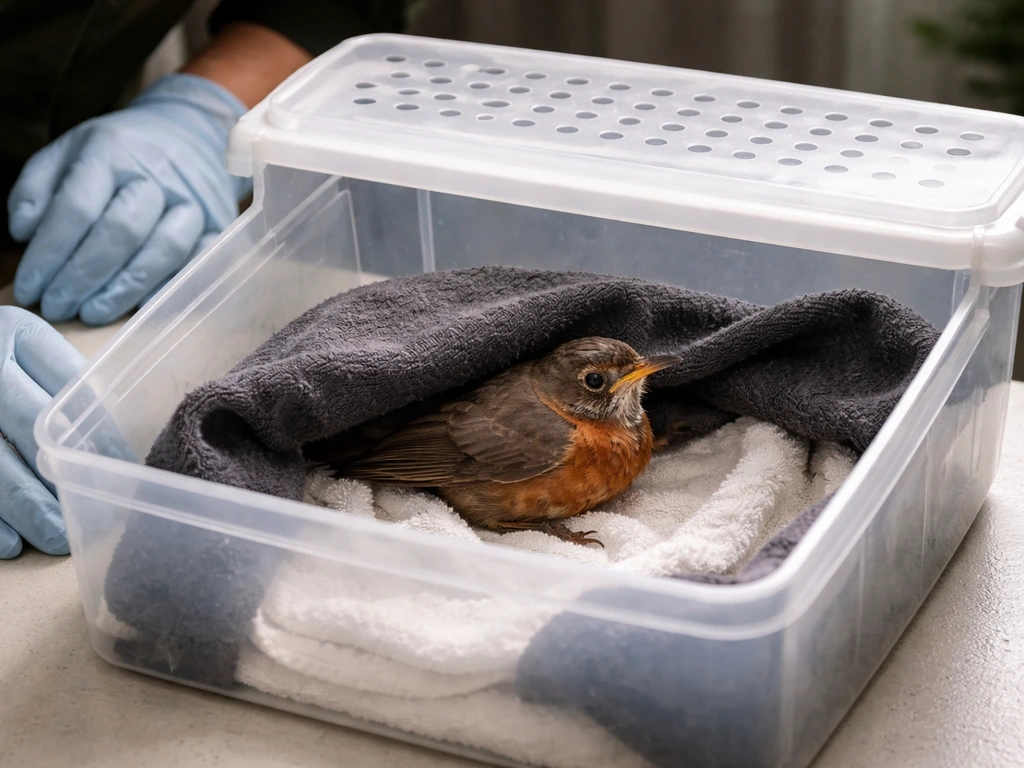
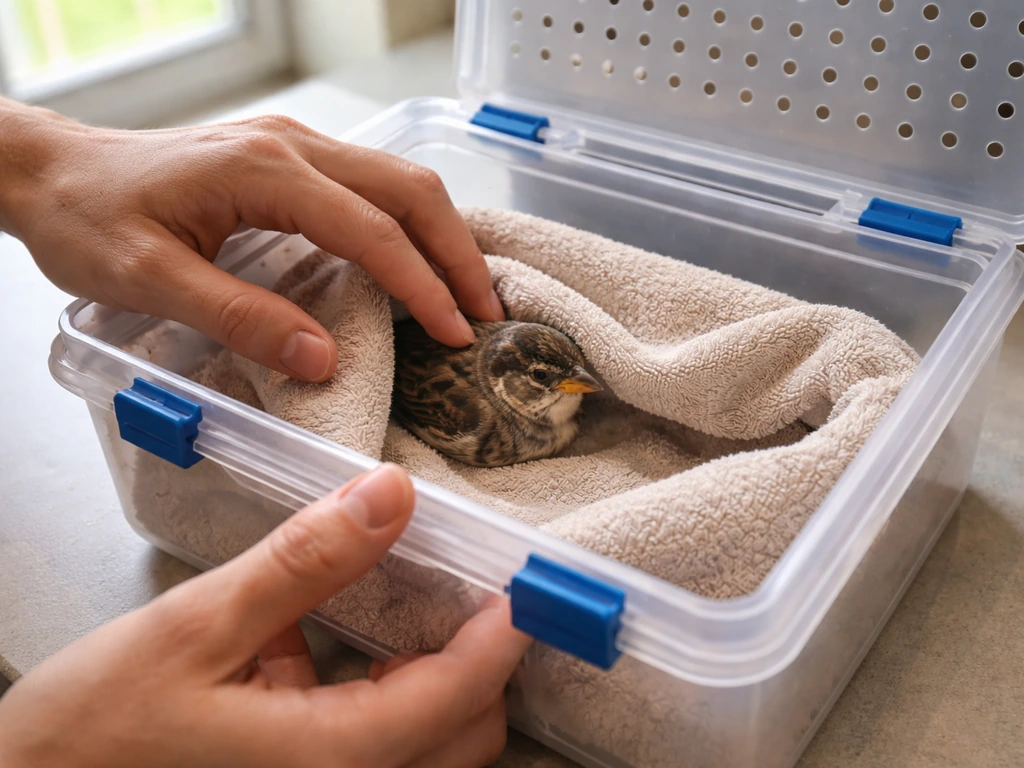
Once you've covered the bird, scoop it up gently and place it in a cardboard box with a few air holes punched in the top. Line the bottom with a folded towel so the bird has traction. Put the box somewhere dark, quiet, and warm, away from pets and children. That's it for now.
Do not try to examine every injury, do not offer food or water yet, and do not keep the lid open. Do not use hydrogen peroxide or alcohol-based cleansers on injured birds, according to wildlife rehab guidance. Darkness alone calms a panicked bird significantly and reduces the stress that can make shock worse.
If the bird is cold to the touch (feet especially), warmth is critical. Wrap a hot water bottle or a heating pad set to LOW in a towel and place it under one half of the box so the bird can move away from the heat if needed. The goal is to keep the container between roughly 75 and 85°F (24 to 29°C). Do not place the heat source directly against the bird.
The most common reasons birds end up needing urgent care
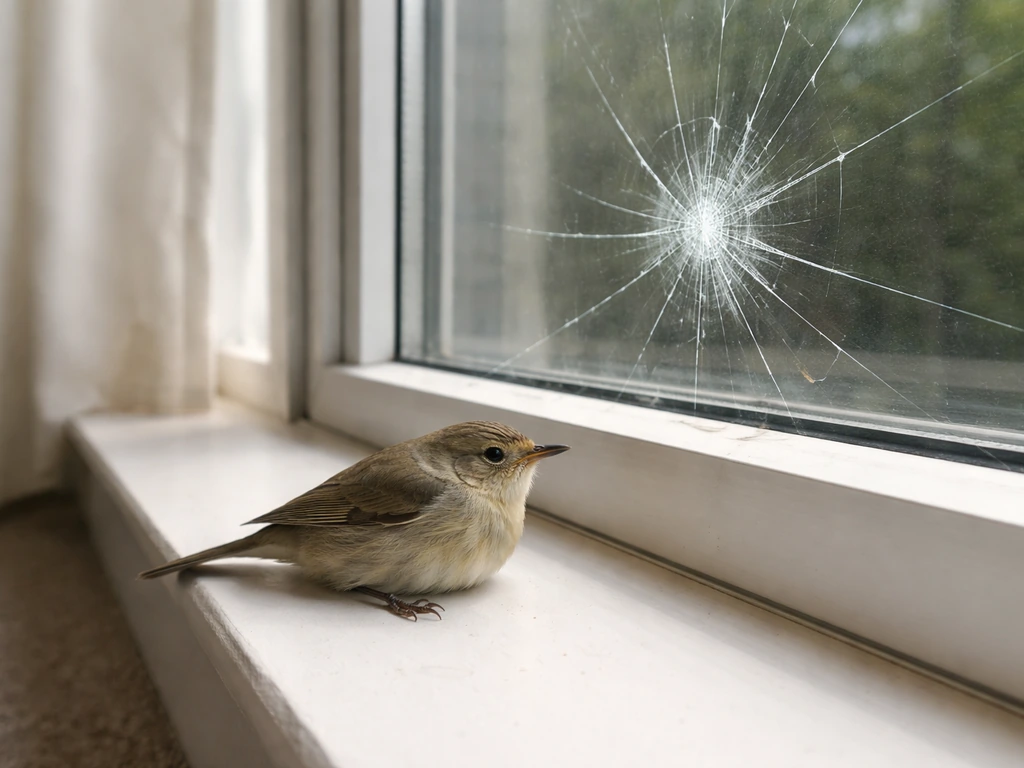
Window collisions are the single most common cause of bird injuries in most urban and suburban settings. The impact typically causes concussion, head trauma, internal bleeding, or a combination of all three. If you have bird feeders, your risk of this happening is double that of homes without them, simply because more birds are regularly flying in the area near your windows. Vehicle strikes work similarly and often cause more severe trauma.
Cat and dog attacks are the second major category. Even a brief bite or claw strike from a pet is more dangerous than it looks. Cats carry bacteria in their mouths (Pasteurella multocida chief among them) that can cause a fatal infection within hours in a bird even if no external wound is visible. Any bird that has been in a cat's mouth needs antibiotics from a vet that same day. There are no exceptions to this rule.
Broken wings and legs can happen from collisions, falls, entanglement, or predator attacks. Entanglement is particularly insidious: fishing line, netting, or wire wrapped around a leg or wing cuts off blood flow, and the tissue damage compounds the longer it stays on. If you can see fishing line, string, or wire on the bird, do not try to cut it yourself unless it is completely loose. You risk cutting through skin or feathers and causing new injuries. Get the bird to a rehabilitator.
Nest emergencies cover nestlings (featherless or pin-feathered babies) that have fallen from a nest, fledglings (fully feathered young birds) that are on the ground and being harassed by predators, and baby birds that have been orphaned when a parent is killed. Not every baby bird on the ground is actually in trouble, but any nestling that is cold, injured, or clearly abandoned needs help today.
Matching what you're seeing to the likely injury and urgency
Use this table as a quick reference. It won't replace a vet's assessment, but it helps you decide how fast you need to move.
| What you're seeing | Most likely cause | Urgency level |
|---|---|---|
| Bird flew into window, sitting dazed but upright | Concussion / mild head trauma | Monitor 1 hour; go to rehab if no improvement |
| Drooping or twisted wing, won't fly | Fracture or dislocation | Urgent: same-day care needed |
| Visible bleeding that won't stop | Trauma (collision, attack, entanglement) | Emergency: go now |
| Open-mouth breathing, tail bobbing, gasping | Respiratory distress / internal injury / shock | Emergency: go now |
| Fluffed feathers, eyes closed, cold feet, very weak | Shock or hypothermia | Urgent: warm and go same day |
| Cat or dog had it in their mouth | Puncture wounds / bacterial infection risk | Emergency: go now, same day |
| Featherless nestling on ground, cold | Fall from nest / orphaned | Urgent: same-day care needed |
| Blood from beak, vent, or droppings | Internal injury | Emergency: go now |
| Leg hanging at wrong angle or swollen | Fracture or entanglement injury | Urgent: same-day care needed |
| Eye injury or protruding eye | Head trauma / impact injury | Emergency: go now |
First aid basics by injury type
Bleeding
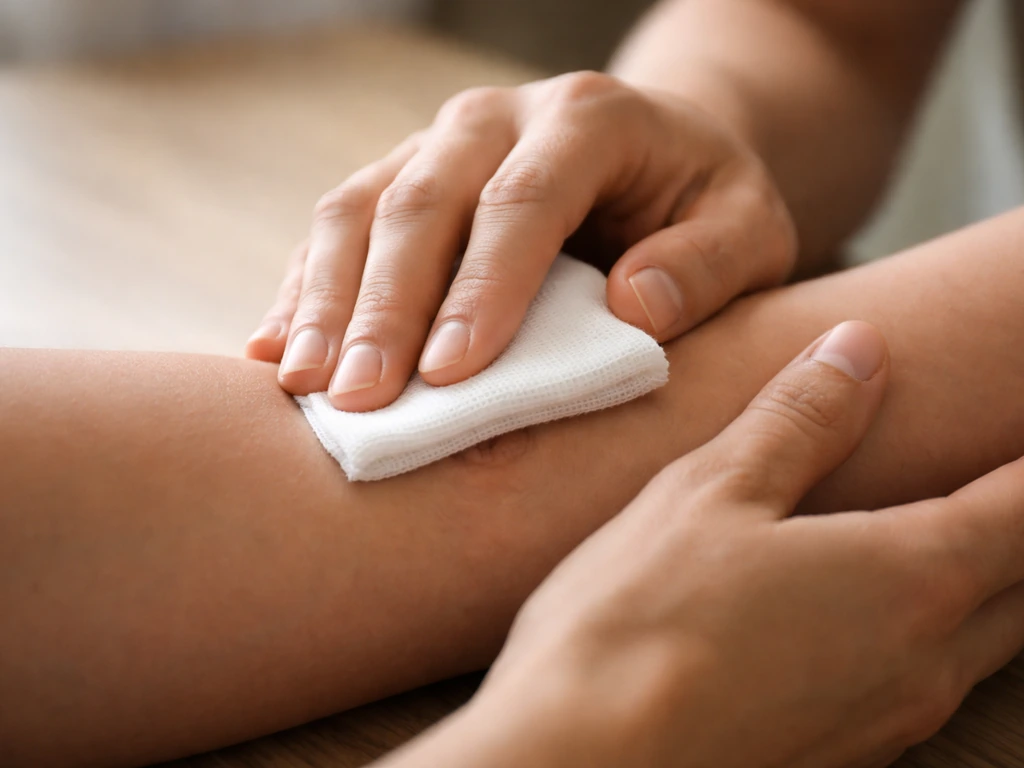
Apply gentle, direct pressure with a clean cloth or gauze. Hold it in place for at least two to three minutes without lifting to check. Do not use tourniquets. If the bleeding is from a broken blood feather (a new feather still growing, which will have a visible dark shaft), you can sometimes stop it by applying firm pressure directly to that quill. If bleeding is from the mouth, vent, or appears in droppings, that signals internal injury and you need to get to an emergency animal hospital immediately. Pressure alone won't fix this.
Shock
A bird in shock will look fluffed up, keep its eyes closed or half-closed, feel cold (especially the feet), and may be too weak to stand. Warmth and darkness are your two most effective tools. Get the bird into that warm, dark box as described above and don't handle it more than necessary. Handling causes cortisol spikes that can be lethal in an already-compromised bird. Every extra minute of unnecessary handling is doing harm.
Wing and leg injuries
Do not try to splint a wing or leg. This is one of the most common DIY mistakes and it almost always makes things worse. Incorrect splinting can cut off circulation, cause the bird to injure itself trying to remove it, and create additional fractures. The correct first aid is secure containment: wrap the bird loosely in a towel so it can't thrash and injure itself further, then place it in the box. The towel acts as a full-body stabilizer without putting pressure on any one limb.
Beak and head trauma
Head trauma and beak injuries are serious even when the bird looks okay initially. A stunned bird may appear to recover in 20 minutes after a window hit, then crash suddenly an hour later as swelling increases. Any bird with a confirmed head impact should be monitored closely for at least an hour in a warm, dark box. If after an hour it cannot stand, fly short distances, or seems to be getting worse rather than better, it needs professional evaluation. Open-mouth breathing or any sign of neurological abnormality (spinning, head tilt, inability to right itself) means emergency care right now.
What not to do: the mistakes that make things worse
- Do not give food or water. This is probably the most important "don't." Force-feeding or giving water to a bird in shock can cause aspiration pneumonia or worsen internal injuries. All birds should be correctly identified before any feeding is even considered, and in most emergency situations, feeding is a job for the rehab team, not you.
- Do not give bread, crackers, or human food to waterfowl or any wild bird you're trying to help. It provides no nutritional value and can cause harm.
- Do not try to splint or tape a broken wing or leg. Duct tape and DIY splints are one of the most common reasons birds arrive at rehab in worse condition than they would have been.
- Do not keep the bird in a glass tank, aquarium, or open wire cage. These cause additional stress and injury risk.
- Do not place the bird in direct sunlight or on a heating pad without a towel barrier. Overheating can kill a bird in shock just as quickly as cold can.
- Do not attempt to clean deep wounds or apply hydrogen peroxide. You'll disrupt tissue that the vet needs to assess.
- Do not assume "it's just stunned" and leave it outside uncontained. A dazed bird on the ground is a target for every cat, crow, or car nearby.
It's also worth knowing that in many states, keeping an injured wild bird beyond the time needed to transport it to a licensed rehabilitator is actually illegal. This isn't about enforcement, it's about the reality that wild birds need specialized care that most people simply cannot provide at home. PetMD similarly warns that bread is not a nutritious substitute for a wild bird diet and advises feeding the right foods instead wild birds need specialized care that most people simply cannot provide at home.
When to call a professional immediately versus when you can give it an hour
If you're unsure whether this is an emergency, the practical rule is: when in doubt, call. Most wildlife centers and avian vets would rather talk you through a non-emergency over the phone than have you wait on a bird that needed help an hour ago. Knowing when your bird needs a vet is genuinely one of the most useful skills you can develop, and it applies to both wild birds and pets.
Call or go immediately if you observe any of the following: active bleeding that won't stop, blood from beak or vent, open-mouth breathing or tail-bobbing while breathing, any blank" rel="noopener noreferrer">confirmed cat or dog contact, suspected head trauma with neurological signs, a protruding or injured eye, extreme weakness or inability to stand, or a cold featherless nestling. If you have a pet bird, knowing how often should you take your bird to the vet helps you plan routine checkups so you can spot problems early before they become emergencies. These are the situations where every hour of delay reduces the bird's odds of survival.
You can give it up to one hour of quiet, warm observation if: the bird hit a window and was briefly stunned but is now alert and upright, it's not bleeding, its breathing is normal, and it responds to your presence by trying to move away. If after one hour it is not clearly improving, make the call. Some birds do fully recover from mild concussions in that window. Many more need professional support for internal injuries that aren't obvious from the outside.
For a fledgling (a fully-feathered young bird hopping on the ground), the default is often to leave it alone and watch from a distance for 30 to 60 minutes. Parents are usually nearby and still feeding it. But if you see injuries, if a cat has been nearby, or if the bird is cold and silent, it needs help. The Avian Wildlife Center makes a good point: don't assume a ground nestling is orphaned, but don't assume it's fine either. Understanding whether you can take an injured bird to a vet can save you time when every minute counts.
How to get help today: finding local care and transporting the bird safely

Start with a quick search for licensed wildlife rehabilitators in your area, or use a locator tool like Animal Help Now (which Audubon recommends) to find the closest appropriate resource. Many areas also have emergency animal hospitals that will triage injured wildlife and provide supportive care until a specialist or rehabilitator can take over. Finding out where you can take your bird to the vet is often easier than people expect, especially if you use dedicated wildlife finder tools.
When you call, keep it brief and factual. Tell them: what species you think it is (or describe it), where you found it, what you observed (what it can and can't do), whether there was any known cause like a window or cat, and what you've done so far. This is exactly the information their intake team needs to prepare for the bird. Knowing how to take a bird to the vet properly, including what to say when you arrive, makes the intake process faster and less stressful for everyone, especially the bird.
For transport, keep the bird in that dark, ventilated box. Don't play music in the car. Keep the temperature comfortable but not hot. Place the box on the seat rather than the floor if possible so it doesn't slide. Resist the urge to open the box and check on the bird during the drive. Safe bird transport to a vet is less about equipment and more about minimizing stimulation the whole way there.
Once you arrive, some centers ask you not to call back for status updates so their phone lines stay free for incoming emergencies. If you want to know how the bird is doing, ask at intake whether email updates are available. Many rehab centers offer this.
A few things worth knowing about bird vets and wildlife care
Not all vets treat birds, and not all bird vets handle wildlife. Understanding what a bird vet is actually called helps when you're searching: the term you want is "avian veterinarian" for a pet bird specialist, and "wildlife rehabilitator" for someone licensed to treat wild birds. Some practices do both; many don't. Calling ahead saves you a wasted trip.
If you have a pet bird (parrot, cockatiel, canary, etc.) rather than a wild bird, the urgency principles are the same but the care pathway is different. How often your bird should see a vet is something every pet bird owner should understand, because birds are prey animals and hide illness until they can't anymore. By the time you notice symptoms, the situation is usually already urgent.
And if you're wondering about treatments and procedures for birds more broadly, such as whether surgery is possible for a broken bone, learning about what can be surgically repaired in birds gives useful context. Avian medicine has advanced significantly, and fractures that would once have been untreatable now have real options, but early intervention is almost always the deciding factor in whether a bird can be saved.
The bottom line: a bird that needs a hospital is a bird that got hurt in a very real, very fixable way in many cases. The reason it ended up in your hands matters less than what happens in the next hour. Box it, warm it, keep it quiet, and make the call. That's the whole job.
FAQ
How do I know if “why did the bird go to the hospital” means a true emergency versus minor recovery?
Use breathing and bleeding as your fastest indicators. If you see blood from the beak or vent, open-mouth breathing, tail-bobbing with breathing difficulty, or any cat or dog contact, treat it as urgent. If the bird is upright, alert, breathing normally, and not bleeding after a window strike, you can do up to one hour of warm, dark observation before calling.
Can I give food or water while I wait for a wildlife hospital?
No. Don’t feed or offer water during the first aid window because swallowing or choking can worsen injuries, especially with head trauma or internal bleeding. Focus on warmth, darkness, and minimal handling until the rehabilitator takes over.
What if the bleeding seems small or has stopped after I press on it?
If bleeding stops from a surface wound, still get the bird evaluated when there was significant impact, an attack, or any head contact. If bleeding returns, or you notice blood from the beak or vent, that can indicate internal injury and needs immediate emergency care.
Should I try to check for broken bones by feeling the bird’s wing or leg?
No. Extensive probing is a common mistake because it increases stress and can make fractures worse. Secure containment in a towel and transport in a ventilated, dark box is safer than trying to locate each injury.
If I suspect a cat bite but I cannot see puncture wounds, do I still need antibiotics?
Yes. Even a brief bite can introduce bacteria that cause rapid, severe infection. The correct next step is veterinary treatment that same day once there has been any cat (and most dog) mouth contact, regardless of whether external wounds are visible.
A bird is sitting on the ground with drooping wings, but it is not bleeding. Could it be “shock” rather than an injury?
It could be. Birds in shock often look fluffed, weak, and cold (especially the feet), and they may keep eyes closed. Still treat it as urgent, because shock commonly follows trauma, head impact, or internal bleeding that you cannot see.
Do I need to splint a wing or leg if it looks bent?
Avoid DIY splinting. Incorrect immobilization can cut off circulation or create additional fractures. Put the bird in a towel for whole-body stabilization, then get it to a wildlife rehabilitator for proper assessment and support.
What temperature should the heating source be, and how do I prevent overheating?
Aim to keep the container around 75 to 85°F (24 to 29°C) by warming one half of the box. Use a low setting and wrap the heat source in a towel, so the bird can move away if it gets too warm. Do not place heat directly on the bird.
If the bird hit a window and seems okay now, when should I worry about delayed symptoms?
Monitor at least an hour after a confirmed head impact. Some birds appear to recover after a short period, then worsen as swelling increases. If it becomes unable to stand or fly short distances, shows abnormal movement, or seems to be getting worse, get professional evaluation right away.
What should I do if the bird has a line, wire, or fishing string attached?
Do not cut anything unless it is completely loose. Cutting can cause new skin and feather damage or worsen blood loss. Stabilize the bird in the box and take it to a rehabilitator for removal under proper control and pain management.
Is it okay to relocate a baby bird I found outdoors?
Only if it appears to be a fledgling and is safe. If it is a nestling that is featherless or very young and cold, that is an immediate help case. If you cannot confirm it is safely placed back with parents, treat it as needing guidance from a licensed wildlife rehabilitator.
I found a fledgling on the ground. Should I always call immediately?
Not always. The default is to watch from a distance for 30 to 60 minutes because parents often continue feeding. Call immediately if the bird is cold or silent, looks injured, or if there is cat activity nearby.
Do wildlife hospitals or avian vets ever turn people away?
Yes, especially if they do not treat wildlife or do not handle the specific injury type. Call ahead and ask whether they accept wild birds, whether they offer emergency triage, and when you should arrive to reduce the chance of an unnecessary trip.
What should I tell the intake team when I call or arrive?
Give a short, factual report: suspected species, where you found the bird, what you observed about movement and breathing, and the likely cause (window, vehicle, cat or dog contact, entanglement, or nest situation). Also mention what first aid you already did, such as keeping it warm and dark, but avoid adding guesses about diagnoses.
Will transport affect survival, and what are the biggest mistakes during the drive?
Transport affects stress levels. Keep the bird in a dark, ventilated box, avoid music, and do not repeatedly open the container. Keep the temperature comfortable, and place the box where it will not slide around the car.
Can it be illegal to keep an injured wild bird at home?
In many areas, keeping a wild bird beyond the short time needed for transport to a licensed rehabilitator is illegal. Even if you mean well, home care is usually not permitted or safe for long-term treatment, so plan to get it to a licensed facility quickly.
Next Articles
What Is a Bird Vet Called? Names and Who to Call
Learn what a bird vet is called and who to contact for pet birds or injured wild birds, with quick next steps.
Can a Bird Live With One Wing? Survival and First Aid
Can a bird live with one wing? Injury outcomes and step-by-step first aid, plus when to get urgent help.
Can a Bird Survive With One Eye? What to Do Now
Learn if birds can cope with one eye and what to do now for an injured bird’s eye safely and urgently.