Yes, you should help an injured bird, but only if it shows clear signs it actually needs you. If you are unsure, see the guidance on should i kill an injured bird so you can make the safest choice quickly. A bird with a visible broken wing, active bleeding, obvious shivering, or one that cannot move away from you when you approach is a bird that genuinely needs intervention. If the bird looks alert, is hopping around, and moves away from your hand, it most likely does not need your help, even if it seems young or out of place. The difference matters, because well-meaning handling of a healthy bird can cause more harm than leaving it alone.
Should You Help an Injured Bird? A Safe Decision Guide
Marcus Chen
6 Jun 2026
Quick decision: when to help vs. when to leave it alone
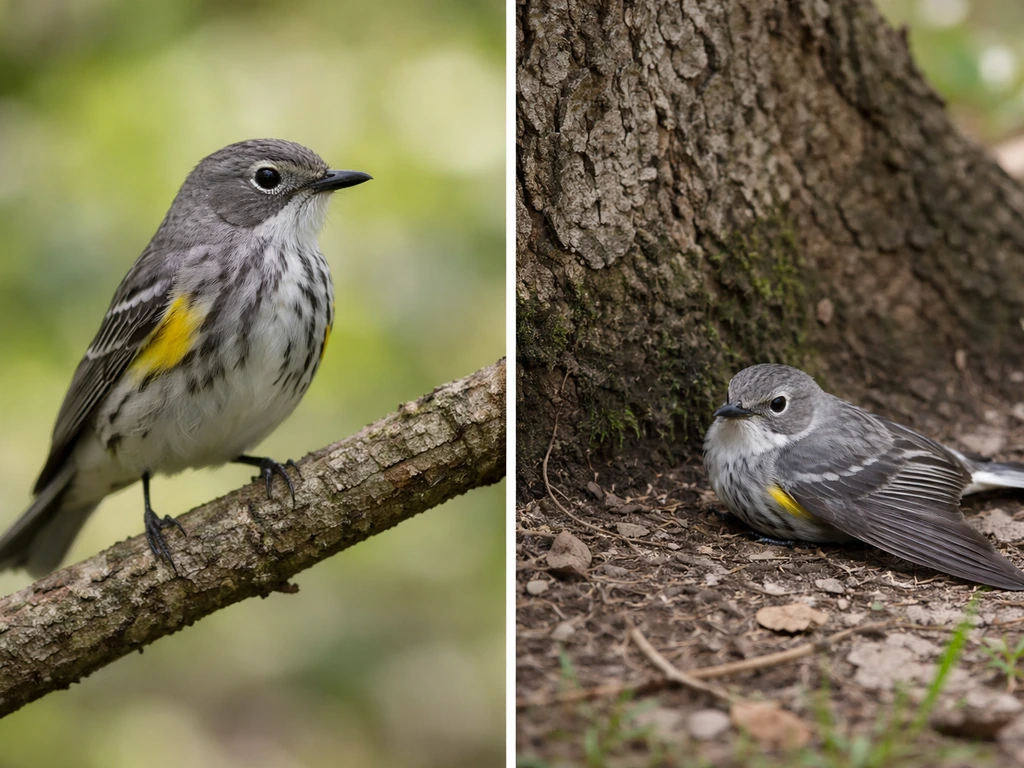
The U.S. Fish and Wildlife Service is clear on this: most of the time, the best thing you can do is leave the bird where it is. Birds are wired to hide illness and injury, and a bird sitting quietly in your yard might just be resting, molting, or watching for predators. Before you touch anything, spend a minute just observing. If you are unsure whether the bird is truly injured, it is usually best to leave it alone and observe from a distance leave the bird alone.
Step in and help if you see any of these:
- A visibly broken or dangling wing or leg
- Active bleeding anywhere on the body
- Shivering or uncontrolled trembling
- The bird cannot stand or keep its head up
- Blood on the feathers, beak, or face
- One wing held dramatically lower than the other
- Panting or labored breathing lasting more than two hours
- A dead parent bird nearby (for a nestling or fledgling)
Leave it alone if the bird is hopping, alert, reacting to your presence, and has no visible injuries. This is especially true for fledglings, those slightly awkward juveniles with stubby tails that look like they fell out of the nest but are actually in a normal stage of learning to fly. Because fledglings often look helpless, it helps to know how to decide, should i help a fledgling bird or leave it with its parents.
Their parents are almost certainly nearby and will return, sometimes after several hours away. Mass. gov’s ACO wildlife handout notes that [very rare situations exist where adults leave young alone for extended periods](https://www. mass.
gov/doc/maf-core-wildlife-handout/download). If you are unsure about a young bird specifically, that situation is covered more closely in guides focused on fledglings and baby birds.
Immediate first aid steps you can do safely
If the bird clearly needs help, your job is not to treat it. Your job is to stabilize it safely until a professional can take over. These steps come directly from wildlife clinics and rehabilitators, and they are simple enough for anyone to follow right now.
- Protect yourself first. Use gloves if you have them, or a cloth or towel. Wild birds can carry diseases including avian influenza (bird flu). If you handle a bird bare-handed, wash your hands and change your clothes afterward.
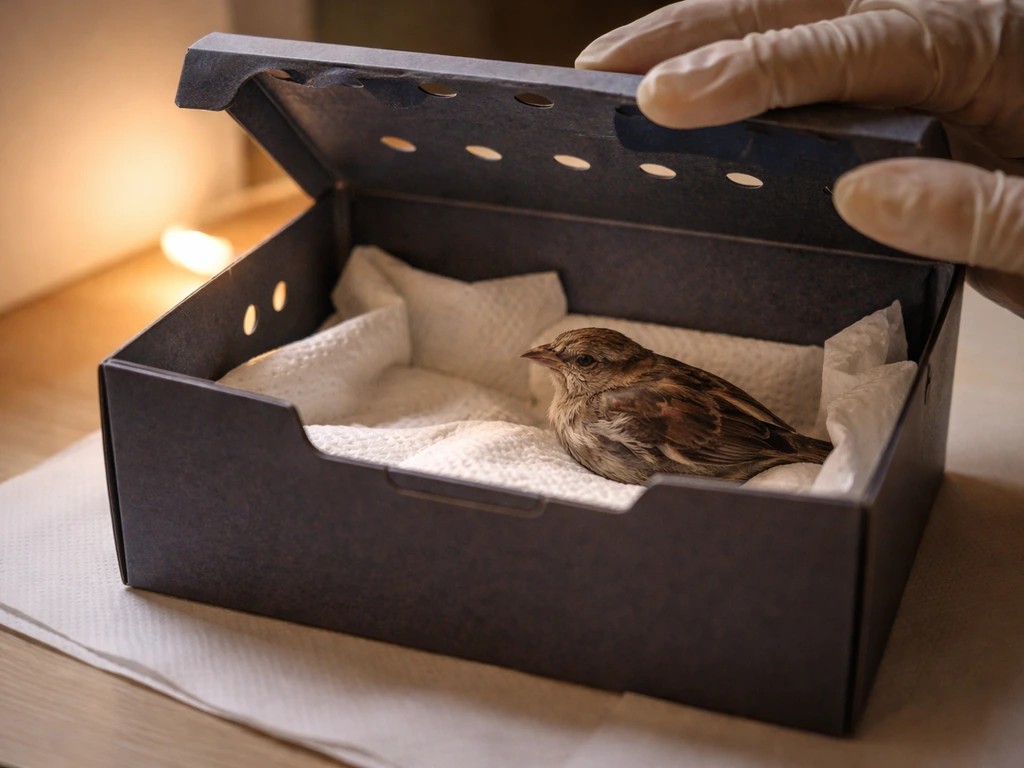
- Gently contain the bird. Place it in a shoebox or cardboard box with air holes punched in the lid. Line the bottom with a folded cloth or a few paper towels so the bird has traction and is not sliding around.
- Keep it warm, dark, and quiet. Put the lid on and move the box to a quiet indoor space away from pets, children, and noise. Darkness reduces panic and stress, which is one of the biggest killers in injured wildlife.
- Add gentle warmth if needed. If the bird is cold or shivering, place the box on top of a heating pad set to low, or on a hot water bottle wrapped in a towel. Aim for around 80 to 90 degrees Fahrenheit near the bird, and make sure half the box floor is off the heat source so the bird can move away if it gets too warm.
- Do not give food or water. This is the single most important thing to avoid. An incorrect diet, or water given to a bird in shock, can cause injury or death. Professional rehabilitators will handle nutrition.
- Call a wildlife rehabilitator or avian vet as soon as the bird is contained. You do not need to wait. Make the call while the bird is resting safely in the box.
Common injury scenarios and what to look for
Window collisions
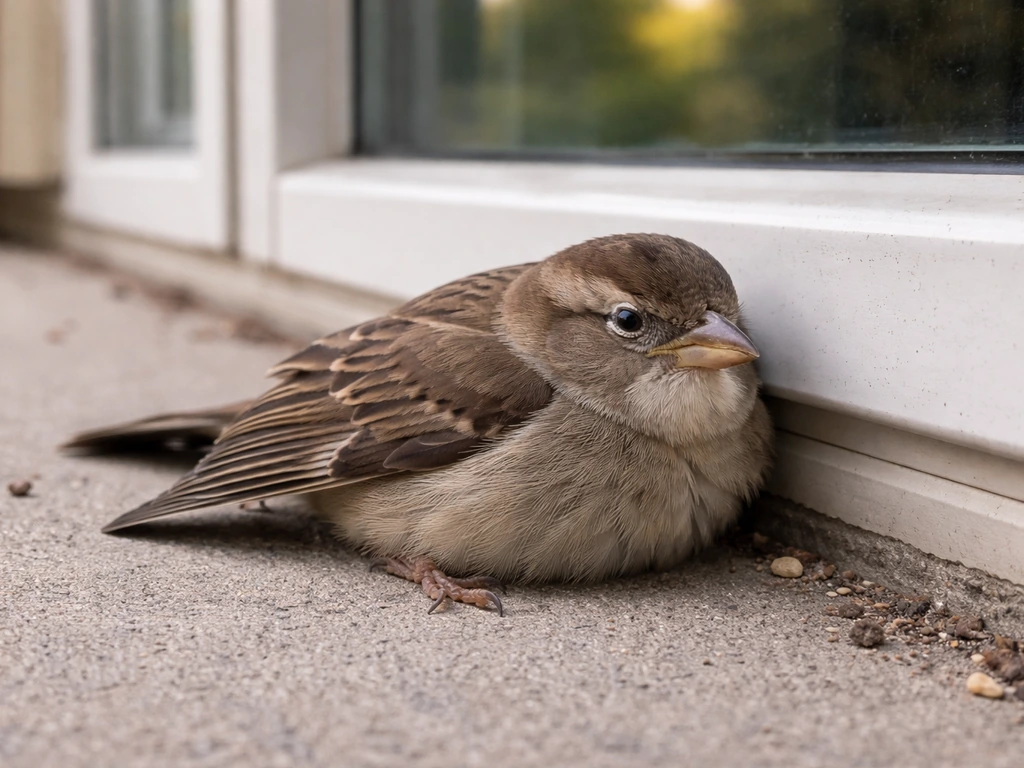
This is far and away the most common scenario. A bird hits a window and lands on the ground, stunned. Window strikes can cause brain swelling, internal bleeding, and internal trauma that is not visible from the outside. A bird that looks fine after a window strike may not be.
Signs to check for include blood anywhere on the body, wings held unevenly, a leg sticking out at a strange angle, or the bird's head tilting to one side. Even if the bird looks uninjured, place it in a ventilated box in a dark, quiet location and wait. According to Audubon, if the bird does not fly away on its own after about an hour, it needs professional evaluation.
Do not assume it is recovering if it is still sitting in the same spot after that window.
Broken wings or legs
A bird with a broken wing will often hold it lower or at an odd angle, and it will not be able to fly. A broken leg may cause the bird to stand on one foot, fall over, or drag a limb. Do not attempt to splint, bandage, or straighten any broken bone yourself. Improper splinting can cut off circulation and cause permanent damage. Contain the bird and get it to a rehabilitator or avian vet as quickly as possible.
Injuries from cats or dogs
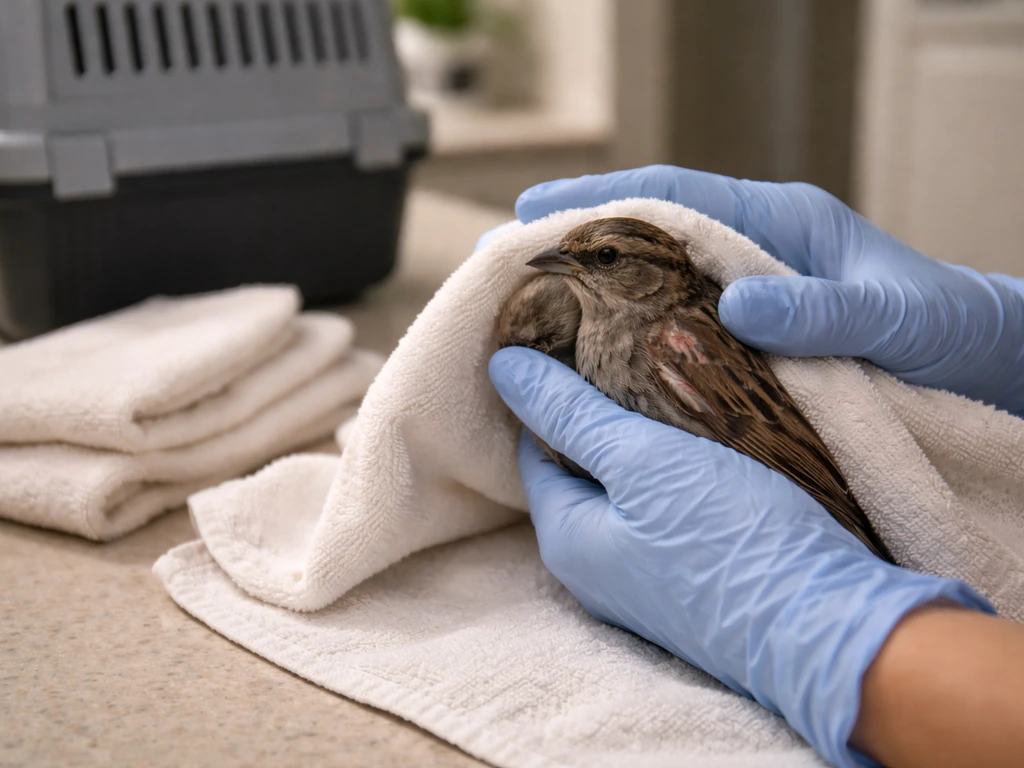
Pet attack injuries are especially serious and deceptive. Even a light bite or scratch from a cat injects bacteria deep into the bird's tissue, and birds can die from infection within 24 to 48 hours even when there are no visible wounds. If a cat or dog has had contact with the bird, treat it as a medical emergency regardless of how the bird looks. Get it to a wildlife rehabilitator or avian vet the same day.
Shock and general trauma
Shock is common in injured birds and can look like the bird is calm or even sleepy. Signs include a bird that is limp, unresponsive, has its feathers puffed out, or does not react when you reach toward it. A bird in shock needs warmth, darkness, and quiet immediately. Do not handle it more than necessary. Stress alone can kill a bird that is already compromised.
Beak injuries
A cracked or broken beak can make it impossible for a bird to eat. You will notice the bird struggling to grasp things, or the beak visibly misaligned or split. There is nothing you can safely do to fix this at home. Contain, keep warm and quiet, and contact a professional.
What NOT to do and common mistakes
This section matters as much as everything else here. The most common mistakes people make when trying to help an injured bird can directly cause its death. If you are tempted to should you put an injured bird out of its misery, treat it as a last resort discussion with a professional instead of a decision you make at home.
- Do not give food or water. Not bread, not seeds, not water from a dropper. Wild birds have specific nutritional needs, and the wrong food or liquid can cause choking, aspiration, or fatal digestive issues. This applies to baby birds too.
- Do not attempt DIY splinting or bandaging. Bones set incorrectly cannot be fixed later. Leave it for professionals with the right tools and training.
- Do not force the bird to walk, fly, or move. Testing whether a wing 'works' by extending it or encouraging flight adds injury on top of injury.
- Do not overheat the bird. A heating pad on high, or a box placed too close to a heat source, can cook a bird that cannot move away. Always give the bird a cooler side of the container to move toward.
- Do not keep a wild bird long-term or attempt to raise it yourself. In most of the United States it is illegal to keep a wild bird without a permit, and birds raised by untrained people rarely survive or become releasable.
- Do not offer well-intentioned but harmful remedies like milk, electrolyte drinks, or human medications.
- Do not handle the bird more than necessary. Every interaction causes stress. Once it is boxed, leave it alone until you hand it off to a professional.
How to handle the bird safely: capturing, warmth, and transport
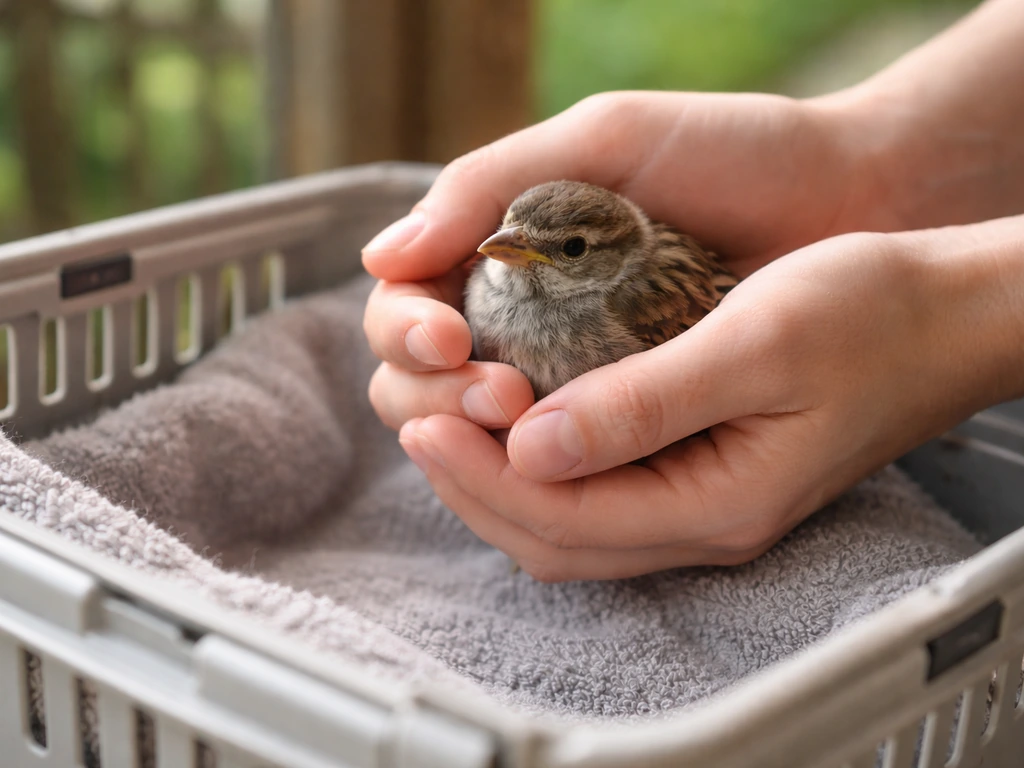
Approach slowly and calmly. Sudden movements will trigger panic and thrashing, which can worsen injuries. If you can, drape a light cloth or small towel over the bird before picking it up. The next step is to follow safe handling guidance so you do not make the injury worse picking it up. This reduces visual stimulation and makes it easier to hold the bird gently without it struggling. Cup the bird in both hands with its wings held against its body. Never grab by a wing or leg.
For raptors like hawks or owls, the risk to you is real. Their talons can cause serious injury. Use thick gloves or a heavy folded jacket, and be especially careful not to let the feet contact your bare skin. The guidance from Audubon is straightforward: contain and transport, do not handle more than necessary.
Your container matters more than you might think. A cardboard shoebox with air holes punched in the lid is ideal for most small to medium birds. Line it with a non-slip surface: a folded cloth, paper towels, or a piece of fleece. Avoid smooth cardboard on its own, since an injured bird can slip and hurt itself further during transport. For window-strike birds, an unwaxed paper bag also works in a pinch. Keep the top ventilated but covered to maintain darkness.
During transport, keep the box on a flat surface if possible and avoid blasting heat or air conditioning directly at it. If you are wondering can you touch an injured bird, remember the goal is minimal handling until help arrives injured birds. Drive calmly. Keep the radio off or low. The bird does not need conversation or reassurance; it needs quiet.
When to contact a wildlife rescue or avian vet, and how to find one
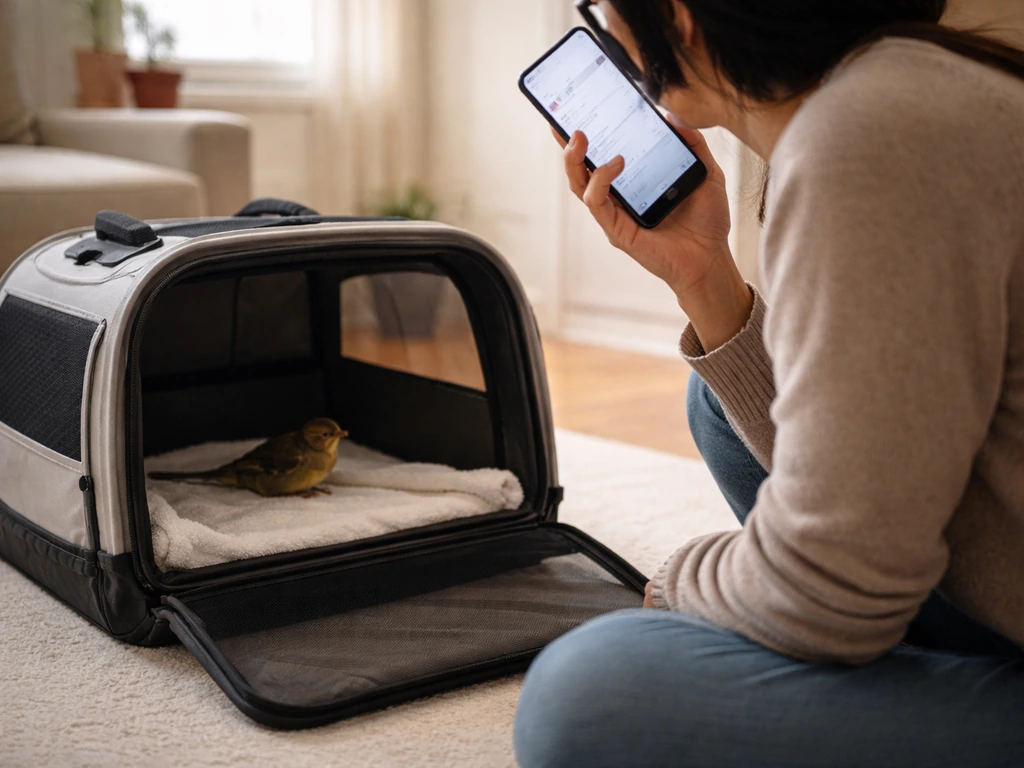
Contact a wildlife rehabilitator or avian vet as soon as the bird is contained and stable. Do not wait to see if it 'gets better.' Birds deteriorate quickly, and the sooner a professional assesses the bird, the better its chances.
Call immediately, without waiting, if:
- The bird is bleeding and the bleeding will not stop
- The bird is completely unresponsive or limp
- A cat or dog has made contact with the bird
- The bird is a raptor (hawk, owl, falcon, eagle)
- The bird is a protected or uncommon species
- The bird has not improved after one hour of quiet, dark, warm rest
To find help near you, try these resources:
- Search 'wildlife rehabilitator near me' or visit the National Wildlife Rehabilitators Association (nwrawildlife.org) to find a licensed rehabilitator in your area
- In the U.S., the U.S. Fish and Wildlife Service website lists regional resources for injured wildlife
- In Massachusetts specifically, MassWildlife maintains a directory at mass.gov/masswildlife
- Your local Humane Society, animal control office, or SPCA can often refer you to a licensed wildlife rehabilitator even if they cannot take the bird themselves
- Many veterinary clinics can assess an injured wild bird in an emergency, even if they are not avian specialists; call ahead to confirm
- Search for a local Audubon Society chapter, bird alliance, or raptor center, as these often have direct contacts for wildlife rescue
When you call, be ready to describe where you found the bird, what species it appears to be (your best guess is fine), what injuries you can see, and what condition it is in right now. The more detail you give, the better the rehabilitator can prepare. If it is after hours, many clinics ask you to leave a message and keep the bird in a secure, dark, quiet box overnight. Organizations like Tufts Wildlife Clinic (508-839-7918) and many others have after-hours protocols exactly for this situation.
Aftercare, monitoring, and release
Once the bird is with a licensed rehabilitator or veterinarian, your role is largely done. That is intentional. Professional wildlife rehabilitators have permits, training, and species-specific knowledge that makes the difference between a bird that survives and one that does not. Attempting to continue home care, even with the best intentions, typically reduces the bird's chances of recovery and release.
If you are in a situation where you genuinely cannot reach a rehabilitator and must hold the bird overnight, keep it in the warm, dark, quiet box and check on it minimally.
If you’re wondering can i keep an injured wild bird overnight, the safest approach is to keep it in a warm, dark, quiet box and contact a wildlife rehabilitator as soon as possible injured bird. If you are wondering how long to keep an injured bird in the box, the safest rule is to keep it only until a wildlife professional can assess it how long to keep injured bird in box. Do not open the box repeatedly.
Do not offer food or water. Check in the morning to see if it is alert and upright. If it has deteriorated overnight, that is critical information to share when you do reach a rehabilitator.
For window-strike birds specifically, Audubon recommends a different protocol: after keeping the bird in a quiet dark box for about an hour, take the closed box outside, open it, and step back. A fully recovered bird will fly out on its own. If it does not, call a wildlife rehabber. Do not release a bird that is not flying confidently, because a bird that cannot escape predators will not survive on its own.
Whether a bird can ultimately be released depends on the nature and extent of its injuries, something only a trained rehabilitator can assess. Some birds recover fully and are released back to the wild. Others with permanent injuries may become education animals. Either outcome is better than a bird left untreated on the ground. If you did your part by containing it safely, keeping it calm and warm, and getting it to the right hands quickly, you gave it a real chance.
FAQ
What should I do if I am not sure the bird is actually injured?
If you do not know whether the bird is injured, choose the “observe first” rule: watch from a distance for a few minutes. If it tries to move away, right itself, flutters to reposition, or resumes normal posture when you step back, it is likely okay. If it cannot get up, keeps falling over, has bleeding, or you see clear asymmetry (crooked wing, tilted head, dragging limb), treat it as needing help and contact a rehabilitator.
Can I feed or give water to an injured bird while I wait for help?
No. Avoid feeding or giving water, especially with a beak injury or shock, because it can cause choking or aspiration and increases stress. If a pro later instructs feeding, they will also tell you the exact food and method, since wrong diet and liquid temperature are common causes of death in wild birds.
How often should I pick up or check the bird before a rehabilitator arrives?
Use the smallest safe level of handling needed to contain it. A good baseline is to pick up only once, place it directly into the ventilated box, close it, and then limit further movement until transport. If the bird is in a safe spot and clearly unhurt, do not move it at all.
If the bird seems fine after a window hit, do I still need to wait or call someone?
With window strikes, the “looks okay” trap is real. Look beyond the body for subtle problems: uneven wing position, head tilt, or labored breathing, then still follow the waiting rule in a dark, quiet box for about an hour. If it does not fly out on its own after that, it needs professional evaluation even if there is no visible bleeding.
What if the bird has no visible wounds after a cat or dog attack?
Yes, and it changes urgency. If a cat or dog had contact, treat it as serious even when there are no open wounds, because bites can cause internal infection quickly. Keep it contained, warm, dark, and contact an avian vet or wildlife rehabilitator immediately, ideally the same day.
How should I handle an injured bird if I think it was poisoned or exposed to chemicals?
If you suspect a bird is poisoned, overheating, or exposed to chemicals (for example, oily feathers, strong chemical odor, or it is unusually lethargic), do not try to wash it yourself. Contain it in a dark, ventilated box, avoid touching your hands or face, and call a wildlife rehabilitator for the correct handling instructions.
When is it safe to release a bird I found on the ground?
Do not attempt to “teach” it to fly. Release only when a rehabilitator confirms it can fly away normally. A bird that is upright but cannot escape quickly will be vulnerable to predators and may be carrying internal injuries that do not show right away.
What if the bird is bleeding, should I try to stop the bleeding at home?
If the bird is actively bleeding, keep it contained and minimize handling, then prioritize professional help. Do not apply home bandages, ointments, or styptic products unless a rehabilitator tells you to, since they can contaminate tissue or restrict circulation.
What if the injured bird is a hawk or owl and I am worried about safety?
If it is a raptor and you cannot secure it safely, do not risk injury to yourself. Use thick gloves or a heavy jacket only if you can contain it without letting talons contact bare skin. If you cannot approach safely, keep people and pets away and call a rehabilitator for instructions.
How do I handle an injured bird overnight if I cannot reach help right away?
If you must keep the bird overnight, keep it in a warm, dark, quiet, ventilated box, do not open repeatedly, and do not offer food or water. Check only once in the morning for whether it is alert and upright, then report what you observe to the rehabilitator.
Next Article
Should You Put an Injured Bird Out of Its Misery?
Humane decision guide for injured birds: first aid, when to seek urgent help, and when euthanasia is appropriate