If you're holding a bird that isn't reacting to your movements, keeps bumping into things, or has eyes that look cloudy or damaged, you're right to wonder whether it can see. The short answer: you can check several clear signs right now, without stressing the bird further, to get a pretty reliable read on whether blindness or severe eye injury is likely. But you also need to know that many of the same behaviors that suggest blindness can also point to concussion, shock, or other injuries that look similar but need different treatment. This guide walks you through exactly what to check and what to do next.
How to Tell If a Bird Is Blind: Signs and Next Steps
Marcus Chen
19 Apr 2026
Safety first: protect yourself and assume the worst until proven otherwise
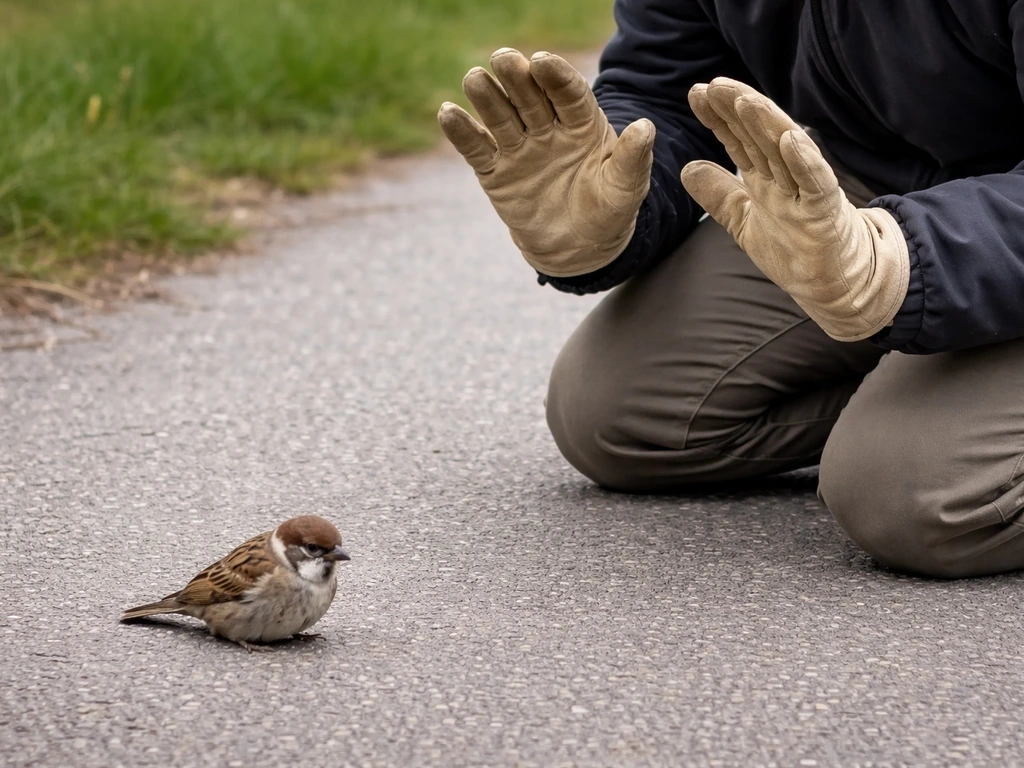
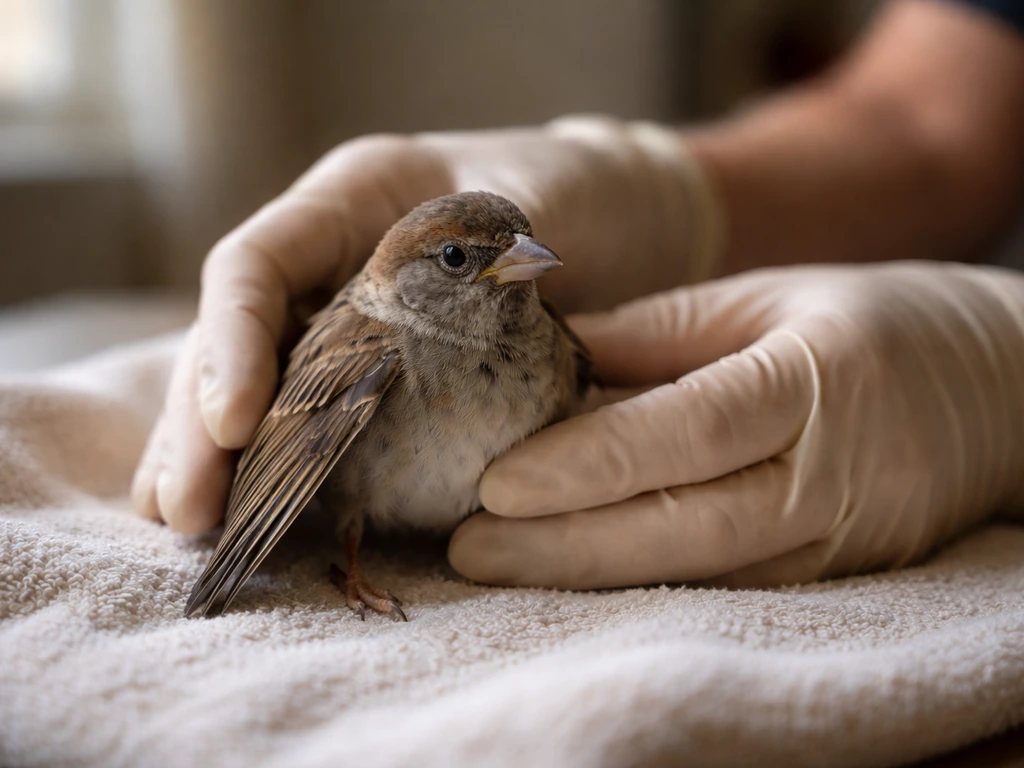
Before you get close, take a breath. A bird that appears blind or dazed can still scratch, bite, or thrash suddenly, and frantic handling makes things worse for both of you. Staying calm genuinely matters here: panicked movements increase the bird's stress and raise your risk of a scratch or bite. Drape a thin towel or cloth gently over the bird before you pick it up. This calms most birds almost immediately and protects your hands from talons and beaks. Use light gloves if you have them, especially with larger birds like pigeons, crows, or raptors.
Assume a severe injury until you know otherwise. Any bird you can easily catch outdoors is already in trouble. Birds that let you walk up to them, that can't hold their head upright, or that have visible blood or swelling around the eyes or face should be treated as urgent cases from the start. If you're reading this to figure out what you're dealing with before you call for help, that's smart. Just don't let the assessment turn into a long handling session. Do a quick check, set the bird up safely, then make the call.
Quick visual check: what the eyes can tell you
Start by looking at the bird's eyes without touching it, if you can. Good lighting helps, but don't shine a flashlight directly into the eyes yet. You're looking at the overall appearance first.
A healthy bird's eyes are round, clear, and equally sized. The pupil (the dark center) should be the same size in both eyes. What you're checking for are departures from that: cloudiness or opacity in one or both eyes, asymmetry in pupil size, swelling around the eye or eyelid, discharge (watery, crusty, or pus-like), any visible redness or blood, or an eye that looks sunken, collapsed, or abnormally large. For corneal ulceration or pain, the Merck Veterinary Manual notes that signs often include excessive tearing and blepharospasm (prolonged eyelid closure), along with other corneal changes over time. Any discharge from a bird's eye is not normal and typically signals trauma, infection, or irritation. Thick white or tan crust around the eye often means the problem has been going on for a while. A cloudy or bluish-gray film over the eye surface (the cornea) can mean a corneal scratch or ulcer, an internal eye injury, or in older birds, a cataract. Cloudiness doesn't always mean the same thing, but all of it warrants veterinary attention.
If the eye looks physically damaged, sunken, or collapsed, that is a genuine emergency. Ruptured corneas and collapsed globes happen in bird-window collisions and cat or dog attacks, and they can look surprisingly subtle at first glance. If one eye looks even slightly smaller or flatter than the other, take it seriously.
- Cloudy, opaque, or filmy eye surface: possible corneal injury, internal eye damage, or cataract
- Discharge (watery, crusty, or pus-like): always abnormal, indicates trauma or infection
- Unequal pupil sizes: possible neurological injury or eye trauma
- Swollen eyelids or swelling around the face/eye area: trauma, infection, or abscess
- Eye that looks sunken, collapsed, or unusually small: severe ocular trauma, treat as emergency
- Eye held shut or squinting constantly: pain, corneal injury, or light sensitivity from neurological injury
- Visible blood in or around the eye: trauma, treat as emergency
Behavioral clues: how a blind or visually impaired bird acts
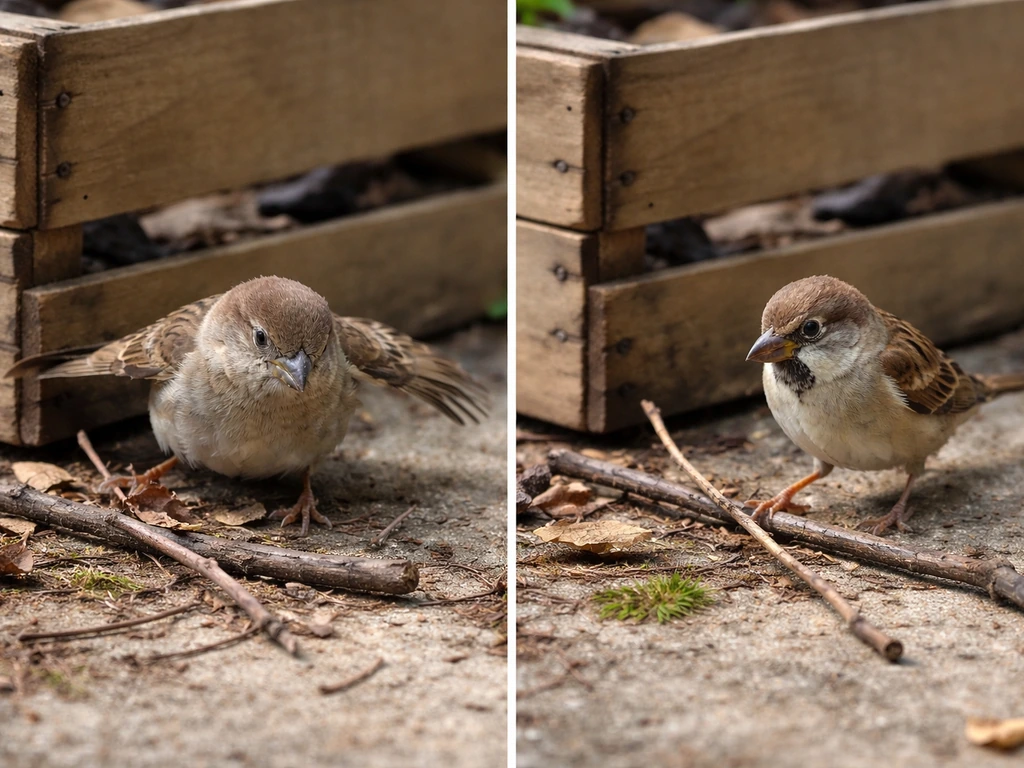
The eyes don't tell the whole story. How the bird moves and orients itself is just as informative, sometimes more so. A bird with significant vision loss will often bump into the walls of a container when placed in one. It may tilt or rotate its head in an exaggerated way, not because it's curious, but because it's trying to use hearing to compensate for what it can't see. Watch for a bird that consistently turns its head to one side at a sharp angle, sometimes called a head tilt, which can signal both neurological problems and severe unilateral (one-sided) vision loss.
A visually impaired bird won't flinch or pull back when your hand approaches silently from in front of it. It may not track your movement with its eyes. Some birds with partial vision will follow moving objects with obvious jerky, effortful eye movements, while a bird with no functional vision won't track at all. Watch whether the bird startles more easily to sound than to movement. If it reacts strongly when you tap the surface near it but doesn't react to your hand moving close to its face, that strongly suggests visual impairment. Also watch for circling behavior, stumbling, or an inability to maintain an upright, stable posture. These lean more toward neurological injury than isolated eye damage, but the two often occur together after a collision.
Simple response tests you can do without stressing the bird
These tests are quick and low-stress. Do them gently, don't repeat them over and over, and stop if the bird becomes very agitated.
- The hand-approach test: very slowly move your open hand toward the bird's face from the front, stopping a few inches away. A bird with functional vision will blink, flinch, pull back, or at minimum track the movement. A bird that does none of these things is likely visually impaired on that side. Test both sides separately.
- The light response test: in a dimly lit room, briefly shine a small penlight or phone flashlight to the side of (not directly into) each eye. A bird with intact vision will typically blink or constrict the pupil. Note whether both eyes respond equally. Unequal or absent pupil response is a red flag for either eye injury or neurological damage.
- The sound-versus-sight test: make a soft sound (tap gently near the bird, or snap your fingers) without any visual movement. If the bird startles to the sound but didn't react to your approaching hand moments earlier, that contrast supports vision impairment rather than just general unresponsiveness.
- The placement test: when you gently place the bird in a box, watch how it navigates. A sighted bird that is mobile will usually orient itself and avoid walls. A visually impaired bird will bump or press against surfaces and may struggle to find a stable position.
Be honest about what the tests tell you. None of these are definitive diagnoses. A severely shocked or concussed bird may fail all of them and still have intact vision once it recovers. What these tests do is give you useful information to pass on to a rehabilitator or vet, and they help you decide how urgently to act.
Don't confuse blindness with these other conditions
This is probably the most important section in this guide for most people, because the majority of birds that look blind after a window strike or outdoor incident are not permanently blind. They're in shock, concussed, or severely disoriented, and many will recover with proper supportive care. Knowing the difference helps you respond correctly.
| Condition | Looks like blindness? | Key distinguishing signs | Urgency |
|---|---|---|---|
| Shock/stress response | Yes | Dull, unresponsive, glazed eyes but structurally normal; often improves within 1-2 hours in a dark, quiet space | Moderate: monitor closely, call rescue |
| Concussion (window strike) | Yes | Disorientation, stumbling, circling, ataxia, sometimes nystagmus (rapid eye movement); eyes may look normal structurally | High: no improvement in 2 hours = urgent |
| Neurological injury | Yes | Abnormal head/neck position, tremors, circling, inability to stand, possible seizures; vision loss may be central (brain), not eye-based | Urgent: call vet/rescue immediately |
| Corneal injury/eye trauma | Possibly | Cloudy, opaque, or physically damaged eye; squinting; discharge; bird may have partial vision or none | Urgent: same-day vet attention |
| Leg or wing injury | No (but looks bad) | Bird is grounded and can't fly but responds visually; eyes and tracking normal | Moderate to high: needs professional care |
| Age-related cataracts (older birds) | Yes | Gradual onset; bilateral lens cloudiness; more common in older parrots/psittacines; no other acute injury signs | Non-emergency but needs avian vet |
Concussion after a window strike is extremely common. A bird may sit on the ground, appear completely unresponsive, and fail every visual test, but it has a functioning brain and eyes that just need time to recover from the impact. The key rule of thumb: if a bird that hit a window has not shown meaningful improvement within about two hours in a quiet, dark, contained space, treat it as a veterinary emergency. If it's improving (holding its head up, starting to move purposefully, reacting to stimuli), continue supportive care and monitor.
Neurological signs that go beyond simple disorientation, like circling in one direction repeatedly, head twisted at a severe angle, tremors, seizures, or paralysis of limbs, tell you something more serious is going on than a brief concussion. These signs require professional evaluation urgently. They also relate closely to the signs covered in the broader topic of how to tell if a bird is in distress, since neurological injury and systemic distress often overlap.
Setting up a safe space right now
Whether the bird is blind, concussed, or in shock, the immediate care is the same: a warm, dark, quiet, contained space. Get a cardboard box that's big enough for the bird to sit comfortably but not so large it can crash around. Line the bottom with a towel or paper towel that has no frayed edges or holes (loose threads can catch on toes or talons). Punch or cut several small ventilation holes in the lid and sides. Place the bird gently inside using the towel you used to pick it up, keeping it wrapped until it's in the box.
Close the box and put it somewhere genuinely quiet and dark: a bathroom, a closet, a spare room away from household activity and pets. Keep it away from children, dogs, and cats. Room temperature is fine for most birds, but if the bird is cold to the touch or shivering, you can place a warm (not hot) water bottle or a hand warmer under one side of the towel inside the box, leaving the other half unheated so the bird can move away from the heat if it gets too warm.
Do not give the bird food or water unless a trained rehabilitator tells you to. If you suspect the bird is suffering, keep it warm and calm and contact a wildlife rehabilitator or avian vet as soon as possible how do you know if a bird is suffering. You should also watch for dehydration signs like sticky gums, dry skin, and a sunken appearance, and seek veterinary help right away if you suspect dehydration how to tell if a bird is dehydrated. This is one of the most common mistakes people make, and it can be fatal. Forcing water into a bird's beak can cause aspiration, where liquid goes into the lungs instead of the stomach. Many birds don't drink by sipping the way mammals do, and an already compromised bird is at very high risk. Skip the feeding entirely until you have professional guidance.
Handle the bird as little as possible. Every time you open the box to check, you're adding stress. One quick check after 30 minutes, then leave it alone until you've spoken to a rehabilitator or vet. If you suspect blindness specifically, make sure the box environment is low-stimulus: no bright light filtering through, no loud TV or music nearby, and minimal vibration from foot traffic or speakers.
A note on fledglings versus adult birds
If the bird you found is very young (covered in fluffy down, or has short stubby feathers and a large gape/open beak) and appears to have eye problems, the situation is more delicate. Young birds have developing immune systems and are extremely vulnerable to stress. Apply the same containment guidelines, but contact a wildlife rehabilitator faster. Don't try to assess vision in a very young bird the way you would an adult: their visual responses are less developed even under normal circumstances, so the tests above are less reliable. Document what you saw and let a professional do the full assessment.
For adult birds, the behavioral and visual tests described earlier are fairly reliable indicators. An adult bird that was flying normally and then had a clear injury event (window strike, cat attack, vehicle collision) gives you a solid baseline: any failure to respond visually after that event is meaningful. An adult bird you found on the ground with no known history is harder to read, but the same checks still apply.
When to call a vet or wildlife rescue right now
Some situations can't wait for a scheduled appointment. Call an avian vet or wildlife rescue immediately if you observe any of the following: You can also check breathing right away by watching the bird's chest for steady movement.
- The eye looks physically damaged, sunken, collapsed, or is bleeding
- There is swelling of the face or around the eye socket
- The bird is circling, having seizures, or can't hold its head upright
- The bird shows no improvement after two hours of quiet, dark rest
- There is pus-like or bloody discharge from the eyes
- The bird is completely unresponsive to both sound and touch
- The bird was attacked by a cat or dog (cat punctures carry serious infection risk even without visible wounds)
- You see both eyes affected simultaneously with cloudiness or damage
For urgent eye injuries specifically, same-day veterinary attention is the standard recommendation. Eye injuries that look minor on the surface, like a small cloudy spot, can involve serious internal damage, including conditions as severe as a ruptured cornea. Eye injuries that look minor on the surface can also include signs a bird is in pain, like cloudiness, swelling, or discharge. What looks like a surface scratch can be masking something that will cause permanent vision loss if not treated promptly.
When you call, tell the person: what species the bird appears to be (or your best guess), what event you think caused the injury (collision, cat attack, found on ground), what the eyes look like, how the bird is behaving, and the results of any of the simple tests you ran. This information helps a rehabilitator or vet triage over the phone and decide whether you need to come in immediately or monitor for a bit longer. The more specific you are, the better. Writing down your observations before you call is genuinely useful, especially if you're stressed.
To find help, search for a licensed wildlife rehabilitator in your area, contact your nearest animal shelter or humane society for a referral, or look for an avian-specific vet if this is a pet bird. Many areas have 24-hour wildlife emergency lines. If you're in the US, the National Wildlife Rehabilitators Association and Wildlife Rehabilitation and Education Network both have online directories. Don't assume that any general vet can handle bird eye injuries: an avian vet or a vet with wildlife experience will be significantly better equipped for this.
Finally, keep in mind that birds can absolutely survive and adapt to vision loss in one eye, and some do reasonably well with proper managed care even with significant impairment. Your job right now isn't to diagnose or treat the bird yourself. It's to keep it safe, calm, and warm while you get it to someone who can. If you are unsure whether your bird needs urgent assistance, review how to know if a bird needs help and act accordingly. You've already done the hardest part by stopping to help.
FAQ
Should I use a flashlight to confirm whether the bird can see?
Avoid shining a flashlight directly into the eyes while the bird is still stressed. Instead, use room lighting to look for cloudiness, asymmetry, swelling, discharge, or a visibly sunken or collapsed eye. If you do need to assess movement, do it quietly from the bird's front at a slow pace, then stop and return the bird to the dark box.
What if the bird seems blind, but it might be recovering after a window strike?
If a bird is improving within about two hours in a quiet, dark, contained space, that suggests concussion or shock is possible and you should continue supportive care while you arrange professional help. If there is no meaningful improvement, or the bird’s condition worsens, treat it as urgent and contact an avian vet or wildlife emergency line right away.
If the bird keeps bumping into things, does that always mean it is blind from eye damage?
No. The same behaviors that can look like blindness, like circling, head tilt, stumbling, or failing visual tracking, can also come from neurological injury, shock, or concussion. Because treatment differs, you should not assume it is only an eye problem when you see disorientation or repeated circling.
How can I tell whether a bird is ignoring my hand because it cannot see, or because it is just dazed?
If the bird startles to sound (for example, responds when you tap near it) but does not react to your hand moving in front of it, that pattern leans toward vision impairment rather than simple fatigue. Still, it is not a diagnosis, and you should treat any eye cloudiness, discharge, blood, swelling, or inability to hold posture as urgent.
Can I gently clean the bird’s eye or remove crust myself to improve its vision?
Do not attempt to examine the eye directly, and do not try to clean it with home solutions. If you see discharge, crusting, blood, a cloudy cornea, or swelling, keep the bird calm in the dark and get same-day veterinary or rehabilitator guidance, because corneal ulcers and ruptures can look subtle early.
Can a bird look blind even if the eye is not permanently injured?
Yes, especially with window strikes or impacts. A bird may temporarily lose functional vision due to concussion even when the eyes look superficially abnormal. That is why the “look then reassess after a short period in a dark, quiet box” approach matters, rather than treating the first observed status as permanent.
How many times should I check the bird’s eyes or behavior after finding it?
Handle the bird as little as possible and limit box openings to brief checks, such as once after about 30 minutes. If you see worsening signs, you may need professional input immediately rather than repeated at-home observation.
What is the safest way to warm a bird that seems blind or unresponsive?
If the bird is cold to the touch or shivering, provide gentle warmth using a warm (not hot) water bottle or hand warmer placed under one side of the towel inside the box, so the bird can move away if it gets too warm. Do not overheat and do not place the warmer directly on the bird’s body.
How should my level of concern change if I found the bird on the ground with no clear injury event?
If it is an adult bird with known injury (window strike, cat attack, vehicle impact), lack of visual response right after the event is meaningful. If it is a bird found on the ground with no known history, the same signs still require caution, but interpretation is less certain, so urgent professional assessment becomes even more important when you see eye cloudiness, blood, discharge, or abnormal posture.
Why are the usual blindness signs less reliable in very young birds?
For very young birds, visual responses can be naturally incomplete, so the typical tracking and startle tests are less reliable. Because chicks and nestlings are vulnerable to stress and have developing systems, contact a wildlife rehabilitator sooner rather than spending time trying to confirm vision at home.
Is urgent vet care really necessary if the eye injury looks minor, like a small cloudy spot?
Same-day care is generally recommended for suspected urgent eye injuries, even if the eye looks only slightly cloudy, because internal damage can be present and can progress. If you see discharge, swelling, blood, a collapsed eye, or signs of pain or severe injury, prioritize immediate professional evaluation.
What should I feed or give water to if the bird seems blind?
Do not offer food or water unless a trained rehabilitator instructs you to. Forcing water into the beak can lead to aspiration, which can cause breathing problems and worsen outcomes, especially in birds that are already disoriented.
How do I handle dehydration concerns without giving the bird water myself?
If you suspect dehydration, look for sticky gums, dry skin, and a sunken appearance, but treat those as signals to seek help, not as reasons to force fluids. Keep the bird warm and calm in the dark box and contact an avian vet or wildlife rehabilitator promptly if you suspect dehydration or worsening weakness.
What details should I prepare before calling an avian vet or wildlife rehabilitator?
Write down key details before calling, such as species guess, what happened (window strike, cat/dog, found on ground), time since the event, what the eyes look like (cloudy, sunken, discharge, blood), and what behaviors you observed (bumping, head tilt direction, response to sound vs movement). This helps triage the urgency and the likely category of injury.
Next Article
Can a Bird Live With One Wing? Survival and First Aid
Can a bird live with one wing? Injury outcomes and step-by-step first aid, plus when to get urgent help.