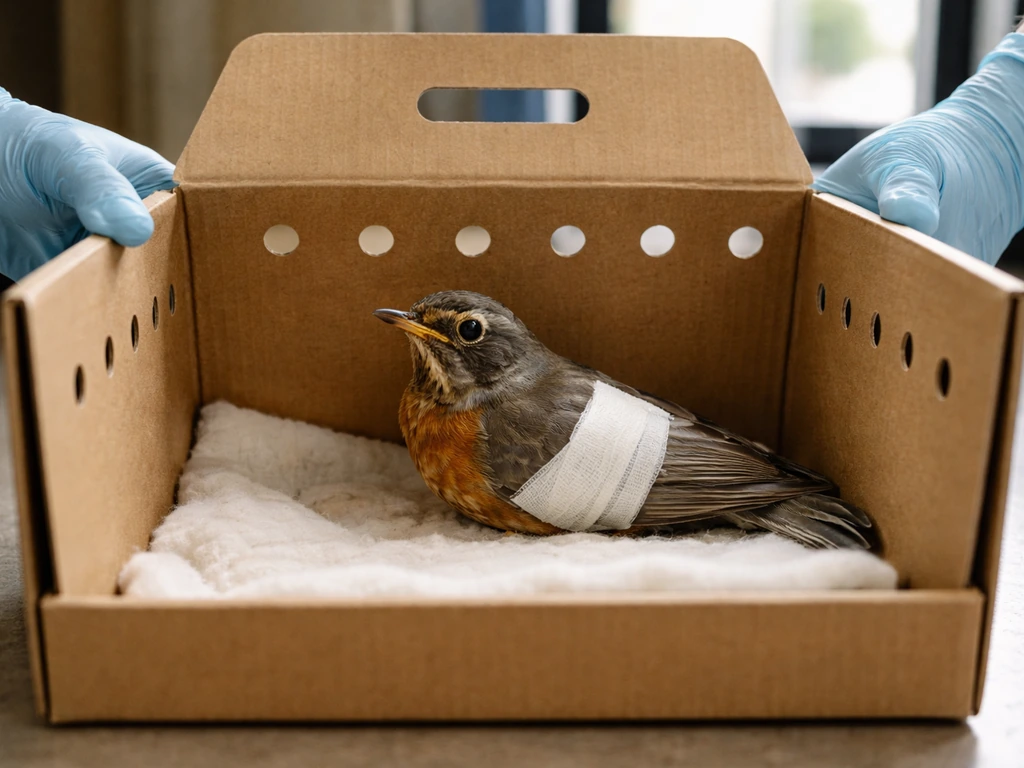
If you're reading this right now, there's probably a bird in front of you and you're trying to figure out what to do. Here's the short answer: contain the bird safely, keep it warm and quiet, do not feed it or try to splint anything, and get it to a wildlife rehabilitator or avian vet as fast as you can.
Bird Broken Wing Treatment: First Aid and When to Get Help
Marcus Chen
22 Apr 2026
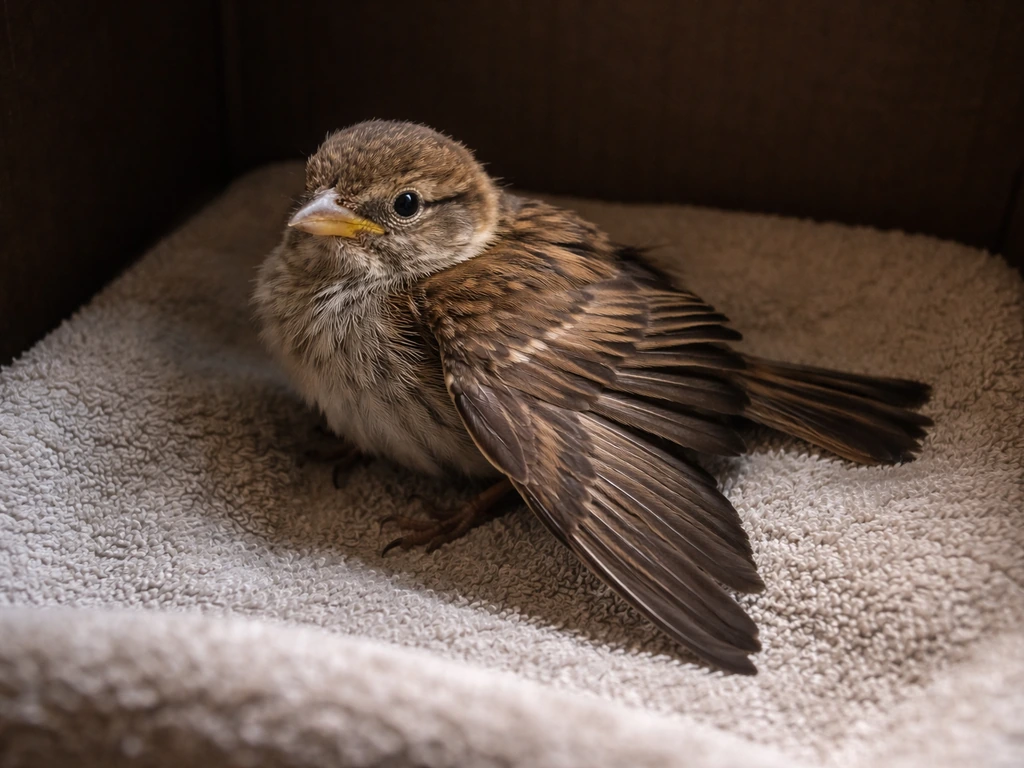
Tufts Wildlife Clinic similarly instructs that when you find a sick or injured songbird, you should not give it food or water do not feed it or give it water. If you're wondering bird with broken wing what to do, use these steps: contain the bird safely, keep it warm and quiet, do not feed it, and get professional help as fast as you can.
If you suspect a bird has a bird broken foot along with reluctance to move or standing problems, the same rule applies: contain it, keep it warm and quiet, and get an avian vet or wildlife rehabilitator help right away. If you found a bird with a broken wing, treat it as an injured adult and get professional care right away.
The rest of this guide walks you through each of those steps in detail so you don't make the situation worse while you're getting help lined up.
How to tell if a wing is actually broken
The clearest sign is a wing that droops or hangs lower than the other one. If you look at the bird straight on and one wing sits noticeably lower, hangs loose, or is held out from the body at a weird angle, that points strongly to a fracture or dislocation. Tufts Wildlife Clinic and NW Parrot Rescue both flag a drooping or misaligned wing as one of the first things to look for, along with visible swelling, bruising, or an open wound on or near the wing.
Other signs that something is seriously wrong: the bird can't fly at all and isn't just a fledgling (more on that below), it can't stand or hop normally, it's breathing hard or with its beak open at rest, it seems lethargic and barely responds to you approaching, or you can see bone protruding or a limb bent in a direction it shouldn't go. Leg injuries can show up as hopping or standing problems, reluctance to move, swelling, bruising, or an obvious limb deformity bird broken leg symptoms. Any one of these signals a genuine emergency.
The most common confusion case is a fledgling bird, which is a young bird that has left the nest and is still learning to fly. These birds often sit on the ground, can't fly well, and may hold their wings slightly awkwardly. That's completely normal. If the bird has feathers (even short ones), bright eyes, and is hopping around actively, there's a good chance it's a fledgling rather than an injured adult. A bird with a genuinely broken wing will typically be still, dull-eyed, and won't try to escape when you approach. When in doubt, call a local wildlife hotline before picking the bird up.
Other things that can look like a broken wing but aren't: window-collision concussion (the bird is stunned but structurally fine and may recover in under an hour), a sprain or soft-tissue injury, or feather damage from a predator encounter. The problem is you can't reliably tell the difference yourself, and even injuries that look minor can hide serious internal damage. That's exactly why professional assessment matters.
First aid basics: safety, stress, and shock
Before you touch the bird, protect yourself. Even small songbirds can scratch and peck hard when they're frightened and in pain. Use a light towel, a cloth, or gardening gloves, and approach calmly and slowly. Sudden movements and loud noise add stress on top of an injury, and a bird that's already in shock can die from handling panic alone. Keep talking to a minimum and move deliberately.
Shock is a real risk with any serious injury. An injured bird may look calm, but that stillness is often a sign it's shutting down, not that it's comfortable with you. The priorities during immediate first aid are reducing stress, keeping the bird warm, and getting it into a dark and quiet space as quickly as possible. Warmth matters because injured and sick birds lose body heat fast. Liberty Wildlife and CA Wildlife 911 both emphasize warmth, darkness, and quiet as the three pillars of holding care while you arrange transport.
To pick the bird up, drape a towel over it first. This covers the eyes, which immediately calms most birds, and gives you a better grip without squeezing the body. WERC recommends this specifically: the cloth reduces stress and prevents the bird from struggling and injuring itself further. Cup the bird gently in the towel with its wings held loosely against its body. Don't grip tightly. You want to support it, not restrain it forcefully.
Setting up a safe enclosure
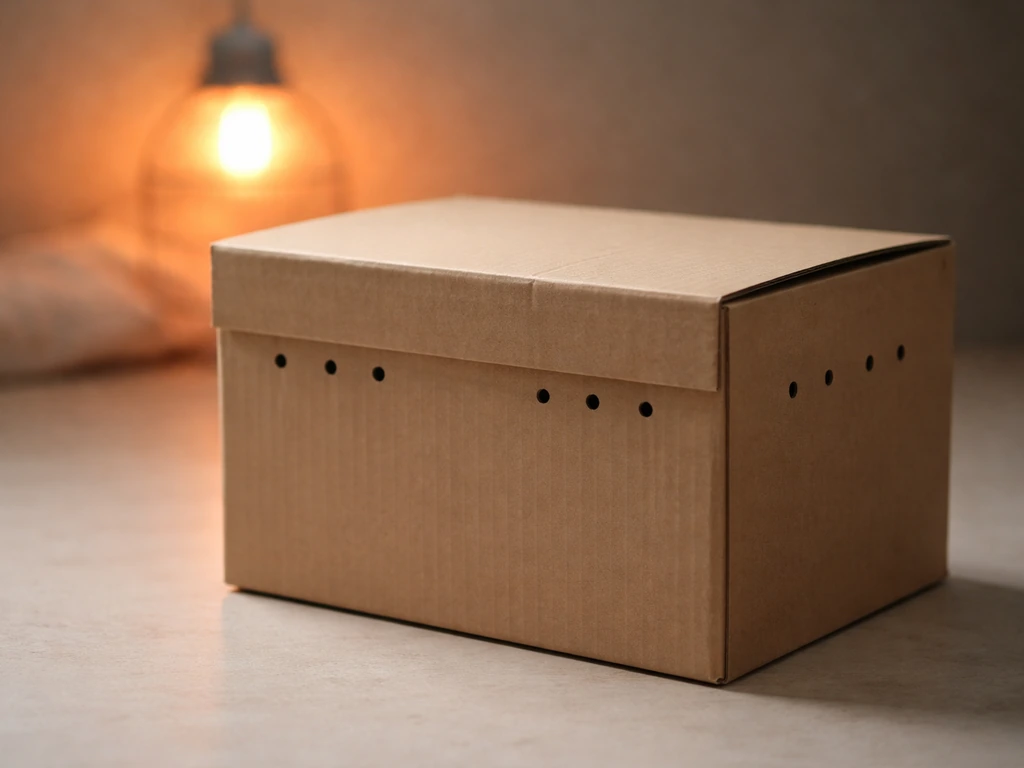
A cardboard box works perfectly. It's dark, it muffles sound, and it limits movement so the bird can't thrash around and cause more damage. Pick a box that's big enough for the bird to sit comfortably but not so large that it can throw itself against the walls. Poke several small air holes in the lid and sides for ventilation. Line the bottom with a folded towel or paper towels so the bird has something to grip, which reduces stress and helps it stay upright.
Close the lid. Put the box somewhere warm (around 85 to 90 degrees Fahrenheit is appropriate for a bird in shock, though room temperature with added warmth is workable), dark, and away from household activity. That means away from other pets, away from children, and away from loud TVs or music. You can place a heating pad on the lowest setting under half of the box so the bird can move away from the heat if it gets too warm. Do not put the heat source directly under the entire base.
If you only have a pet carrier, that's fine too. Cover it with a towel or blanket to darken the interior, as the DFW Wildlife Hotline suggests. The goal is the same: dark, quiet, and warm. Once the bird is in the box, resist the urge to keep opening it to check on it. Every time you open that box, you reset the bird's stress response.
What not to do (this part matters a lot)
Do not try to splint the wing yourself. It seems like the helpful thing to do, but improper splinting causes far more harm than leaving the wing alone. WERC is explicit about this: do not try to immobilize fractures except by wrapping the whole animal securely in a towel. An incorrectly applied splint can cut off circulation, shift bone fragments, and cause the bird serious additional pain. Splinting requires training, the right materials, and knowledge of the specific fracture type. A licensed rehabilitator or avian vet can do this properly. You can't, and that's okay.
Do not try to straighten or reposition the wing. Do not probe the injury, clean an open wound with hydrogen peroxide or antiseptic, or apply any ointment or cream. These all cause harm. If there is active bleeding from the wing, you can gently apply light pressure with a clean cloth, but do not wrap or bandage tightly.
Do not feed the bird or give it water. This is one of the most important rules, and it surprises a lot of people. An injured bird in shock has a suppressed swallow reflex, and fluids squirted into its mouth can go directly into the lungs, causing fatal aspiration. CA Wildlife 911 says explicitly: never squirt water into a bird's mouth. Bidwell Wildlife Rehab and WERC both reinforce this: no food, no liquids, period, unless a rehabilitator has specifically told you otherwise. Hummingbirds are the one partial exception some centers note, but even then, call first.
Do not leave the bird outside in the open, near other pets, or in a location where it can overheat in direct sun. And do not assume the bird will recover on its own and release it without evaluation, even if it seems to perk up a bit. Birds are very good at masking distress, and what looks like improvement can be temporary.
When you need professional help right now
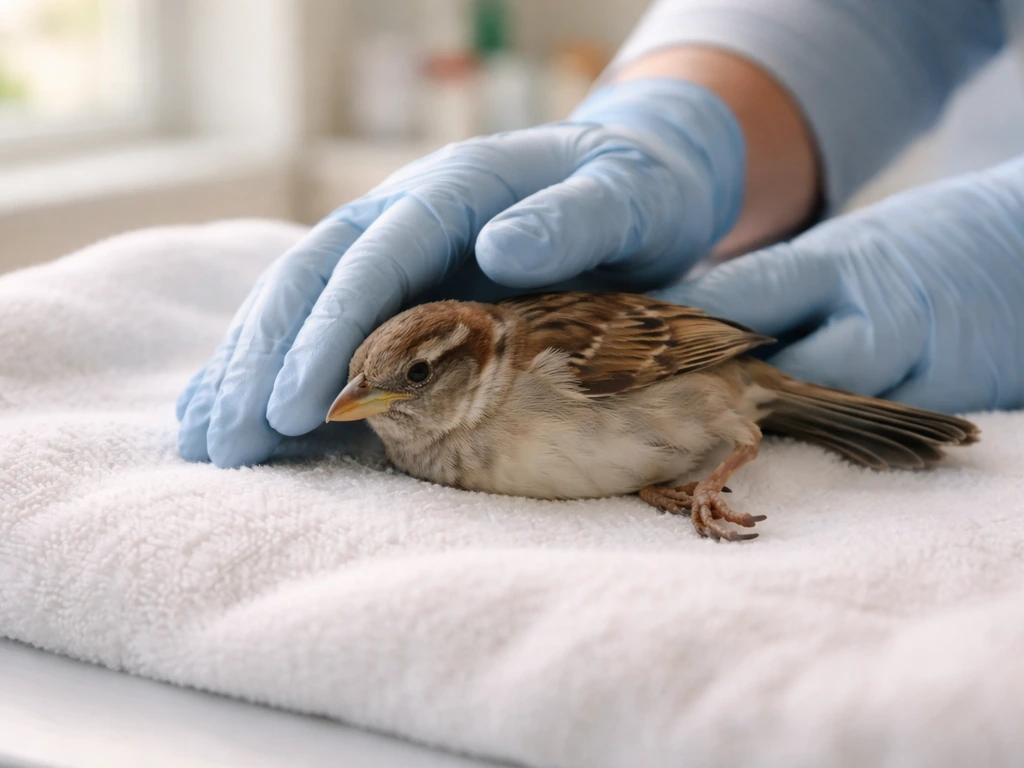
Some situations are clear emergencies and need immediate professional attention, not a wait-and-see approach. Contact a wildlife rehabilitator or avian vet right away if you see any of the following:
- Visible bone sticking out or a limb bent at an unnatural angle
- Heavy or ongoing bleeding that doesn't slow with gentle pressure
- Open wounds, puncture marks, or lacerations anywhere on the body
- The bird cannot stand, hold its head up, or respond to stimuli
- Labored breathing, open-mouth breathing at rest, or gurgling sounds
- Severe lethargy, eyes closed, body cold to the touch
- Head tilt, loss of coordination, or seizure-like shaking
- Any contact with a cat, dog, or other predator (even if wounds aren't visible)
That last point about cat contact is critical. Cat saliva contains bacteria that can cause fatal infection in birds within hours even when there are no visible wounds. Virginia DWR and CA Wildlife 911 both list cat bites and puncture wounds as automatic reasons to get the bird to a professional immediately. If a cat had the bird in its mouth for even a moment, treat it as an emergency regardless of how the bird looks.
Your two options for professional care are an avian veterinarian and a licensed wildlife rehabilitator. An avian vet can diagnose, splint, and treat injuries but may charge for services. A wildlife rehabilitator is typically a nonprofit or government-licensed operation that handles wild birds specifically and often provides care at no cost. For most wild bird situations, a rehabilitator is the right call. To find one fast, go to animalhelpnow.org and search your location. You can also call your local animal control or humane society and ask for a wildlife rehab referral.
When you call, tell them: what kind of bird it is if you know, where you found it, what you observed (drooping wing, bleeding, not flying), and what you've already done. That saves time and helps them prepare.
Transporting the bird and caring for it while you wait
Transport the bird in the same box you used to contain it. Keep the box on the seat or floor of the car where it won't slide around. Do not put it in a hot trunk. Keep the car at a comfortable temperature. Drive calmly, avoid hard braking and sharp turns, and keep music and conversation low. The less stimulation the better.
If you're waiting for a rehabilitator to respond or for someone to meet you, keep the bird in its box in a warm and quiet room. Check on it by opening the box briefly every 30 minutes or so, just enough to see that it's still breathing and hasn't worsened. Do not handle it again unless it's escaped from the container. The best thing you can do during a wait is leave it alone.
One bird per box, unless the rehabilitator has specifically told you otherwise. Birds in pain may attack other birds even ones they normally coexist with, and the stress of a box companion makes things worse. USFWS transport guidance reinforces this: one bird per container is the standard.
If you're monitoring the bird and it deteriorates quickly (stops breathing, seizures, goes completely limp), contact the rehabilitator or vet immediately and describe what you're seeing. Don't attempt CPR or any intervention on your own.
Scenario playbooks: what to do in specific situations
Window collisions
A bird that hits a window may sit stunned for several minutes to an hour. If it's sitting quietly on the ground or on a surface near the window and you can't see visible injury, give it up to 60 minutes in a safe, quiet spot away from predators before intervening. Some birds recover from concussion fully and fly off.
But if it's not flying after an hour, if it's showing any of the emergency signs listed above, or if there's any visible blood or bone, treat it as an injury and contain it for professional evaluation. Audubon is clear that window collisions can cause internal injuries that you can't see, so even a bird that seems okay after a collision may benefit from a rehab check.
The Schuylkill Center and Philadelphia Metro Wildlife Center both recommend bringing a window-collision bird to a rehabilitation facility immediately if it shows a wing or leg held away from the body or difficulty breathing.
Cat or dog interactions
Do not wait. If a cat or dog has had any physical contact with the bird, even a brief grab, get the bird contained and to a rehabilitator as fast as possible. Do not spend time trying to assess the injuries yourself. The bacterial infection risk from cat contact is serious and time-sensitive. Tell the rehabilitator specifically that the bird was caught by a cat or dog, because that changes the treatment urgency. This scenario doesn't allow for a wait-and-watch approach.
Bird found on the ground
If you find a bird sitting on the ground that can't or won't fly, first check whether it might be a fledgling. Fledglings have feathers, move around actively, and may have parents nearby watching from a distance. If the bird is clearly adult-sized, still, and not reacting to your presence, it's likely injured. Observe it briefly from a distance before approaching. If it doesn't try to flee when you get within a few feet, that's a sign something is wrong. Contain it and call for help. If you're unsure whether it's a fledgling or injured adult, your local wildlife hotline can help you make the call.
Nest and nestling emergencies
If a nest has fallen and the nestlings (very young, mostly or entirely featherless birds) appear uninjured, the best outcome is getting them back into the nest. The myth that parent birds will reject young that have been touched by humans is not true. USFWS confirms: if you can locate the nest, place the nestling back in it.
If the nest itself is destroyed, Audubon suggests making a makeshift nest from a small box or container with air holes, lined with crumpled paper towels, placed as close to the original nest location as possible. Then watch from a distance to see if the parents return. If the young bird appears injured, has a drooping wing, is bleeding, or has been on the ground for more than a couple of hours without parent contact, contact a rehabilitator.
Do not attempt to raise a nestling yourself.
A quick reference: do this, not that
| Do this | Not that |
|---|---|
| Use a towel to gently pick up the bird | Grab the bird with bare hands or forcefully |
| Place the bird in a dark, ventilated cardboard box | Keep the bird in an open cage or carrier without covering it |
| Keep the bird warm, quiet, and away from pets | Leave the bird outside or near household activity |
| Contact a wildlife rehabilitator or avian vet promptly | Wait more than a few hours before seeking help |
| Tell the rehab center exactly what you saw and did | Assume the bird will recover without professional assessment |
| Apply gentle pressure to active bleeding with a clean cloth | Apply ointments, antiseptics, or tight bandages |
| Wrap the bird in a towel to keep wings gently against the body | Try to splint, straighten, or reposition the wing yourself |
| Leave the bird alone once contained | Keep opening the box to check, handle, or comfort the bird |
| Get any cat-contact bird to a professional immediately | Wait to see if symptoms appear before seeking help |
A broken wing is painful and frightening for a bird, but your calm, quick action in the first few minutes makes a real difference. Healing time varies by species and severity, but a bird with a broken wing often needs weeks of rest and proper care to recover bird broken wing healing time.
If you are wondering where to take a bird with a broken wing, you can start by contacting a licensed wildlife rehabilitator or an avian veterinarian right away where can i take a bird with a broken wing. For killdeer birds specifically, a broken wing act is a common decoy behavior, so still treat any drooping or immobile wing as a possible injury and get help fast. You don't need to fix the injury yourself.
Your job is to reduce harm, reduce stress, and get the bird into the hands of someone who can actually treat it. That's genuinely enough, and it matters. If you're noticing bird broken leg symptoms like inability to stand or an odd bent leg, treat it as an injury emergency and get professional help right away.
FAQ
Can I use a homemade splint or tape just to keep the wing still until I get help?
No. Even if it seems gentle, improvised splints can shift fracture fragments, cut off circulation, and increase pain. The safer approach is to contain the whole bird securely in a towel-covered container, keep it warm and dark, and get it to an avian vet or licensed rehabilitator.
What temperature should I aim for while the bird is waiting for care?
A common target is about 85 to 90°F (29 to 32°C) for a bird in shock, but you should create a gradient, with warmth only on part of the container. If the bird is able to move away from the heat, it reduces the risk of overheating.
Is it okay to check the wing by looking closer once I put the bird in a box?
Limit handling and avoid repeated opening. If you must verify breathing, briefly check through a quick opening every so often, then close it again. Every reopen can restart stress and struggling, which can worsen the injury.
How do I tell if the bird is a fledgling versus an injured adult?
Look for active movement and normal-ish behavior (hopping around, bright eyes, some functional flying attempts) as a sign it may be fledgling. An injured adult often looks still, dull-eyed, and does not try to escape. If you are unsure, call a wildlife hotline before picking it up.
Should I cover the bird completely or leave some air exposed?
Covering the eyes with a towel and putting the bird in a dark, quiet container is recommended, but ventilation matters. Use a box with air holes and avoid sealing the bird in plastic or an airtight bag, because it can trap heat and reduce airflow.
The bird is bleeding a little, can I clean the wound with hydrogen peroxide?
Avoid cleaning with peroxide or antiseptics and do not apply creams or ointments. If there is active bleeding, apply only light pressure with a clean cloth to slow it, then keep the bird contained for professional care.
Can the bird drink water from a spoon if it seems awake?
Do not offer food or water, because an injured, stressed bird may aspirate fluid into the lungs. If you believe it needs fluids, the only safe move is to wait for a rehabilitator or avian vet to instruct you (some centers have specific guidance for special cases, like certain hummingbirds).
What if the bird vomits or gapes its beak after being contained?
Open-mouth breathing, gasping, or persistent gaping at rest are emergency signs. Contact the rehabilitator or avian vet immediately and describe the breathing behavior, since it can indicate shock or internal injury, not just stress.
Do I need to call an emergency service if a dog or cat only bumped the bird?
Yes, treat any physical contact as urgent. Even brief grabbing can introduce bacteria through saliva or puncture wounds that are not obvious, especially with cats. Tell the professional specifically that a cat or dog had contact, because it changes treatment urgency.
Should I keep the bird in the same box if I’m transporting it long distance?
Yes, use the same container you used for holding care, keep it stable in the car so it does not slide, and avoid a hot trunk. Drive calmly with minimal stimulation, and do not let the bird bounce around.
Can two birds share one box if I only have one container?
No, keep one bird per container unless the rehabilitator tells you otherwise. Pain and stress can trigger aggression, and companionship can increase struggling, which risks further injury.
If the bird seems to improve after 30 to 60 minutes, can I release it?
Do not release it based on temporary improvement. Birds often mask distress, and internal injury from causes like window collisions can worsen later. Continue containment and get professional evaluation.
What should I do if the bird stops breathing while I’m waiting?
If it stops breathing, becomes limp, or has seizures, contact the rehabilitator or avian vet immediately and describe what you observed. Do not attempt CPR or other interventions on your own.
Is it ever safe to place a window-collision bird back outside if there’s no visible blood?
Not automatically. Even without visible injury, internal damage is possible. If it is not flying after about an hour, or if you notice any breathing difficulty or a wing held away from the body, treat it as injured and get professional evaluation.
Where should I take the bird if I cannot find an avian vet right away?
A licensed wildlife rehabilitator is usually the fastest and often the best match for wild birds. If you cannot reach one quickly, contact local animal control or a humane society for a rehab referral, and keep the bird warm, dark, and quiet until you transport.
Next Article
Where Can I Take a Bird With a Broken Wing Today
Get urgent steps and where to go for a broken wing bird: avian vet, wildlife rehab, and what to tell intake now.