
If you've found a bird with a broken foot or damaged toe, the most important thing you can do right now is stay calm, get the bird into a safe container, and contact a wildlife rehabilitator or avian vet as soon as possible. You don't need to be an expert to help. You do need to avoid a few common mistakes that can make things worse. This guide will walk you through everything step by step.
Bird Broken Foot What to Do Now: First Aid Guide
Marcus Chen
7 Apr 2026
Broken foot, sprain, or something else? How to tell
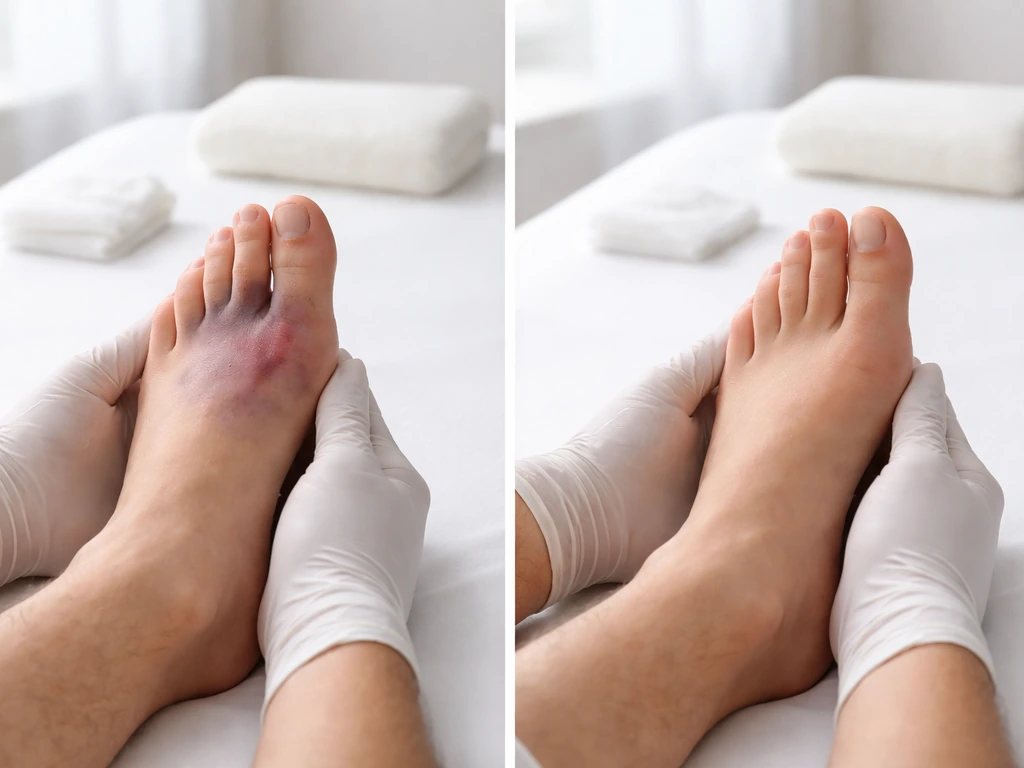
Not every limping bird has a fracture, but it's worth knowing the difference because the urgency level changes. A sprain or minor toe injury might cause some tenderness and reluctance to use the foot, but the foot still looks roughly normal. A broken foot or fractured toe is usually more dramatic.
Look for these signs that point toward a fracture rather than a minor soft tissue injury:
- A toe or the whole foot is rotated at an abnormal angle or visibly bent the wrong way
- Obvious swelling around the foot, toes, or lower leg
- The bird can't stand, bear weight, or perch at all
- You can see a break in the skin or exposed bone (an open fracture)
- The bird holds the foot completely off the ground and won't put it down
Any one of those signs is enough to treat the situation as a fracture. If you're unsure, err on the side of caution. It's also worth knowing that bird broken leg symptoms can overlap with foot injuries, since swelling and weight-bearing problems show up in both. If you see swelling anywhere from the knee down and the bird can't stand normally, get professional help involved quickly.
Immediate first aid: the first 10 minutes matter
Your first job isn't to fix the foot. It's to reduce stress, prevent further injury, and get the bird into a safe holding space. Injured birds go into shock easily, and a panicking bird can make a fracture worse by thrashing. Move slowly, speak quietly, and keep handling to an absolute minimum.
Getting the bird contained
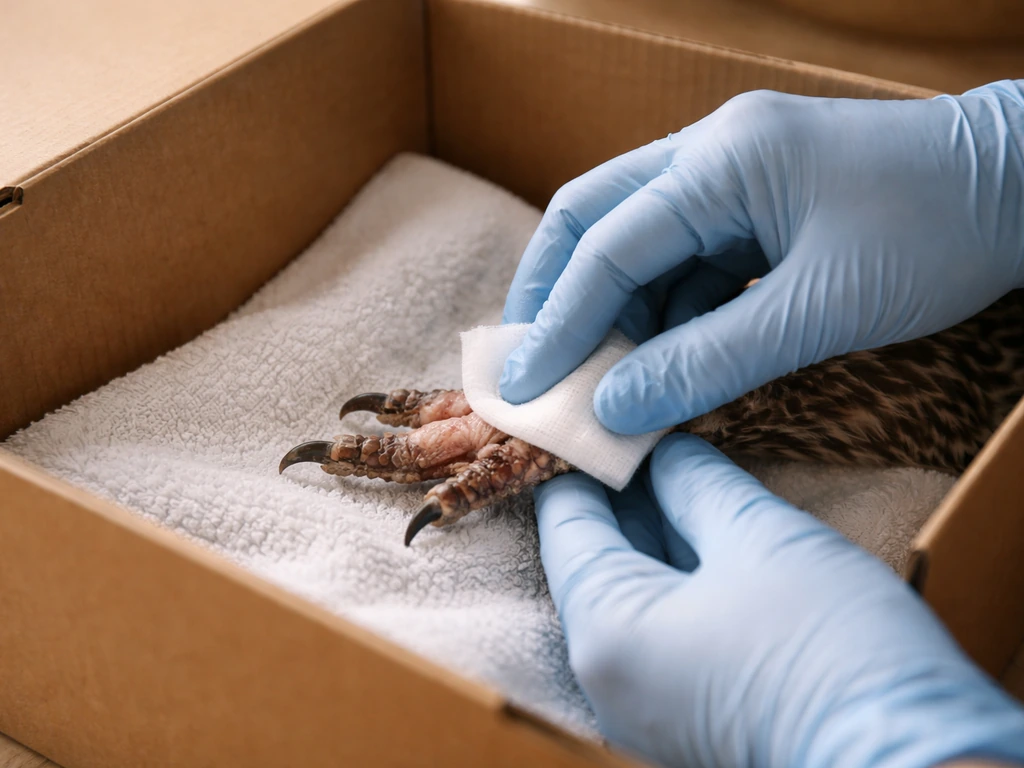
Use a cardboard box with a secure lid and a few small air holes punched in the sides. Line the bottom with a folded towel or a few layers of paper towel to give the bird something soft to rest on. Gently pick the bird up using both hands or wrap it loosely in a small towel to reduce wing flapping, then lower it carefully into the box. Close the lid. Darkness alone calms most birds significantly.
Controlling bleeding
If there's active bleeding from the foot or toes, apply very gentle pressure with a clean cloth or gauze for a few minutes. Don't press hard enough to cause more pain or move the fracture. Don't apply any ointments, antiseptic creams, or wound sprays unless a vet or rehabilitator specifically tells you to. What looks helpful can actually introduce more harm or stress in that fragile window right after injury.
Keeping the bird warm
Warmth is one of the most genuinely useful things you can provide. An injured bird's body temperature drops fast, especially in shock. Fill a hot water bottle with warm (not boiling) water, wrap it in a towel, and place it against one side of the box so the bird can move toward or away from the heat as needed. Never put the bird directly on a heat source, and never use an electric heating pad on high settings directly under the bird.
No food or water right now
This surprises a lot of people, but do not offer food or water while you're waiting for professional help. An injured bird may be in shock and unable to swallow safely. Forcing food or water can cause aspiration, which can be fatal. blank" rel="noopener noreferrer">Keep the box warm, dark, and quiet and leave feeding to the professionals once the bird has been properly assessed.
How to stabilize the foot for transport (and what not to do)
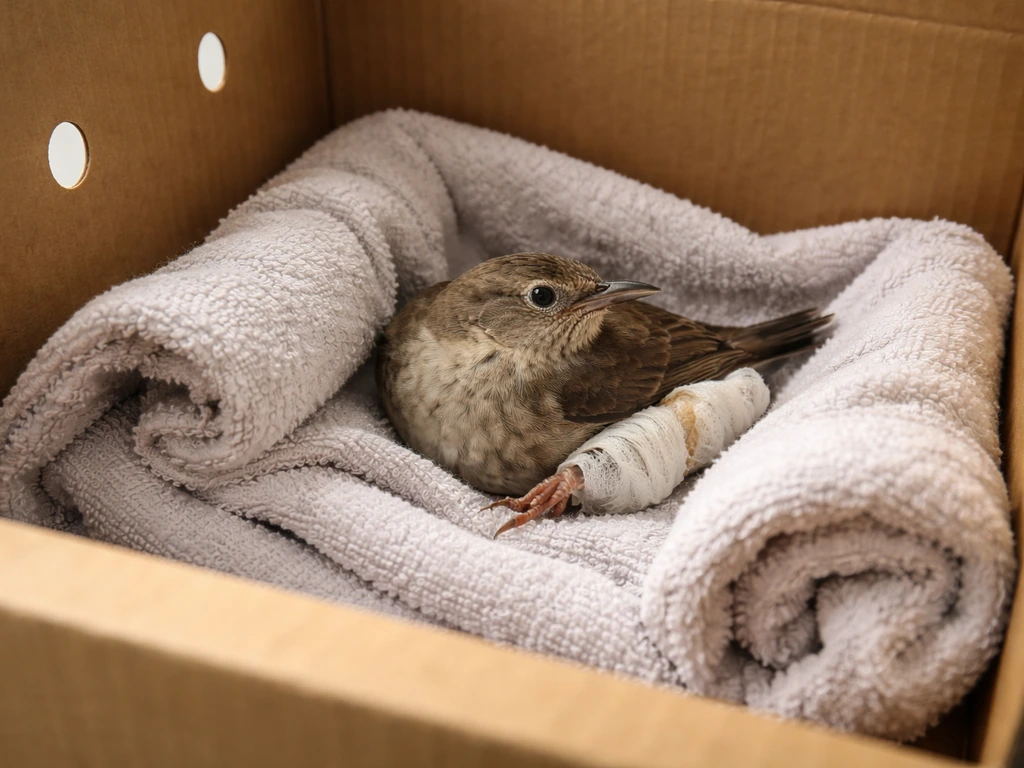
In most cases, the safest form of immobilization for a broken foot during transport is simply keeping the bird still in a padded box. That said, if you need to move a significant distance and a toe is visibly displaced, there is one method that wildlife rehabilitators use for basic toe injuries: buddy taping.
Buddy taping a broken toe
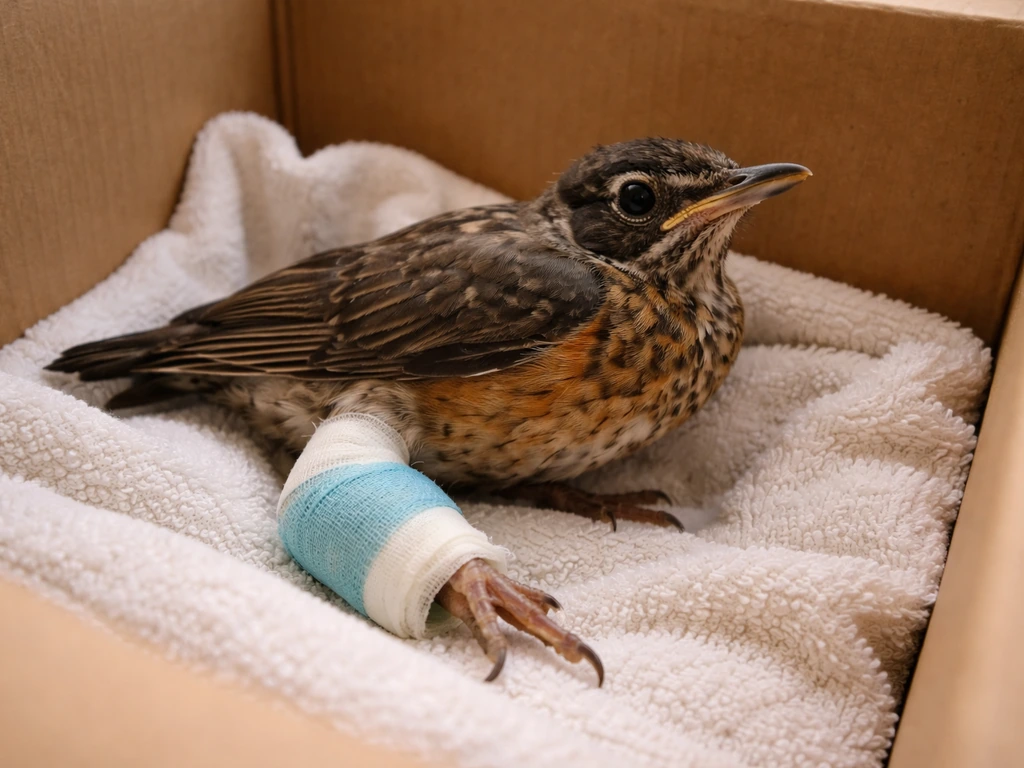
Buddy taping means gently taping the injured toe against the adjacent uninjured toe to give it support and alignment. Use a thin strip of medical tape or first aid tape, and apply it snugly but not tightly. You should be able to slide a fingernail under the tape. The idea is to use the healthy toe as a natural splint, which keeps the fracture from shifting further during movement. This is a short-term measure for transport only, not a treatment.
A proper avian splint, when applied by a professional, follows the principle of stabilizing the joint above and the joint below the fracture site. You shouldn't attempt a full splint at home, but understanding this principle helps explain why buddy taping a single toe has limits: it works for isolated toe fractures but doesn't adequately stabilize foot or ankle fractures.
What you must not do
- Don't try to force the foot or toe back into a normal position
- Don't wrap the foot or leg tightly with bandages or tape that could cut off circulation
- Don't apply any ointment, antiseptic, or home remedy to the wound
- Don't give pain medication of any kind, including human medicines
- Don't let the bird walk around on the injured foot while you're deciding what to do
- Don't place the bird in a water dish or any container where it could get wet if it's unstable
Tight bandaging is one of the most common well-meaning mistakes. If the bandage is too tight, swelling builds underneath it and cuts off circulation to the toes. That can cause tissue death faster than the original injury would have. If you do apply any tape or wrapping, check every 20 to 30 minutes and loosen immediately if you see swelling above the bandage line.
When to get help urgently (don't wait on these)
Some foot injuries need professional care within hours, not days. If any of the following apply, stop reading and make the call to a vet or wildlife rehabilitator right now while you're still on this page:
- You can see exposed bone or the skin is broken over the fracture (open fracture)
- The fracture appears to be right at or very close to a joint
- The bird cannot stand or bear any weight on either foot
- There is severe or uncontrolled bleeding
- The bird also has other visible injuries, such as a wing problem or head trauma
- The bird was injured by a cat or dog (predator saliva causes rapid bacterial infection, even through tiny punctures)
- The bird is a protected wild species, which covers almost all wild birds
That last point about predator attacks is one that people underestimate. A bird that looks fine after a cat grab can develop a life-threatening infection within 24 hours. If you know the injury came from a cat or dog, treat it as an emergency regardless of how the bird appears.
Avian vet vs. wildlife rehabilitator: which one do you need?
For pet birds (parrots, canaries, finches, and similar), contact an avian veterinarian directly. For wild birds, a licensed wildlife rehabilitator is usually the right call because they are trained and legally permitted to treat protected species. Many areas have wildlife rescue hotlines that can direct you to the nearest facility. If you're struggling to find help, the same advice that applies to where to take a bird with a broken wing applies here: try your nearest wildlife rehab center, local animal shelter, or your state or national wildlife agency.
What to expect during recovery
Recovery from a bird foot or toe fracture takes longer than most people expect. Bird bones heal in stages: first a blood clot forms at the fracture site, then soft tissue (soft callus) bridges the gap, then mineralization hardens the callus, and finally remodeling reshapes the bone. Full strength doesn't return until the last stage is complete, which can take several weeks even for small toe fractures.
In clinical practice, a retrospective study of tibiotarsal fractures in birds treated with tape splints found a median time to fracture stabilization of 19 days, with a range of 7 to 49 days depending on the individual bird and fracture type. In most cases in that study, the original splint was kept in place until healing was complete. Toe fractures in small birds may heal faster, but the general principle holds: healing takes weeks, not days.
During recovery, the bird will have limited mobility and will need a confined, safe enclosure to prevent re-injury. A professional will likely apply a proper splint, such as an Altman tape splint or a similar method, and will schedule follow-up evaluations. A key checkpoint: no fracture should go more than 10 days without re-evaluation, including imaging if possible, to confirm proper healing is progressing. If you're managing aftercare for a pet bird at home following veterinary treatment, ask your vet exactly when the next check-in should happen.
Splint monitoring at home (if instructed by your vet) means checking the toes daily for signs of swelling above the tape line, skin abrasion under the tape edges, and any changes in pain response. If the bird suddenly seems more distressed or the foot looks more swollen, contact your vet the same day.
Foot vs. wing injuries: how the approach compares
It's worth quickly comparing foot injuries with wing injuries since they're both common trauma presentations and the first-aid steps differ in a few important ways.
| Factor | Broken Foot/Toe | Broken Wing |
|---|---|---|
| Primary containment goal | Keep bird still, prevent weight-bearing | Keep wing close to body, prevent flapping |
| Buddy taping at home | Possible for isolated toe fractures only | Not recommended without guidance |
| Bleeding risk | Moderate: open fractures can bleed | Moderate to high: wing vessels can bleed significantly |
| Shock risk | High: treat warmth/quiet as priority | High: same warmth/quiet approach |
| Urgency if open fracture | Immediate vet/rehab required | Immediate vet/rehab required |
| Recovery timeline | 7 to 49 days depending on fracture | Varies widely; wing fractures often longer |
If you're dealing with a bird that has both a foot injury and a drooping wing, the approach to handling and transport is the same, but the urgency is even higher. For more detail on wing-specific care, the guidance around bird broken wing treatment covers the professional intervention side in more depth, and it's useful reading even if the foot is your primary concern.
Aftercare at home and stopping the injury from happening again
Once a bird has been treated by a professional and you're managing aftercare, the environment matters enormously. Keep the bird in a warm, quiet space away from household activity, other pets, and loud noise. For wild birds being temporarily housed before transport back to a rehab facility, a quiet room away from children and other animals is ideal. For pet birds recovering at home, lower the perches in the cage so the bird doesn't have to climb or jump, and consider removing any toys or accessories that could cause an awkward landing.
Prevention comes down to identifying the cause. The most common reasons birds end up with broken feet and toes include:
- Window and glass collisions, which cause impact trauma to feet and legs when birds hit the ground or a surface after striking glass
- Cat and dog attacks, which often cause puncture wounds and bone fractures simultaneously
- Falls from nests, especially in young birds whose bones are still developing
- Entanglement in string, netting, or wire, which can fracture toes as the bird struggles to free itself
- Foot-ring or band entrapment in pet birds, where a loose or improperly fitted leg band catches on cage wire
For wild birds, the most effective prevention steps are keeping cats indoors (or supervised when outdoors), applying window decals or screens to reduce collision risk, and checking your yard before mowing or doing garden work during nesting season. For pet birds, regular veterinary checks of leg bands and perch condition go a long way.
It's also worth knowing that some birds use distraction behaviors that can look like injury. The killdeer is a famous example: if you've ever seen what appears to be a bird dragging its wing or limping exaggeratedly near a nest, that's a deliberate distraction display, not a real injury. Read up on the killdeer bird broken wing act before intervening with a bird you think is injured near open ground, because the right response there is to back away rather than pick the bird up.
A quick recap: your action steps right now
- Contain the bird gently in a ventilated cardboard box lined with a soft towel
- Keep the box warm, dark, and quiet: use a wrapped hot water bottle against one side
- Do not offer food or water
- If there's bleeding, apply gentle pressure with clean gauze; don't use ointments
- If the toe is clearly displaced and you're transporting a significant distance, consider gentle buddy taping only for isolated toe fractures
- Call a wildlife rehabilitator (for wild birds) or avian vet (for pet birds) as soon as possible
- If you see an open fracture, can't stop bleeding, or the bird was attacked by a predator, treat it as an emergency and make the call immediately
The honest truth is that a broken foot is not something you can fully treat at home, but you can absolutely give this bird a much better chance by handling those first steps correctly. Warmth, darkness, quiet, and fast access to professional care are the things that make the real difference. You're already doing the right thing by finding out what to do first.
If you found this bird and it also has a wing that looks wrong, the guidance for a found bird with a broken wing will give you the same calm walkthrough for that specific injury. And if you want to understand the full picture of what a vet will do and how long recovery realistically takes, the bird broken wing healing time article covers the staged healing process in detail, which applies broadly to avian fractures including foot injuries. For a more general overview of how to respond when you first encounter a wing-injured bird, what to do with a bird with a broken wing walks through the same first-response framework from the start.
FAQ
Can I use a splint or cast I have at home to stabilize a bird’s broken foot or toe?
You should not. A proper avian splint typically stabilizes the joint above and below the fracture site, which is hard to reproduce safely at home. For toe-only injuries during transport, buddy taping may be acceptable, but full splinting or casting at home can trap swelling or shift the fracture.
What if the bird’s foot is not bleeding but it still cannot stand?
Treat it as a fracture until a professional says otherwise, because displacement and internal damage can occur without open wounds. Keep the bird warm, dark, quiet, and contained, then contact a wildlife rehabilitator or avian vet as soon as possible.
How tight is too tight if I buddy tape a toe for transport?
It should be snug but not compressive. You should be able to slide a fingernail under the tape, and you should check for swelling regularly. If toes look more puffy above the tape line or the bird seems more distressed, remove the tape and get professional guidance.
Is it safe to try to “reset” a visibly crooked toe or foot?
No. Do not attempt to straighten or manipulate a displaced toe or foot at home. Any realignment attempt can worsen tissue damage, increase pain, or shift the fracture further.
Should I cover the bird with a towel to keep it still?
Covering can be calming, but avoid restraining the bird tightly or wrapping in a way that adds pressure on the injured foot. Use the towel only to gently limit wing flapping during placement into the container, then leave the bird inside the box with minimal handling.
Do I need to stop the bleeding quickly with strong pressure?
Only use gentle pressure for a few minutes if there is active bleeding, just enough to slow bleeding. Pressing hard or holding pressure for long periods can cause extra pain and may move the fracture.
Can I give pain medication I have at home?
Do not. Human painkillers can be dangerous for birds, and dosing is species-specific. Focus on warmth, darkness, quiet, containment, and professional care instead.
What container is best for transport, and should I use a ventilated cage?
A secure cardboard box with a lid is usually safest because it reduces movement and keeps the bird calmer. Punch a few air holes, line the bottom with soft absorbent material, and avoid an open cage that lets the bird walk or flap during transport.
How warm should the hot water bottle be?
Use warm water, not boiling. Wrap it in a towel and place it to one side of the box so the bird can move toward or away from the heat as needed. Never place the bird directly on the hot surface or use a high setting that could overheat it.
If the bird is a pet and I cannot reach a vet immediately, what is my safest interim plan?
Keep the bird in a warm, dark, quiet container, do not offer food or water, and minimize handling. Arrange urgent communication with an avian veterinarian or emergency clinic, and be ready to describe the injury cause (trauma, fall, pet/cat encounter) and whether there is swelling or visible displacement.
When do I consider the situation an emergency even if it seems stable?
Treat it as urgent if the injury came from a cat or dog, if there is significant swelling from the knee down or the bird cannot bear weight normally, or if you suspect a fracture based on deformity, open wound over the toes, or a foot that looks misaligned. Infection risk after predator contact can become life-threatening quickly.
Can I release a found bird after it seems to be walking better?
No. Apparent improvement can hide ongoing fracture or damage, and unstable healing can restart problems. A bird with a fracture should not be released until it is evaluated and cleared by a wildlife rehabilitator or avian vet.
How often should the bird be rechecked during recovery?
A fracture should not go more than about 10 days without professional re-evaluation, including imaging if possible. If you were instructed to monitor at home, check daily for swelling above tape edges, skin abrasion, and any increase in pain or distress.
What should I watch for after professional treatment or taping that means “call the same day”?
Call the same day if the foot suddenly looks more swollen, the bird seems more distressed or unusually painful, the skin under tape edges shows abrasions, or you notice circulation-like changes such as increased swelling above the tape line.