If your dog just killed a bird, here is what to do right now: secure your dog, protect yourself before touching anything, then check whether the bird is actually dead or just stunned. From there, the steps depend on what you find. This guide walks you through all of it, including what to do if there is any chance the bird is still alive, when to call for professional help, and how to make sure this does not happen again.
My Dog Killed a Bird: What Should I Do Next?
Marcus Chen
17 Apr 2026
First things first: secure everyone and protect yourself
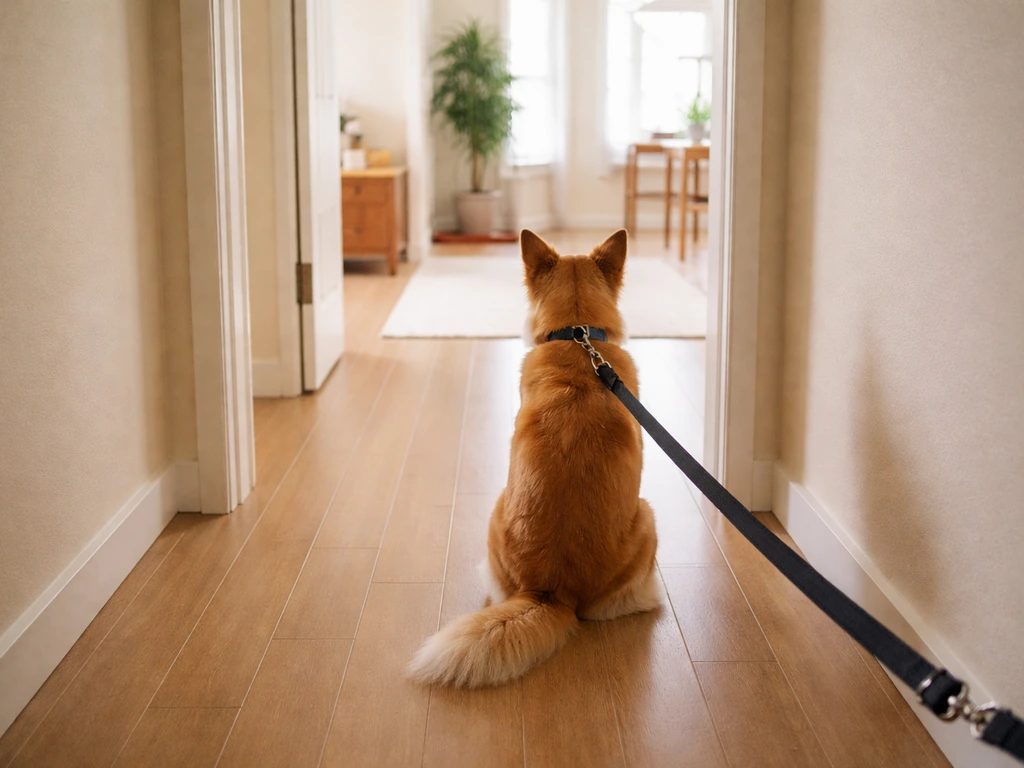
Before anything else, get your dog away from the bird and put them somewhere secure, inside or on a leash. Even the calmest dog can go back for the bird, and you need them out of the picture while you assess. If you have other pets nearby, move them too. A second dog or a cat nearby will only add stress to the situation, and if the bird is alive, that stress can kill it.
Next, protect yourself. Bird carcasses and attack scenes can carry bacteria and viruses, and dog saliva is no exception. Put on rubber or medical examination gloves before you touch the bird, the ground around it, or anything the dog had in its mouth. The CDC recommends gloves and minimal contact when handling animals or materials that may be contaminated with animal fluids. If you touched the bird or the scene bare-handed before reading this, wash your hands immediately with soap and running water. The CDC specifically recommends handwashing with soap and running water after any contact with birds or their droppings.
If the dog has blood or feathers on its fur, you can use mild liquid dish soap (not dishwasher detergent) for a gentle rinse, which is what the ASPCA recommends for dermal decontamination after animal exposures. If you have any open cuts or broken skin that came into contact with animal fluids during the cleanup, wash that area with soap and running water for at least 20 minutes, which is the CDC's recommended protocol for reducing infection risk from animal body fluid exposure. If the wound is significant or was caused by a bite, Mayo Clinic advises seeking medical attention depending on the severity.
Is the bird actually dead? How to check
This is the step most people skip, and it matters a lot. Birds can appear completely dead when they are actually in shock or unconscious. A bird that was just attacked may be limp, unresponsive, and still, and still be alive. Before you assume the worst, take 30 seconds to look more carefully.
Look for breathing first. Even very shallow chest movement counts. An injured bird in shock may have irregular or labored breathing, including open-mouth breathing or a slight rise and fall you can barely see. Watch for 15 to 20 seconds before concluding there is none. You can also look for a corneal reflex by very gently passing your fingertip close to (not touching) the eye: a living bird will usually blink or react. Absence of any reflex, breathing, or warmth in the body are the clearest signs that the bird has died.
If you are not sure, treat the bird as alive. A bird that looks dead but has any warmth, slight movement, or reaction should be handled as a potential survivor. Shock is one of the primary killers of injured wildlife, and it can make a living bird look completely gone. The good news is that the early response to shock, which is warmth, darkness, and quiet, costs you nothing to provide.
Safe handling and containment
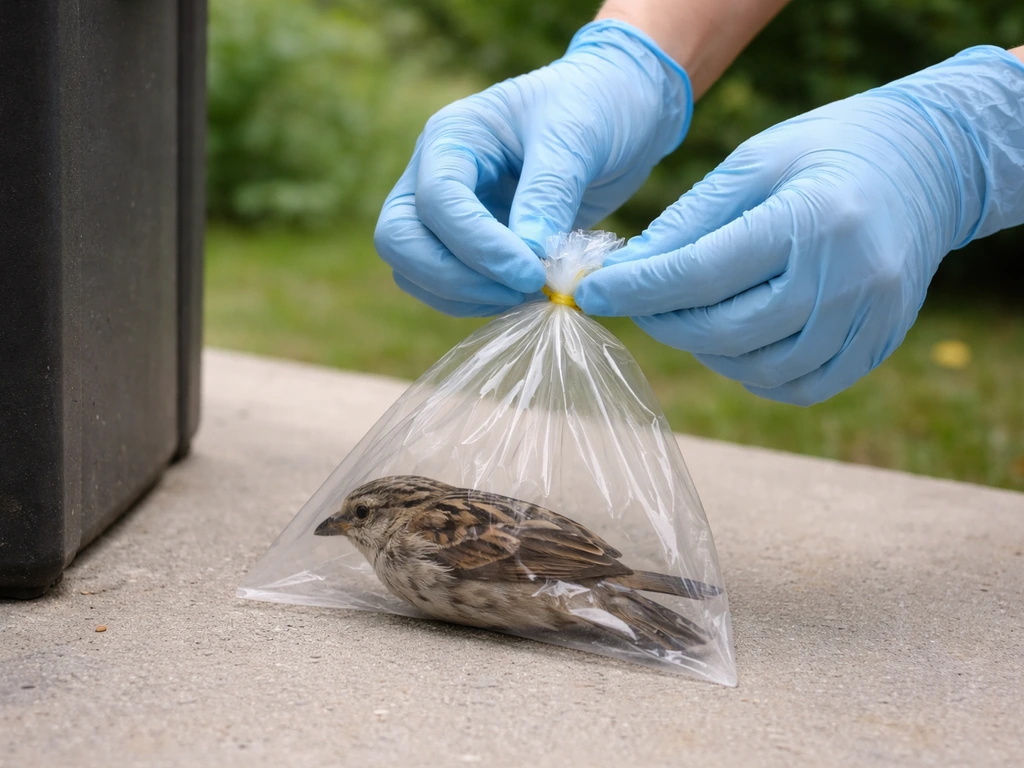
If the bird is dead, use gloves to place it in a sealed plastic bag and dispose of it in an outdoor trash bin. You do not need to bury it, and you should not leave it where your dog (or another animal) can return to it. Clean the surrounding area, especially if there is blood, and wash your hands thoroughly afterward.
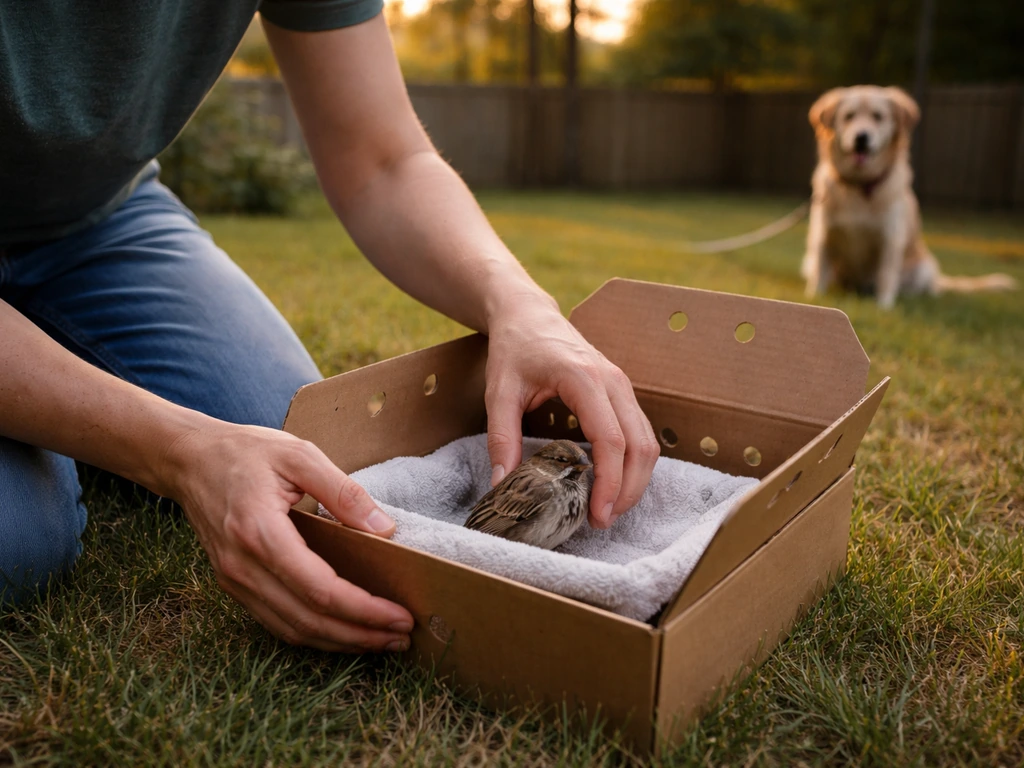
If the bird may be alive, your job right now is containment, not treatment. The safest first step, as the American Bird Conservancy puts it, is to get the bird off the ground and into a secure container. Use gloves, move slowly, and scoop the bird gently into a cardboard box lined with a soft cloth or paper towels. A shoebox with air holes punched in the lid works well. Do not hold the bird in your hands any longer than you have to, and do not put it in a wire cage where it can injure itself further.
Once the bird is in the box, put the lid on and place it somewhere warm, dark, and completely quiet. A closet, a laundry room with the door shut, or a bathroom works. Keep pets and children away. Do not peek inside every few minutes. Do not talk loudly near the box. Human noise, eye contact, and touch are all stressors for a wild bird, and stress alone can cause a bird to die in your hands.
Here is a critical rule that almost everyone gets wrong: do not offer food or water. American Bird Conservancy also advises that you should keep an injured bird in a dark, quiet place and not provide food or water. Audubon also instructs that you should not attempt to give an injured raptor food or water and instead transport the bird to a wildlife rehabilitator [do not offer food or water.
](https://www. audubon. org/cbop/get-involved/how-help-sick-or-injured-raptor). Multiple wildlife rehabilitation organizations, including Wings of the Dawn, Sea Biscuit Wildlife Shelter, and Wild Nest Bird Rehab, all say the same thing: no food or water until a professional tells you otherwise.
An injured bird may not be able to swallow safely, and forcing water on an unstable bird can cause aspiration. If you see any scenario where the bird is wobbly or cannot hold its head up, do not place a water dish in the box at all.
Basic first aid for a potentially injured bird
Your actual first aid job here is minimal, and that is not a bad thing. The best thing you can do for a bird that has been attacked by a dog is reduce its stress and keep it warm while you get professional help lined up. Wildlife rehabbers say this repeatedly, and it is true: a dark, quiet box is treatment. Shock kills injured birds fast, and warmth and stillness can buy critical time.
If the room is cold, you can place a heating pad on the lowest setting under half of the box (never the whole bottom, so the bird can move away from heat if needed). A small hand warmer wrapped in a cloth works too. The goal is ambient warmth, not heat. You are not trying to warm the bird directly.
Do not try to splint a wing, bandage a wound, or administer anything orally. Beyond the warmth-and-quiet protocol, how to treat a bird attacked by a dog is genuinely a job for someone trained in avian care. Dog bites, even small ones, can drive bacteria deep into tissue, and a bird that looks fine externally may have internal injuries or puncture wounds you cannot see. This is why getting professional eyes on the bird matters even when it seems okay.
Signs that mean you need help urgently
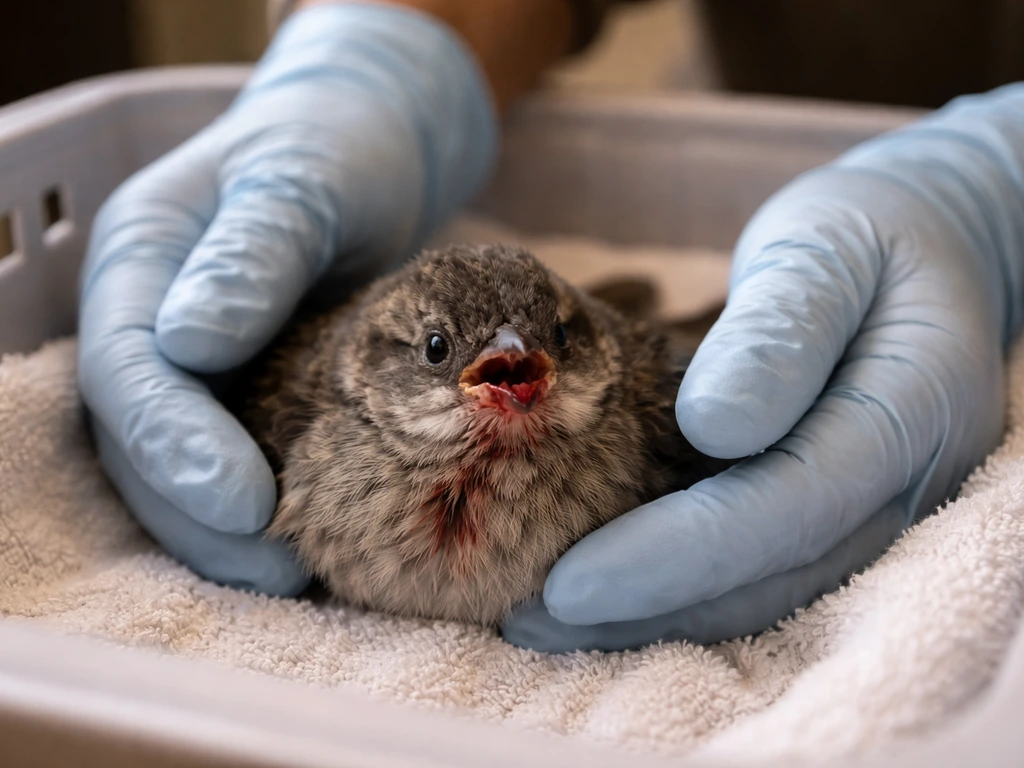
Some situations require a call to a wildlife rescue or avian vet right now, not after you finish reading this. If the bird is showing any of the following, stop and make the call first.
- Labored, open-mouth breathing or wheezing
- Active bleeding that is not slowing down
- A visibly broken wing or leg (bone through skin or limb hanging at a wrong angle)
- Seizure-like movements or inability to hold its head up
- Complete unresponsiveness with no visible breathing
- The bird was in the dog's mouth for more than a few seconds (puncture wounds are almost certain)
Even if none of those apply, any bird that was directly caught or bitten by a dog should be seen by a rehabilitator. Dog saliva contains blank" rel="noopener noreferrer">Pasteurella bacteria, which is lethal to birds and can cause fatal septicemia within 24 to 48 hours of exposure, even when a bite leaves no visible mark. This is not a wait-and-see situation. If you are reading this because your dog attacked a bird, getting the bird to a rehabber is always the right call.
How to find local help and what to tell them
Wildlife rehabilitators are licensed professionals who handle exactly this kind of situation. Finding one near you is easier than most people expect. The fastest option is Animal Help Now (ahnow.org), which lets you click "wildlife emergency" and search for the closest rehabber by location. The National Wildlife Rehabilitators Association also has a member search directory you can filter by state. Your state's fish and wildlife agency (like New York's DEC) usually maintains its own searchable list of licensed rehabilitators as well. If you are stuck and cannot find anyone immediately, call a local veterinary clinic: many have contacts for wildlife referrals even if they do not treat wild birds themselves.
When you call, be ready to give them: the approximate species or a description ("small brown songbird," "pigeon," "mourning dove"), where the attack happened (your yard, a park, your neighborhood), what time it happened, how the dog made contact (caught it, shook it, had it in its mouth), and what the bird is doing now. This information helps the rehabilitator triage and give you specific interim instructions. As you wait, keep following the warm-dark-quiet protocol. Do not release the bird outside, even if it seems to have recovered. How to help a bird that has been attacked always includes a professional assessment, because a bird that looks fine can still be injured internally.
If for any reason you cannot reach a rehabber quickly, Audubon notes that a wildlife rehabilitation center is the right destination for any bird that appears inert but possibly alive, and that is your target. Cornell's Janet L. Swanson Wildlife Hospital is one example of a dedicated veterinary hospital set up specifically to treat injured and ill wild animals, and many university vet schools have similar programs. They are worth a call if local rehabbers are not answering.
If the dog ate part of the bird
This situation adds a layer of concern for your dog. If your dog consumed any part of the bird, the bird's bones, feathers, or organs can cause problems ranging from mild GI upset to intestinal blockage or parasite exposure. For a full breakdown of what to watch for and when to call your vet, my dog ate a bird, what do I do covers the dog-health side of this scenario in detail.
Prevention: how to keep this from happening again
Most people feel genuinely bad after their dog kills a bird, and that response is worth channeling into some concrete changes. The core issue is that prey drive in dogs can override even solid recall training once a chase is underway. The AKC notes directly that prey drive can kick in so fast that a dog with good obedience may not respond to a recall once it has locked onto something. That is not a training failure; it is biology. Management is the practical answer.
The Florida Fish and Wildlife Conservation Commission recommends walking dogs on a non-retractable leash of 6 feet or less, especially at dawn, dusk, and night when birds are most active and vulnerable. Colorado Parks and Wildlife adds that even a fenced yard is not a guarantee, since birds land inside fences regularly. The most effective prevention is keeping your dog under direct control whenever they are outside, which means leash or supervised enclosure, full stop.
Research from the University of Illinois Extension shows that even well-behaved leashed dogs reduce bird density in an area, because birds recognize dogs as predators and flee proactively. That gives you a sense of the scale of impact. Keeping your dog close is not just about your yard; it affects the birds in your whole neighborhood. Wildlife Illinois reinforces this with a straightforward recommendation: pets should be on a leash or inside a fenced enclosure whenever they are outdoors, even if they are well-trained.
If your dog has a strong prey drive and has now caught a bird, that behavior is likely to repeat if given the opportunity. Working with a trainer on impulse control and strengthening recall is worthwhile, but realistic management (leash, supervision, no unsupervised yard time during high bird activity) is what actually prevents the next incident while training is in progress. Understanding how to address hard-mouth behavior in dogs can also help if your dog is prone to gripping and shaking birds or small animals.
A quick comparison: what to do based on what you find
| What you find | Immediate action | Next step |
|---|---|---|
| Bird is clearly dead, no movement or warmth | Gloves on, bag and dispose of bird, clean area | Wash hands thoroughly; no further bird care needed |
| Bird appears stunned or is breathing faintly | Box it up (warm, dark, quiet); no food or water | Call a wildlife rehabber now; transport if directed |
| Bird has visible injuries (broken wing, bleeding) | Contain carefully; do not attempt to treat | Call rehabber or avian vet immediately; this is urgent |
| Dog had the bird in its mouth (bite likely) | Contain bird even if it looks okay | Rehabber call is essential: Pasteurella risk within 24-48 hours |
| Dog ate part or all of the bird | Bird care may not apply; focus on dog health | Call your vet to discuss what the dog consumed |
What to do while you wait for help
Once you have the bird contained and a rehabber on the way or on the phone, your job is to leave the bird alone. That is genuinely the most helpful thing you can do. No checking, no showing others, no trying to comfort it. A bird in a warm, dark, quiet box has the best possible chance of surviving until professional help arrives. That is the whole protocol, and it works.
If you are not sure whether what your dog did counts as "caught" versus something more serious, my dog caught a bird, what do I do and bird attacked by dog, what to do both cover the full range of contact scenarios and give you specific guidance for each. And if you want a detailed walkthrough of the dog-health side of a bird encounter, what to do if your dog eats a bird has that covered too.
The bottom line: secure your dog, glove up, check the bird carefully, contain it if there is any chance it is alive, and call a wildlife rehabber. You do not need to be an expert to do all of that right now, and doing it right gives the bird its best shot.
FAQ
What if I cannot find the bird after my dog killed or caught it?
If you think the bird flew away after your dog grabbed it, do a quick check nearby while the dog is secured. Birds that are injured often hop rather than fly, and they can collapse within minutes. Keep pets inside or on leash, then call a wildlife rehabber if you find the bird unable to fly, sitting very still, or breathing with effort.
My dog is still holding the bird in its mouth, what should I do?
If your dog is still chewing or carrying the bird, only remove the bird after you have fully secured your dog. Use a leash or keep the dog behind a barrier, then use gloves to handle anything contaminated. Avoid reaching into your dog’s mouth with bare hands, even if you think it will let go.
I did not touch the bird, but my dog’s blood or saliva got on me. Do I still need to clean up?
Yes, if you never touched the bird but your dog got saliva or blood on you (shoes, pants, skin), treat it as possible contamination. Change or launder clothing, wipe shoes, then wash exposed skin with soap and running water. If any saliva got into an open cut, clean it thoroughly and consider calling a clinician if you have symptoms like redness, swelling, or fever.
Can I give the bird food, water, or a home remedy to help it recover?
Do not give any medication, vitamins, or “bird safe” home remedies. Also avoid de-stressing attempts like covering the box with a blanket in a way that traps heat or blocks airflow. The safest approach is warmth (ambient), darkness, quiet, and minimal handling while you contact a wildlife rehabber.
What should I do if the bird is severely injured and won’t stay in a box?
If the bird is bleeding heavily, appears to be actively dying, or you cannot safely contain it (for example, it keeps escaping), call a wildlife rehabber immediately and keep your dog secured and away. Do not attempt to stop bleeding or stitch anything. Your job is to prevent further predation and keep the bird as calm as possible until professionals advise next steps.
How do I use a heating pad correctly, and when should I stop using it?
A heated pad is only for ambient warmth, use the lowest setting and place it under half the container so the bird can move away. Stop if the area becomes hot or if the bird seems overheated (panting or very restless behavior). If your home is warm, you may not need a heating pad at all.
What if the bird was attacked near chemicals, bait, or a busy road?
If the bird was caught in an area with pesticides, rodent poison bait, lawn chemicals, or heavy pollution, mention that to the rehabber. Put the bird in a lined box as usual, but avoid additional cleaning that could spread contaminants, and do not rinse the bird with water.
Does this affect my dog too if the bird bit or scratched my dog?
If you suspect your dog was bitten back (for example, there was blood from the bird’s beak area, or your dog has new mouth wounds), contact your veterinarian. Dog saliva, bird bacteria, and puncture wounds can all lead to infection. Do not let the dog lick the area while you wait, and clean any external wounds with mild soap and water if accessible and safe.
I can’t reach a wildlife rehabber right away, what’s the best backup option?
If you cannot find a wildlife rehabber quickly, call a local veterinary clinic for wildlife referral guidance or an emergency triage line (some hospitals have wildlife contacts). If the bird is possibly alive but you are waiting on instructions, keep the warm-dark-quiet setup and minimize handling. Do not release it outdoors to “see if it recovers.”
What symptoms should make me call a vet for my dog, or a doctor for me?
For the dog, call your vet if there are any signs of illness or injury after the incident, especially if your dog ate part of the bird (vomiting, diarrhea, decreased appetite, lethargy) or if you notice oral bleeding or swelling. For people, watch for fever or redness at any exposed cuts, especially if you handled the scene without gloves before washing.