
Yes, a bird can survive a broken leg, but survival depends heavily on how quickly it gets proper care, what kind of fracture it is, and whether complications like infection or shock set in. A clean fracture on a small bird that reaches a wildlife rehabilitator or avian vet within a few hours has a genuinely good chance of recovery. An open fracture (where the bone is poking through the skin), a fracture near a joint, or any break left untreated for more than a day or two becomes a much more serious situation. The short answer is: don't wait and see. Act now.
Can a Bird Survive a Broken Leg? First Aid and Next Steps
Marcus Chen
9 Apr 2026
Can a bird with a broken leg still fly?
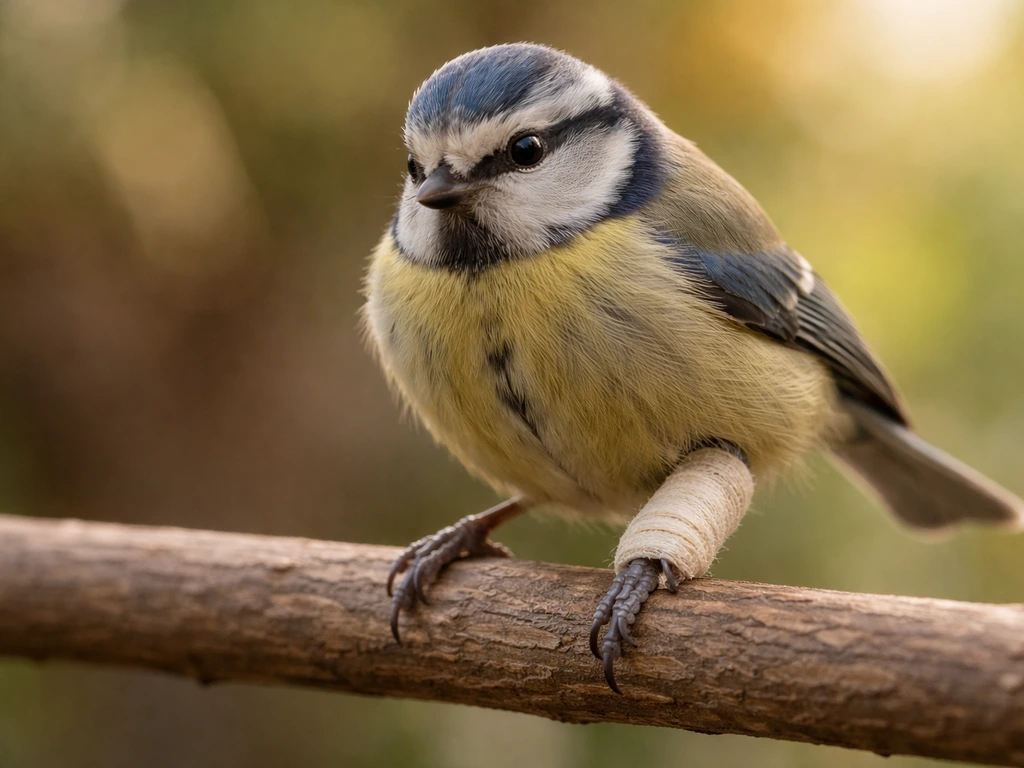
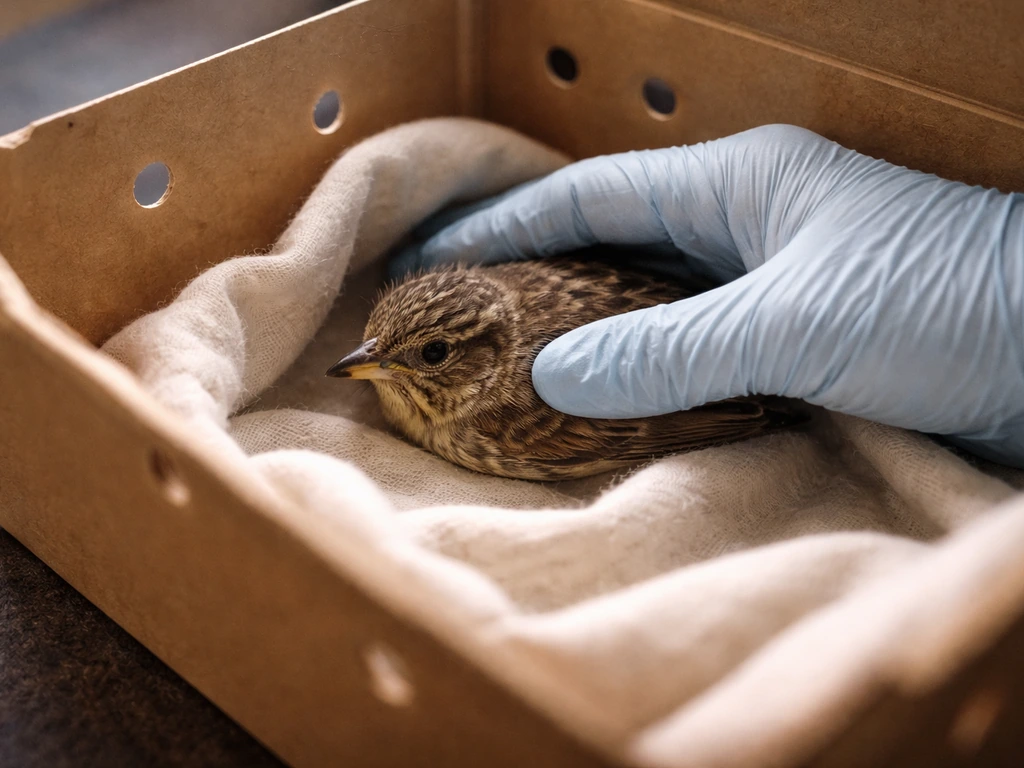
This surprises a lot of people, but flight and leg function are more connected than they look. A bird needs its legs to launch, land, and grip a perch. When a leg is broken, the pain and instability usually stop the bird from attempting a normal takeoff. You might see it flapping but not getting off the ground, hopping awkwardly on one leg, or just sitting very still on the ground. That stillness is a warning sign, not a sign it's okay.
That said, some birds will still manage short, desperate bursts of flight even with a broken leg, especially if they feel threatened. Don't interpret a bird flying a few feet as a sign it's fine. As the American Bird Conservancy points out, a bird that looks like it might be able to fly away can still have an injury that will eventually kill it without treatment. If you're seeing any limping, dragging, or unusual posture, treat it as a real emergency regardless of whether the bird took flight for a moment.
When a broken leg becomes life-threatening
A broken leg alone won't always kill a bird outright, but several things that follow the injury can. Here's what turns a survivable fracture into a fatal one:
- Shock: Any major trauma puts a bird into shock almost immediately. A bird sitting fluffed on the ground, refusing to move, eat, or drink is showing classic shock symptoms. Without warmth and calm, shock alone can be fatal within hours.
- Infection from an open fracture: If the bone has broken through the skin, bacteria get in fast. Open fractures need antibiotic treatment urgently, and without it, infection spreads quickly in a small bird's body.
- Inability to eat or drink: A grounded bird can't forage. Small birds especially have almost no fat reserves. Depending on species, a bird unable to feed itself can decline critically within 24 to 48 hours.
- Predation: A bird stuck on the ground with a broken leg is an easy target for cats, dogs, raccoons, and hawks. Even a temporary inability to escape can be fatal.
- Dehydration: Combined with shock and an inability to reach water, dehydration compounds rapidly and can cause organ failure in a small bird within a day.
- Fracture near a joint or a compound (open) fracture: These have a grave prognosis even with veterinary care. A dislocated or luxated fracture near a joint is considered a serious emergency by avian rehabilitation guidelines, and euthanasia may sometimes be the most humane outcome.
One thing that catches people off guard: birds are experts at hiding how sick or hurt they are. It's a survival instinct, and it means a bird that looks only mildly affected could be in serious trouble. How fast a bird can die from a broken wing gives a useful parallel here, because the same rapid deterioration timeline applies to untreated leg fractures.
What to do right now: immediate first aid steps
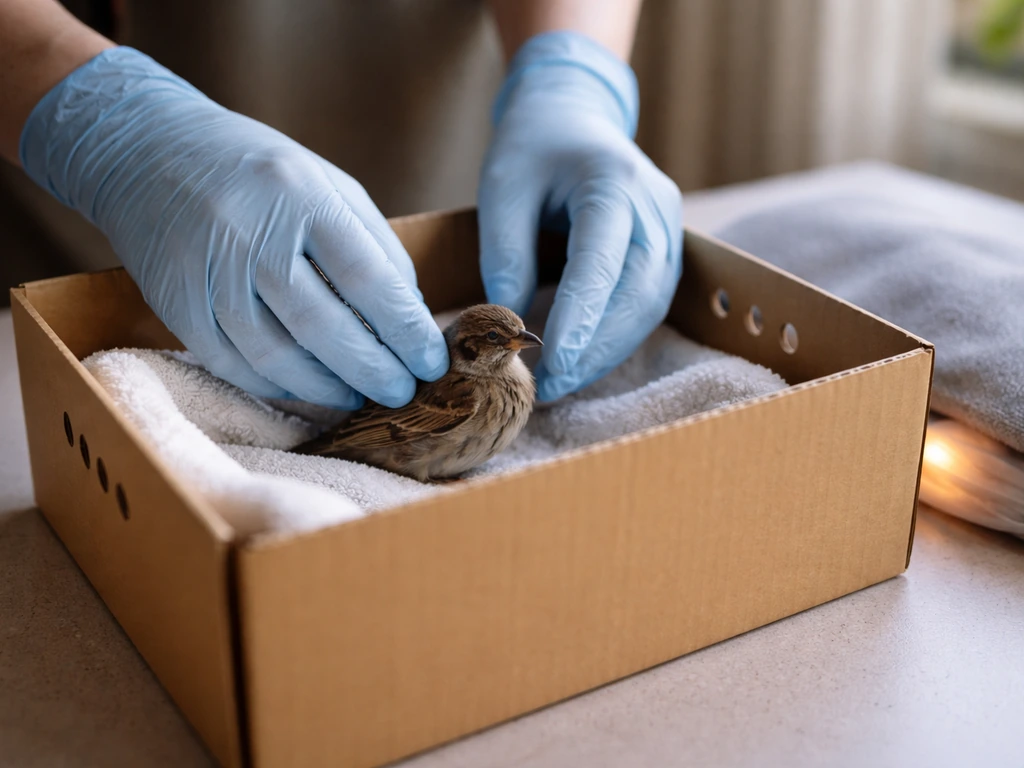
Your goal in the first 30 minutes is containment, warmth, calm, and getting the bird to a professional as fast as possible. You are not trying to fix the leg yourself. Here's exactly what to do:
- Protect yourself first. Use gloves or a folded cloth. Even small birds can scratch or bite when scared and in pain.
- Gently wrap the bird in a light cloth or small towel. Drape it loosely over the bird from above, covering its eyes, then scoop it up. Covering the eyes reduces panic, and the wrap keeps the wings and legs from flailing and causing more damage.
- Place it in a cardboard box with air holes. Line the bottom with a folded cloth or paper towels. Do not use a wire cage or a container where the bird can flap against hard surfaces.
- Keep it warm. Place the box in a warm room (around 85 to 90°F is ideal for a shocked bird). If it's cold outside and you have no warm room, you can place a hot water bottle wrapped in a cloth under half the box so the bird can move away from the heat if needed. Never apply direct heat.
- Keep it dark and quiet. Put the box somewhere quiet, away from pets, children, and loud noise. No peeking every five minutes. Stress from handling is itself a shock trigger.
- Do not offer food or water. This is counterintuitive but important. Force-feeding or offering water to a bird in shock can cause aspiration or make things worse. Both the USFWS and wildlife emergency services explicitly say do not offer food or water while the bird is in crisis.
- Call a wildlife rehabilitator or avian vet immediately. This is step one, not step seven. Make the call while you're setting up the box. Don't wait until morning if it's the evening.
What about the broken leg itself during transport?
Unless you have been trained in avian first aid, do not attempt to splint or wrap the leg yourself. Improper immobilization can cut off circulation, worsen the fracture, or cause the bird to struggle harder and injure itself more. A licensed rehabilitator or avian vet can apply proper coaptation splints or external fixation once the bird is stable enough. Your job is safe containment, not field surgery.
If the fracture is open and you can see bone, keep the exposed area moist by gently covering it with a clean, damp cloth. Do not probe it, clean it with hydrogen peroxide, or apply anything oily or thick. Get to professional care as fast as possible.
Mistakes that make things much worse
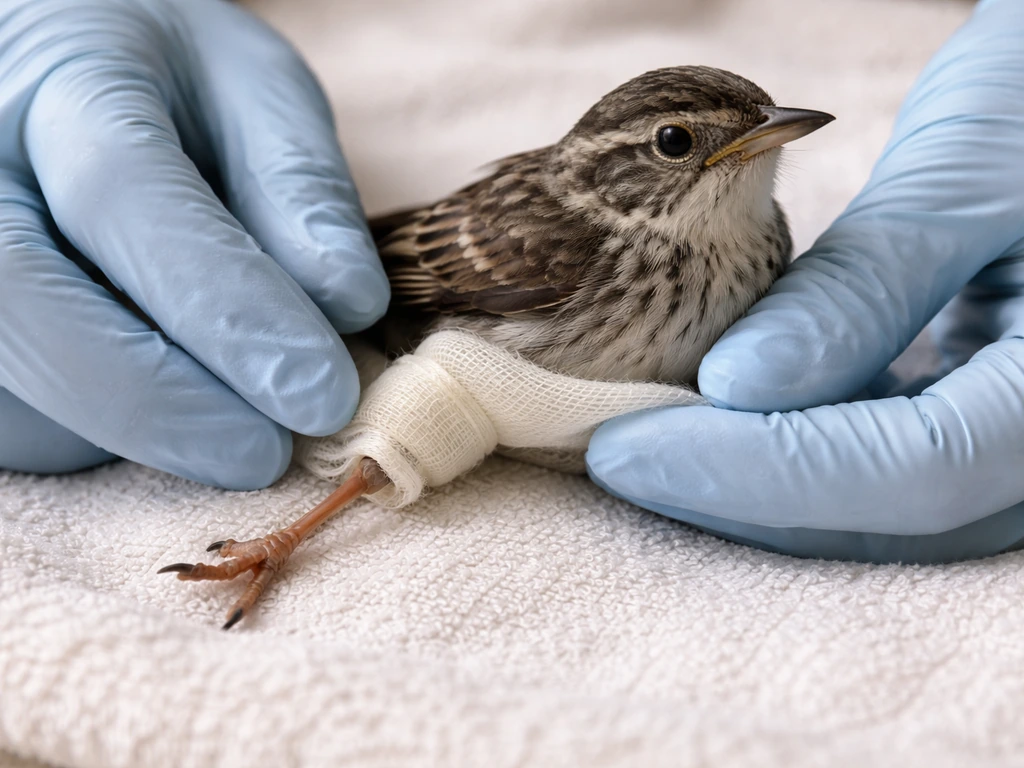
I've seen well-meaning people accidentally harm birds more than the original injury did. Here are the most common mistakes to avoid:
- Trying to set or splint the leg without training. Even a correctly placed improvised splint can apply uneven pressure and damage tissue or blood flow.
- Giving food or water. A bird in shock cannot safely swallow. Forcing liquid especially can go into the lungs.
- Keeping the bird somewhere bright, noisy, or with other animals around. Stress triggers secondary shock on top of trauma shock.
- Handling the bird repeatedly to check on it. Every time you open that box, you're causing a stress response. Set it up right once, then leave it alone.
- Applying antiseptic sprays, hydrogen peroxide, or oily substances to wounds. These can damage tissue and cause more harm than the wound itself.
- Assuming it just needs rest and leaving it outside. A grounded bird with a broken leg will not heal on its own in the wild. It will be eaten, starve, or die from infection.
- Waiting too long. The first 2 to 4 hours matter enormously. Don't delay calling for help while you research online.
When you need professional help urgently, not tomorrow
Some situations are clear emergencies that can't wait. Contact a wildlife rehabilitator or avian vet immediately if you see any of the following:
- Bone is visibly protruding through the skin (open/compound fracture)
- Active bleeding that isn't stopping
- The bird is completely unresponsive or unconscious
- The bird is sitting flat on the ground, eyes closed, unresponsive to approach
- The leg appears dislocated at the joint rather than just fractured mid-bone
- The bird is a large species (raptor, heron, goose) as these require specialist handling
- The bird is a protected migratory species, which has specific legal handling rules
For open fractures specifically, the prognosis is serious and sometimes a humane euthanasia decision is the kindest outcome. That's not a failure on your part; it's exactly why getting a professional assessment quickly matters. A vet can make that call, and you can't do it from a visual inspection alone.
To find help fast: search for a licensed wildlife rehabilitator in your state or province, or call your nearest animal emergency clinic and ask for a referral to someone who handles birds. The USFWS and most state wildlife agencies maintain online directories. USFWS describes migratory bird rehabilitation as involving a permitting framework with federal requirements and potential additional state permits blank" rel="noopener noreferrer">the USFWS and most state wildlife agencies maintain online directories.. If you're in the US, the Wildlife Rehabilitators Association of North America (blank" rel="noopener noreferrer">NWRA) finder is a solid starting point.
Wild bird vs. pet bird: does it change what you do?
Mostly the immediate steps are the same: contain, warm, calm, get to a professional. But there are some important differences. For a wild bird, you are legally required in most US states to hand the bird to a licensed wildlife rehabilitator rather than keep and treat it yourself. Wild birds are protected under the Migratory Bird Treaty Act, and attempting home treatment beyond basic containment is not allowed for most species.
For a pet bird, your avian vet is the right call. Pet birds (parrots, cockatiels, finches, etc.) have the advantage of an established care relationship and veterinary records, which helps the vet make faster, better decisions. The fracture treatment options for pet birds are also broader because amputation or long-term splinting is a viable path, whereas for wild birds, the ability to return to full function in the wild is often the threshold for treatment vs. euthanasia decisions.
Is it a fracture or a sprain? How to tell
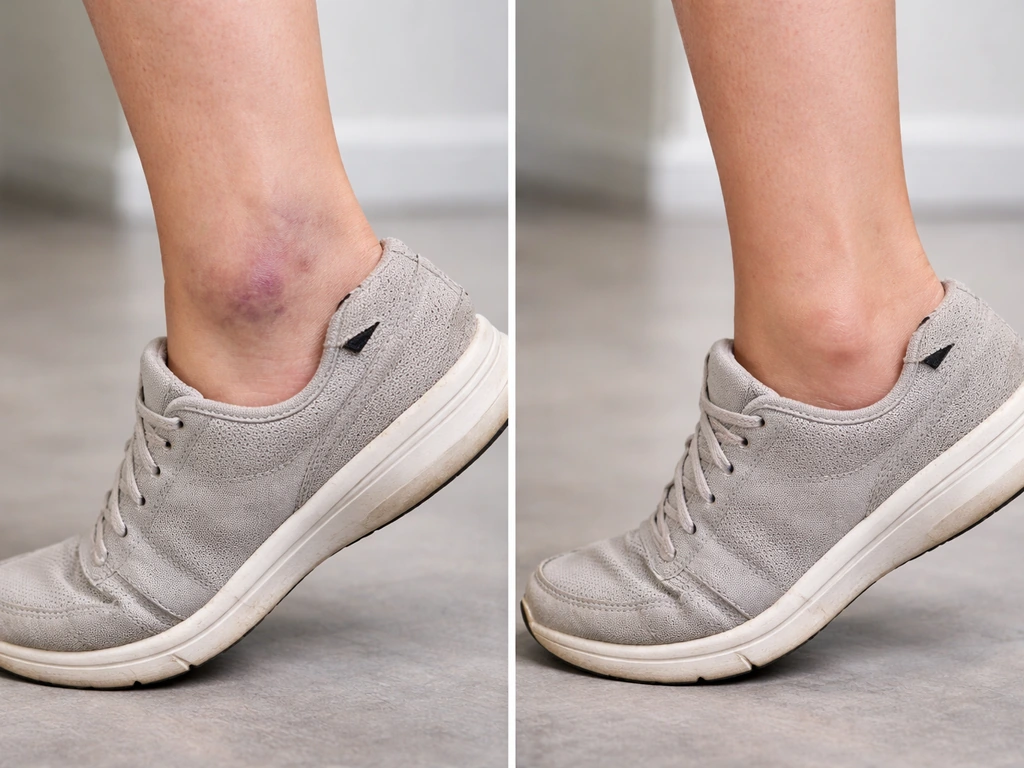
You can't tell definitively without an X-ray. But here are the signs that point toward a fracture rather than a sprain or soft tissue injury:
| Sign | More likely a sprain | More likely a fracture |
|---|---|---|
| Weight bearing | Some weight still placed on leg | Will not place any weight on leg |
| Leg position | Slightly favored but normal angle | Leg hangs at abnormal angle or rotated |
| Swelling | Mild swelling | Visible swelling, possibly bruising |
| Bone visibility | No visible bone | Bone may protrude (open fracture) |
| Movement response | Pulls leg back if touched | Little to no response, or extreme pain response |
| Overall behavior | Alert, moving around | Fluffed, grounded, not eating |
Even if it looks like a sprain, the professional call is still the right move. A sprain in a wild bird still means a grounded bird with all the same survival risks. And a fracture can look deceptively subtle. If the bird is on the ground and not flying normally, assume it needs care.
Keeping the bird safe while you arrange transport
Once the bird is boxed and warm, your job is essentially to do nothing except get it to help. Here's how to manage the waiting and transport period:
- Keep the box closed and dark. Peek in only if you truly need to check whether the bird is still alive.
- Maintain warmth: room temperature at minimum, ideally 85 to 90°F for a shocked bird. A hot water bottle wrapped in cloth under one side of the box works well.
- Do not add food or water to the box. Rehabilitators and vets will assess hydration and nutrition properly when the bird arrives.
- Transport the box upright and stable. Don't put it on the car seat where it can tip and slide. Wedge it between bags or on the floor.
- Keep the car quiet. No loud music, no sudden braking if you can help it.
- Note what you observed before capture: where you found it, what position it was in, whether you saw any incident (cat attack, window strike, car hit). This information helps the vet.
If you're waiting several hours for a rehabilitator pickup (which happens in rural areas), keep checking that the box is warm and that the bird is still alive by listening for movement. If it's completely still and silent for more than an hour, gently open a corner to check. Still breathing but very still is okay; it may be sleeping or conserving energy.
What recovery looks like if treatment works
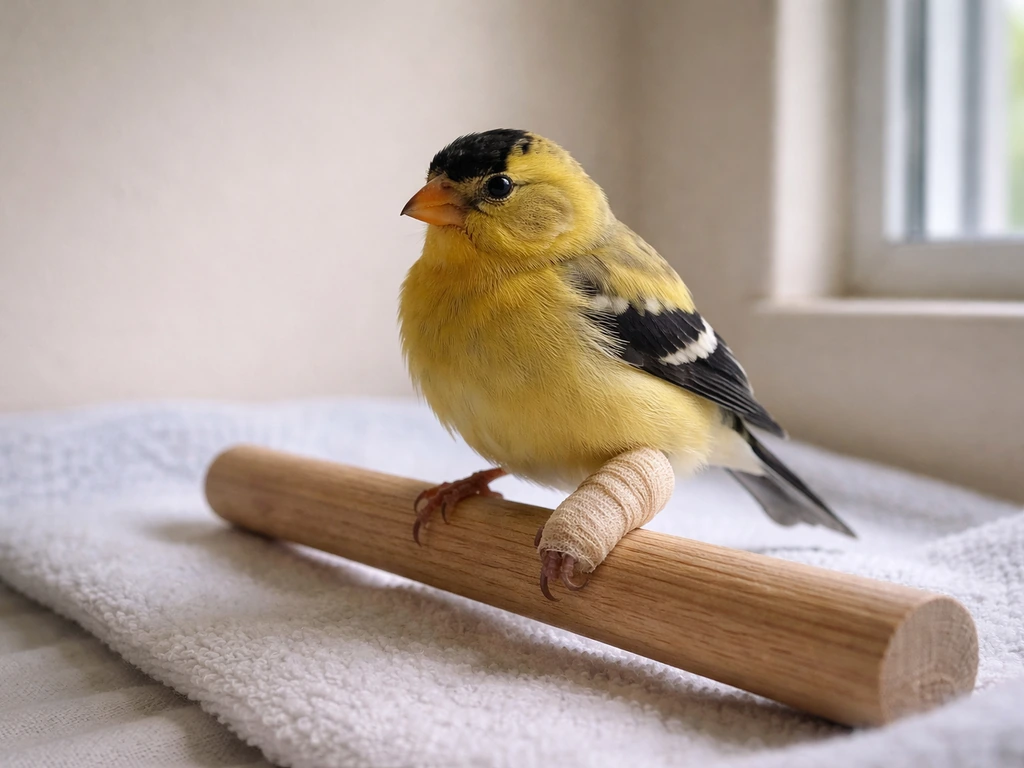
For a clean fracture that gets to a vet within hours, the outlook is genuinely good for many species. Vets and rehabilitators will typically immobilize the fracture with a splint, coaptation bandage, or in more serious cases, external fixation hardware. Recovery in a rehabilitation facility usually takes several weeks of restricted activity. For wild birds, the goal is returning to full function so they can survive in the wild, which means the bird needs to be able to perch, walk, and in most cases fly normally before release.
Some birds do lose a leg entirely and still go on to live full lives, particularly as permanent residents in sanctuaries. If you're curious about what life with a single limb actually looks like for a bird long-term, what it means for a bird to live with one leg covers that in more detail. It's not automatically a death sentence, but it does significantly change what's possible for a wild bird vs. a captive one.
How this compares to other serious bird injuries
Leg fractures are serious, but they're not the only injury that demands immediate action. If the bird you've found also seems to have a wing that won't fold correctly, that's a separate injury layered on top. Whether a bird with a broken wing can survive follows the same general logic, though wing fractures have their own complications with flight prognosis. Similarly, injuries that affect other structures like the beak add another layer of urgency: a bird surviving with a broken beak is possible but requires specialized care that's quite different from a limb fracture.
Birds sometimes present with multiple injuries after trauma events like window strikes or cat attacks, and it's worth knowing that what looks like a leg problem might actually involve a head injury or internal trauma too. Virginia's Department of Wildlife Resources specifically notes that other injuries including head trauma and internal injuries may not be immediately apparent, which is another reason not to rely on your own visual assessment and to get the bird to a professional quickly.
For reference, here's a quick side-by-side of how leg fractures compare to other common serious bird injuries in terms of survival outlook and first-aid approach:
| Injury type | Survival possible? | Can fly? | Immediate priority | Needs professional care? |
|---|---|---|---|---|
| Broken leg (closed fracture) | Yes, with prompt care | Usually not, may attempt short bursts | Contain, warm, call vet/rehab | Yes, urgently |
| Broken leg (open/compound fracture) | Possible but serious | No | Cover exposed bone, urgent transport | Yes, emergency |
| Broken wing | Yes, with care | No | Contain, minimize wing movement | Yes, urgently |
| Broken beak | Possible depending on severity | Yes, but can't eat properly | Soft food access, urgent vet | Yes, urgently |
| Single eye injury | Often yes | Depends | Dark containment, reduce stress | Yes, assessment needed |
| Single leg amputation (post-treatment) | Yes, especially in captivity | Limited or no for wild birds | Post-surgical care | Yes, rehabilitation facility |
It's also worth noting that birds can adapt remarkably to certain permanent disabilities. A bird surviving with one eye is more common than people think, and living with one wing is possible in a sanctuary setting. But these outcomes require professional assessment and ongoing care, not a wait-and-see approach at home.
The bottom line
A bird with a broken leg can survive, but only with the right help and only if that help comes quickly. Your job in the next 30 minutes is simple: gently contain the bird in a dark, warm, quiet box, don't offer food or water, and make a call to a licensed wildlife rehabilitator or avian vet right now. Don't try to splint it yourself, don't leave it outside to see if it recovers on its own, and don't keep checking on it. The birds that make it are the ones whose finders acted fast and got them to a professional. That's genuinely all you need to do today.
FAQ
Should I give a bird water or food if I suspect a broken leg?
Not offering food or water is the safest default. In a stressed, injured bird, handling and drinking attempts can increase aspiration risk, and many birds are too painful or unstable to eat. If the bird is conscious and you need to keep it calm, focus on darkness, warmth, and quiet, and let the rehabilitator or vet decide when supportive fluids or feeding are appropriate.
Is it okay to gently move or check the leg to see if it’s really broken?
You should not try to hold the leg straight or “test” range of motion. Even if the bird seems calm, moving the limb can worsen a fracture or damage surrounding tissue, and it can trigger shock. Instead, minimize handling, place it in a secure box, and treat any unusual posture, limping, or dragging as an injury that needs professional care.
What should I do if there’s bleeding from the leg?
If the bird is bleeding externally, apply gentle, direct pressure with a clean cloth or gauze around the bleeding area, without washing the wound or adding antiseptics. Bleeding can be life threatening, especially in small birds. Keep the bird warm and transport quickly, because bleeding control at home is not the same as fracture stabilization.
Can I immobilize the leg with tape or a snug wrap to help it heal?
No, you should not tape a bird’s legs for immobilization. Improper wrapping can constrict circulation, create swelling that makes later treatment harder, and cause additional injury if the bird struggles. Only trained people should apply immobilization devices, and even then they typically do it after the bird is stabilized and assessed.
If the bird hops or flies a little, does that mean the injury is minor?
A grounded bird can deteriorate quickly, even if it still hops or gives short bursts of flight. Use behavior as a trigger to act, not as proof of recovery. If the bird is limping, sitting very still, dragging, or not using the leg normally, treat it as a fracture-level emergency and get it to a licensed professional.
What’s the best way to set up a carrier/box for transport?
Choose a small, secure container that limits movement, line it with soft paper or towel, and keep it mostly dark. Ventilation matters, so don’t seal the bird in a way that blocks airflow. Avoid loose bedding that can catch the leg, and avoid a perch-like surface that encourages stepping before immobilization by a professional.
Can I leave the bird outside to see if it recovers on its own?
Do not keep the bird outside “to see what happens,” because temperature changes, predation risk, and stress can worsen injury and shock. Even in mild weather, a bird with a broken leg is less able to thermoregulate and escape. Move it indoors or into a protected, dark, warm space immediately, then contact help.
How can I tell a fracture from a sprain if I can’t do an X-ray?
Yes, it’s common to see the “good leg” used more and the injured leg left behind, which can look like a sprain to a layperson. Without an X-ray, you cannot reliably distinguish fracture from soft tissue injury, and a sprain can still leave the bird grounded and at risk. The safe approach is to pursue professional assessment whenever the bird is unable to move and perch normally.
The bird keeps struggling when I try to pick it up, what should I do?
If the bird is conscious and trying to struggle, restraint should be minimal and for the shortest time possible. Gently cover the bird with a light towel or use a controlled hold only to move it into the box, then stop. Sudden, repeated handling increases stress and can worsen breathing and circulation.
What if the bird also has other signs of injury besides the leg?
Yes, multiple injuries are possible after impacts, cats, or window strikes. If you notice head tilt, abnormal breathing, disorientation, bleeding from other areas, or a wing that will not fold correctly, treat it as multi-injury trauma and prioritize emergency contact. Getting a bird to a professional quickly is even more important when other signs are present.
What if I can’t find a rehabilitator right away, who should I call?
If you cannot reach a wildlife rehabilitator immediately, call your nearest animal emergency clinic or ask for a direct referral. While waiting, keep the bird warm, dark, and contained, and avoid repeated checks that disturb it. If the bird stops moving for an extended time, do a cautious check by opening a corner briefly, then continue transport steps without delay.
Does the first-aid approach change for a pet bird compared to a wild bird?
Pet birds can be handled differently because they have an existing relationship with a vet and they may sometimes tolerate more controlled immobilization plans. Still, you should not attempt DIY splinting. Arrange an urgent avian vet visit, and mention it is likely a fracture, plus how the injury happened (fall, cage accident, unknown trauma).