Yes, a bird can survive with a broken beak, but whether it does depends almost entirely on the severity of the injury, how quickly it gets professional care, and whether it can still eat and drink on its own. Some beak injuries are minor chips that heal with minimal intervention. Others are life-threatening emergencies that need a veterinarian today. The goal of this guide is to help you figure out which situation you are dealing with right now, what you can do in the next few minutes, and what steps to take next.
Can a Bird Survive With a Broken Beak? What to Do Now
Marcus Chen
10 Apr 2026
Is a broken beak survivable? The quick answer by severity
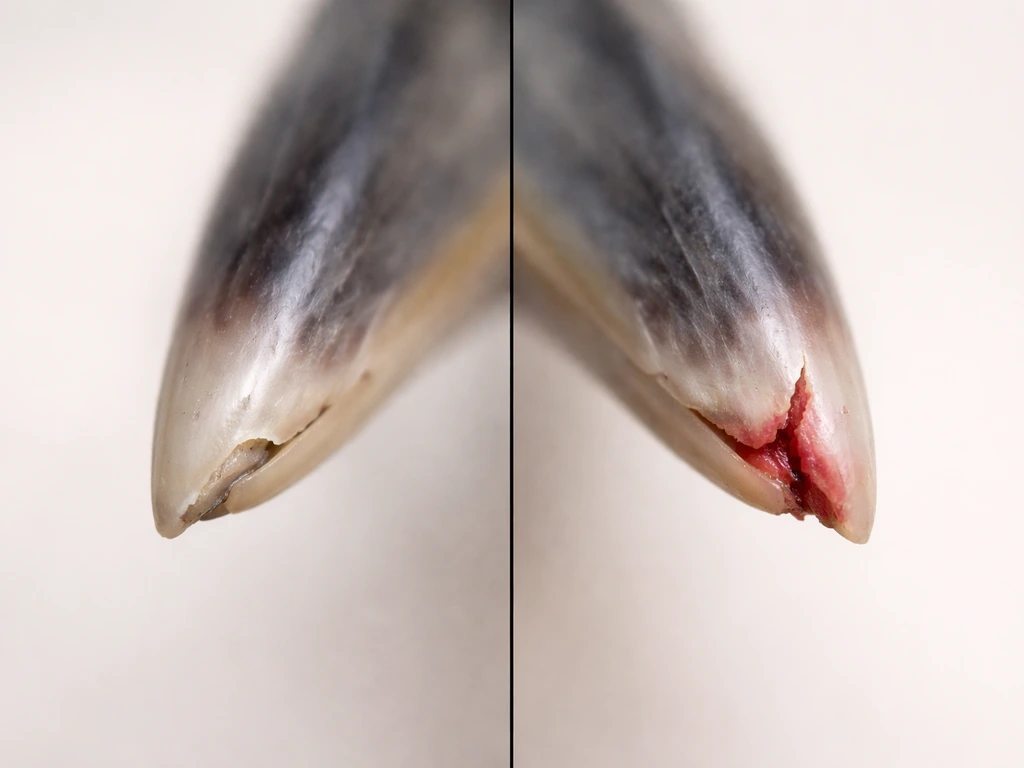
The beak is not just a hard outer shell. It contains blood vessels, nerves, and living tissue, which means a beak injury can cause significant bleeding and real pain very quickly. How survivable the injury is depends on a few key factors you can assess right now.
| Severity Level | What It Looks Like | Survival Outlook | Urgency |
|---|---|---|---|
| Minor chip or crack | Small piece missing from tip, no active bleeding, bird still opening/closing beak, still eating | Good with basic care | See a vet soon, not necessarily today |
| Moderate fracture | Visible crack or split, some bleeding, beak slightly misaligned, eating is difficult or slow | Survivable with prompt treatment | Vet within hours, not days |
| Severe fracture | Large portion broken off, heavy bleeding, beak completely misaligned or hanging, bird cannot close mouth | Serious risk without immediate care | Emergency vet now |
| Open fracture with exposed tissue | Raw flesh visible, wound communicates with mouth/throat, possible infection signs | Life-threatening without intervention | Emergency vet immediately |
A fresh beak injury is typically more painful and more likely to interfere with eating than one that has been healing for a day or two. If the bird has an older injury that has already begun to knit back together, it may be managing better than it looks. But if the injury happened recently and the bird is struggling, every hour matters.
Signs your bird can't eat or drink (life-threatening indicators)
The most immediate survival threat from a beak injury is the inability to eat or drink. Birds have extremely fast metabolisms and can deteriorate quickly when they cannot get nutrition. Watch for these warning signs that the injury has crossed into life-threatening territory.
- The bird is making repeated attempts to eat or drink but failing every time
- The beak will not open or close properly
- Food or water is falling out of the beak without being swallowed
- The bird is drooling, foaming at the mouth, or showing gagging motions
- The tongue or soft tissue inside the mouth is visibly damaged or swollen
- The bird is losing balance, falling over, or is non-responsive
- Breathing appears labored: open-mouth breathing, tail bobbing, or the wings pumping with each breath
- Heavy or ongoing bleeding from the beak or mouth area
- The bird is lying on its side or cannot hold its head up
Any one of these signs means you are dealing with a medical emergency. Do not wait to see if the bird improves on its own. Difficulty breathing in particular needs to be triaged immediately since birds can decline very fast once respiratory distress sets in.
Immediate first aid you can do right now
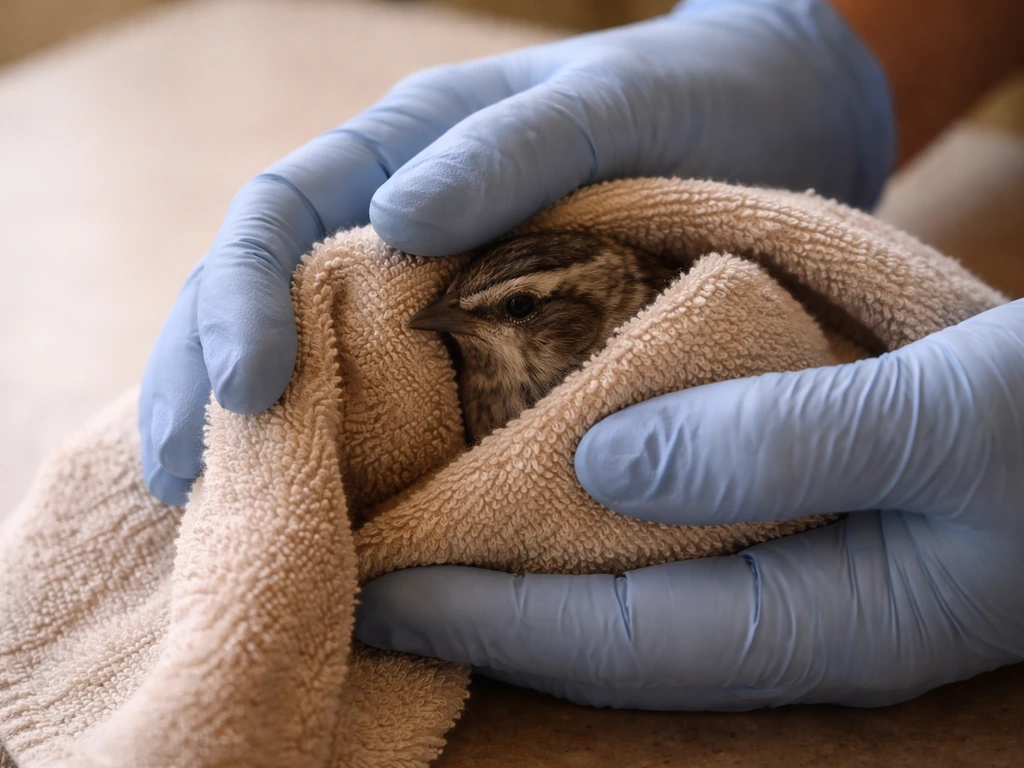
The most helpful thing you can do in the first few minutes is reduce the bird's stress, keep it warm, and control any bleeding. Here is exactly how to do that safely.
- Put on gloves if you have them, then gently scoop the bird up using both hands. Hold it loosely but securely enough that it cannot thrash and injure itself further. Avoid squeezing the chest, which can restrict breathing.
- Place the bird in a cardboard box with air holes. Line the bottom with a non-fluffy cloth like a paper towel or thin cotton. The box should be just large enough for the bird to stand without room to flap around.
- Keep the bird warm. Injured birds lose heat fast and spend precious energy trying to regulate their temperature. Place a heating pad set to low under one half of the box only, so the bird can move off the heat if it gets too warm. The goal is a warm environment around 85°F if possible.
- If there is active bleeding from the beak, apply very gentle pressure with a clean cloth or gauze. If you have styptic powder (the kind used for pet nail trims), a tiny amount applied with gentle pressure can help slow bleeding. Do not probe or poke inside the beak.
- Put the box in a quiet, dark, warm room. Darkness reduces panic and stress. Keep pets, children, and loud noises away. Do not keep checking on the bird every few minutes as this makes things worse.
- Call a wildlife rehabilitator or avian veterinarian immediately. You do not need to wait until you have stabilized the bird perfectly. Make the call while the bird is resting.
That is genuinely it for what a non-professional should do. The temptation to do more is understandable, especially when the bird looks distressed, but more intervention from an untrained person usually causes more harm.
What NOT to do during at-home help
This section is just as important as the first aid steps above. The following mistakes are common and some of them can kill an injured bird faster than the injury itself.
- Do not give food or water. This is the single biggest mistake people make. Incorrect feeding can cause choking, and an injured beak makes aspiration (inhaling liquid into the lungs) extremely easy. Multiple wildlife organizations including the Wildlife Center of Virginia and Wings of the Dawn Wildlife Rescue are explicit: do not feed or water an injured bird unless a licensed rehabilitator has specifically told you to and explained how.
- Do not squirt water into the front of the beak or into the nostrils. Water can be aspirated directly into the lungs, causing pneumonia on top of the existing injury.
- Do not try to realign or splint the beak yourself. Beak alignment is critical to long-term function, and improper manipulation can cause permanent deformity or additional fractures. This must be done in a clinical setting.
- Do not use human medications. Ibuprofen, acetaminophen, and other common pain relievers are toxic to birds. Do not give anything.
- Do not attempt to clean the wound with hydrogen peroxide or alcohol. These damage tissue and delay healing.
- Do not place the bird in a cage with other birds. It needs isolation, quiet, and rest.
- Do not assume the bird only has a beak injury. Birds that have been hit by a car, struck a window, or been caught by a cat often have head trauma, internal injuries, or eye damage that are not immediately visible.
How to get professional care fast
A beak fracture that involves exposed tissue, heavy bleeding, misalignment, or any of the life-threatening signs listed above needs professional care today. Even a seemingly minor injury deserves a professional evaluation because what looks like a small chip on the outside can involve deeper structural damage you cannot see.
Who to call

- A licensed wildlife rehabilitator (for wild birds): Search your state's fish and wildlife agency website for a list of permitted rehabilitators in your area. In Virginia, for example, you can call 1-855-571-9003 (Monday through Friday, 8 AM to 4:30 PM) to be connected with a permitted wildlife rehabilitator near you.
- An avian veterinarian (for pet birds or if no rehab is available): Not every general vet treats birds, so search specifically for 'avian vet near me' or check the Association of Avian Veterinarians directory online.
- Your local wildlife rescue center: Many centers offer phone triage and can walk you through what to do while you arrange transport. Organizations like Greenwood Wildlife Rehabilitation Center, for instance, encourage you to call and describe what you are seeing so they can help you decide whether and how urgently the bird needs to come in.
What to tell them
When you call, have this information ready: the species if you know it (or a description), where you found the bird, how the injury likely happened, what the beak looks like right now (bleeding, misaligned, chip, etc.), whether the bird is breathing normally, and whether it is alert or non-responsive. The more specific you can be, the faster they can triage your call and give you useful guidance.
Transport, temporary housing, and recovery support until treated
Once you have made your call and have a plan for getting the bird to professional care, your job is to keep the bird stable and as calm as possible until then. Think of this phase as holding steady, not fixing things.
Housing
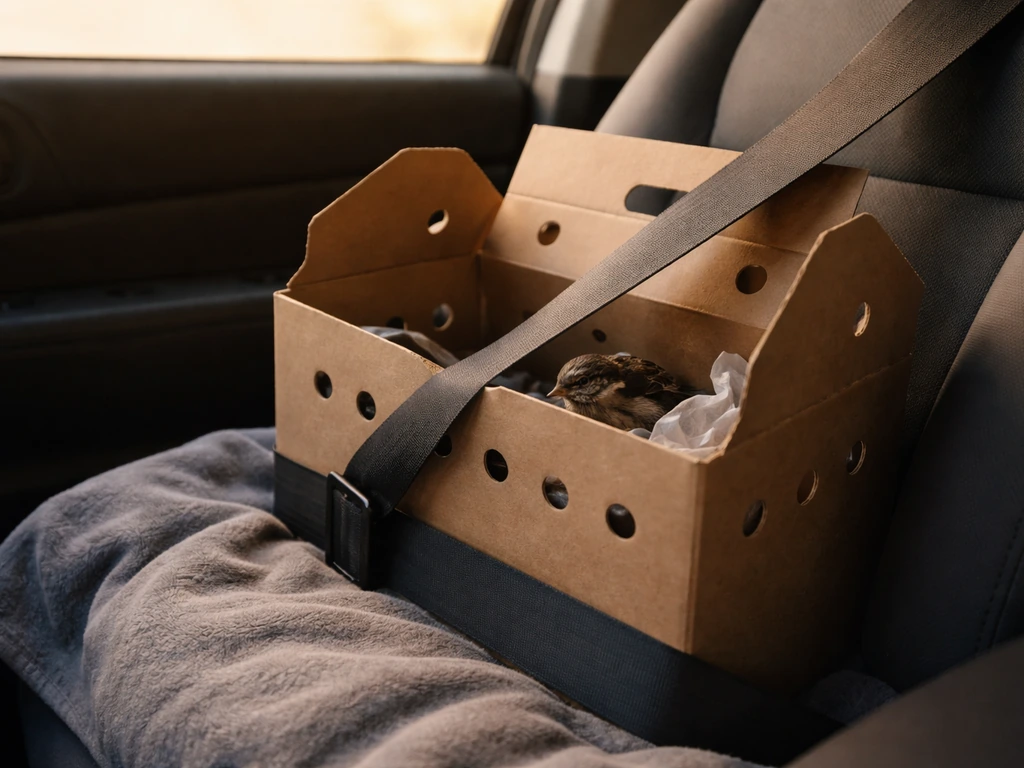
Keep the bird in the ventilated cardboard box described in the first aid steps. The enclosure should be warm (around 85°F), dark, and quiet. Do not use a wire cage since the bird can damage its beak further by grabbing or scraping the bars. If the bird is not bleeding, a heated environment is genuinely life-saving because it reduces the energy the bird has to spend keeping itself warm, energy it needs to survive the injury.
Transport
Keep the box on a flat surface in your vehicle. Avoid sudden starts and stops. Do not turn the radio up. Keep the car warm but not overheated. If the drive is longer than 30 minutes, check in with the rehabilitator or vet by phone about whether any additional steps are needed.
What about food and water during transport
I know it feels cruel to withhold food and water from a bird that looks hungry or thirsty. But multiple wildlife organizations are unanimous on this: do not attempt to give food or water unless a trained professional has specifically instructed you to and told you exactly how. The risk of aspiration with a damaged beak is very real, and the wrong food can cause additional harm. Get the bird to care as quickly as possible instead.
Prognosis and long-term outcomes after beak injury
Here is the honest picture of what recovery looks like for birds with beak injuries, because knowing this will help you make good decisions now.
What survival depends on
- Severity and location of the fracture: tip injuries are generally more manageable than fractures at the base of the beak near the face
- Whether the fracture is open (exposed tissue, communicating with the oral cavity) or closed: open fractures carry a much higher infection risk, including osteomyelitis, which is the most common bone infection seen in birds
- Time to treatment: the sooner a bird receives professional care, the better the outcome
- Species and body size: larger birds like parrots often have better surgical options than very small songbirds
- The bird's overall health before the injury
What recovery looks like
With veterinary treatment, many beak fractures are survivable and birds can regain meaningful function. Case reports in the veterinary literature describe birds with serious mandibular fractures recovering well after surgical repair, including restored ability to eat and use the beak normally. That said, recovery takes time. The bird will likely experience swelling and pain initially, and eating will be difficult or impossible without help. A professional will often modify the bird's diet during recovery, offering soft foods or hand-feeding as needed. Beak tissue can regenerate to some degree over weeks and months, but alignment must be correct from the start or long-term function is compromised.
It is worth knowing that beak injuries are not the only trauma a bird can survive with the right support. If you have found a bird with other injuries alongside the beak damage, it helps to understand the full picture. For example, whether a bird with a broken wing can survive follows similar logic: severity, speed of treatment, and access to professional care are the determining factors. Birds are remarkably resilient when given the right help.
One thing that affects prognosis significantly is how quickly a bird declines without treatment. If you are wondering about the time pressure involved in other injuries, the same urgency applies here: how fast a bird can die from a broken wing gives you a sense of how rapidly an untreated bird can deteriorate, and beak injuries follow a similar trajectory when feeding is compromised.
When full recovery may not be possible
Some beak injuries result in permanent changes to the beak shape or function. A bird that cannot forage or feed independently in the wild may need to remain in a wildlife rehabilitation setting or with a licensed keeper long-term. This is not necessarily a death sentence. Many birds adapt remarkably well. Birds that live with one leg are a good example of how adaptable birds can be even with permanent physical changes, and similar resilience is seen in birds managing with beak deformities when their environment and diet are properly supported.
Birds also show this kind of resilience across many injury types. A bird surviving with a broken leg is another scenario where the outcome hinges on timely care and the bird's baseline health, much like beak fractures. And if you are dealing with a bird that has multiple injuries, including potential eye damage from a collision, knowing whether a bird can survive with one eye may also be relevant as you assess the full situation.
The bottom line on prognosis: birds that receive professional care quickly, have injuries that do not compromise the airway or completely prevent eating, and have no major secondary infection have a genuinely good chance of surviving. Birds left without treatment for more than a day or two, especially those that cannot eat or are showing signs of shock, face a much harder road. This is why getting help today, not tomorrow, is the decision that matters most.
Your decision path right now
If the bird is bleeding heavily, cannot breathe normally, is non-responsive, or has exposed tissue: this is an emergency. Contain the bird safely, apply gentle pressure to any bleeding, keep it warm, and get to an avian vet or emergency wildlife center immediately. Call ahead so they can prepare.
If the bird is alert, breathing normally, and has a minor chip or crack with no heavy bleeding: keep it warm and quiet, do not feed or water it, and call a wildlife rehabilitator or avian vet today to arrange an evaluation. CDC guidance for dealing with wildlife says that if an animal is badly injured or looks very sick, contact a wildlife rehabilitator or your state wildlife office so they can connect you with a rehabilitator call a wildlife rehabilitator or avian vet today. Even a bird that looks okay deserves a professional look, because what you cannot see can still be serious.
In both cases, the bird needs more than you can provide at home. Your job right now is to keep it stable, reduce its stress, and get it to someone who can actually treat it. That is enough, and it makes a real difference. Birds that have suffered wing amputations or lost a limb entirely and still go on to live full lives in rehab settings are a reminder that survival with serious physical injury is genuinely possible when the right care is in place. A broken beak is serious, but it is not automatically a death sentence. Act fast, do no harm, and get professional help today.
FAQ
If the beak is only chipped, is it still an emergency?
A bird with a chipped tip can sometimes survive without immediate intervention, but you should still arrange a vet or wildlife rehab evaluation within the same day if the chip is fresh, the beak looks irregular or bleeding, or the bird is dropping food or acting like it cannot pick up normal items. Minor-looking injuries can hide deeper fractures that affect alignment for weeks.
Can I give the bird water or food to help it heal faster?
Do not try to “test” the beak by offering seeds, water, or fruit. Even if the bird seems alert, a damaged beak can make swallowing unsafe, and aspiration can worsen quickly. If professionals have not specifically told you what to offer and how, the safest default is to keep the bird warm and quiet and contact a rehabber or avian vet.
What breathing signs mean the broken beak is getting life-threatening?
Watch breathing first. Open-mouth breathing, audible wheezing, tail-bobbing, repeated stretching or gasping, or visible effort to breathe are red flags. If any of these are present, treat it as time-critical emergency care rather than waiting for bleeding control or comfort measures.
How should I control bleeding from a beak injury without making it worse?
If the beak is actively bleeding or you can see exposed tissue, control bleeding with gentle, steady pressure using clean gauze or a soft cloth, then proceed to emergency care. Avoid tourniquets or anything that could compress the airway, and do not apply powders, sprays, or human antiseptics unless a professional instructs you.
What if the bird seems able to swallow but is not eating?
A bird that cannot eat may still be able to drink at first, but drinking problems can lag behind. Look for inability to swallow, food dribbling from the beak, repeated attempts to eat without success, wetness around the beak that does not improve, or lethargy that follows. Any pattern of not eating or not swallowing is a prompt for professional care today.
Do I need to rush to emergency care even if I’m already taking the bird to a rehabber?
If a bird is non-responsive, bleeding heavily, has exposed tissue, or is breathing abnormally, transport is an emergency. Even if you are driving yourself, keep the bird warm, dark, quiet, and in a ventilated container, and call the facility en route so they can triage and prepare for intake.
How can I tell whether the bird is truly improving versus just coping?
After the first day, subtle improvement can be misleading. The bird may look calmer but still not have the correct beak alignment to feed effectively in the wild. A professional evaluation is still important if the bird cannot feed independently, keeps dropping food, or the beak is crooked.
Could other injuries change the outcome of a broken beak?
Yes. Trauma events that break the beak often come with other injuries, such as head trauma, concussion, or eye damage from collisions or impacts. If you suspect other injuries, tell the rehabber or vet what likely happened and whether the bird’s eyes appear swollen, cloudy, or misaligned, since that changes how the injury is treated and stabilized.
What should I describe to the vet or rehabilitator to get the fastest, most accurate advice?
When in doubt, assume the injury is more severe than it looks externally. Ask for guidance on urgency when you call, and describe exactly what you see: bleeding amount, exposed tissue or not, crookedness or misalignment, and whether the bird is alert and breathing normally. Those details help triage, even over the phone.
If the drive takes a while, what changes should I make during transport?
Long transport can accelerate decline, especially if the bird is not eating. If the trip will exceed about 30 minutes, contact the rehabber or vet by phone to ask whether you should add or change steps at home for warmth, containment, or other stabilization. Do not start feeding unless you receive explicit instructions.