
Whether your bird flew away, hit a window, is bleeding, or you found a baby bird on the ground, the answer to 'will my bird come back' depends entirely on what's actually happening right now. Some birds do return on their own. Others need you to act fast to give them any chance. This guide walks you through every real scenario so you know exactly what to do today.
Will My Bird Come Back? What to Do Today and Next Steps
Marcus Chen
27 Apr 2026
First, figure out which situation you're actually in
The phrase 'will my bird come back' covers a few very different emergencies, and the right response depends on which one you're dealing with. Getting clear on this first saves you from doing the wrong thing under pressure.
- Your pet bird flew away and you're wondering if it will return home on its own.
- Your bird was injured (window collision, bleeding, broken wing or leg, or shock) and you need to know if it will recover.
- You found a baby bird or disturbed a nest and you're not sure whether to intervene or leave it alone.
- Your bird was attacked by a cat or dog and you're unsure how serious it is.
Each of these situations has a different timeline, a different level of urgency, and different steps you need to take. Work through the sections below that match your situation. If your bird is bleeding, struggling to breathe, or collapsed, skip straight to the first aid and emergency sections right now.
If your bird flew away: what to do in the first hour
A pet bird that escapes outdoors is a genuine emergency. Most pet birds, especially parrots, parakeets, and cockatiels, have no survival instincts for the wild. They can and do return, but the odds drop with every passing hour, so move quickly.
- Stay outside and keep the bird in sight if you can see it. Don't chase it. Chasing causes panic and makes the bird fly farther away.
- Call its name calmly and repeat familiar sounds or phrases it knows. Birds often respond to voices they recognize.
- Bring its cage outside and place it somewhere visible near where it was last seen. Put favorite food and water inside. A familiar object can draw a scared bird back.
- Play a recording of its own voice or of birds of its species through your phone speaker. This can work surprisingly well.
- Contact neighbors immediately. Knock on doors, post on local neighborhood apps, and call local bird clubs or rescue groups. The more eyes looking, the better.
- Post on social media with a clear photo, the bird's description, and the exact location. Lost bird Facebook groups and platforms like Nextdoor have reunited many birds with their owners.
- Contact your local animal shelters and avian veterinarians so they know to watch for it.
- Search at dawn and dusk when birds are most vocal and active.
Wild birds generally do not stay in unfamiliar areas if they sense they can get somewhere safer. A pet bird, though, has no 'safe' place to return to outdoors. It may land nearby and wait, especially if it's frightened. Your best window is the first 24 to 48 hours. After that, it can travel much farther or encounter predators. Don't give up after the first day, but prioritize that first hour.
How to tell if a bird is injured
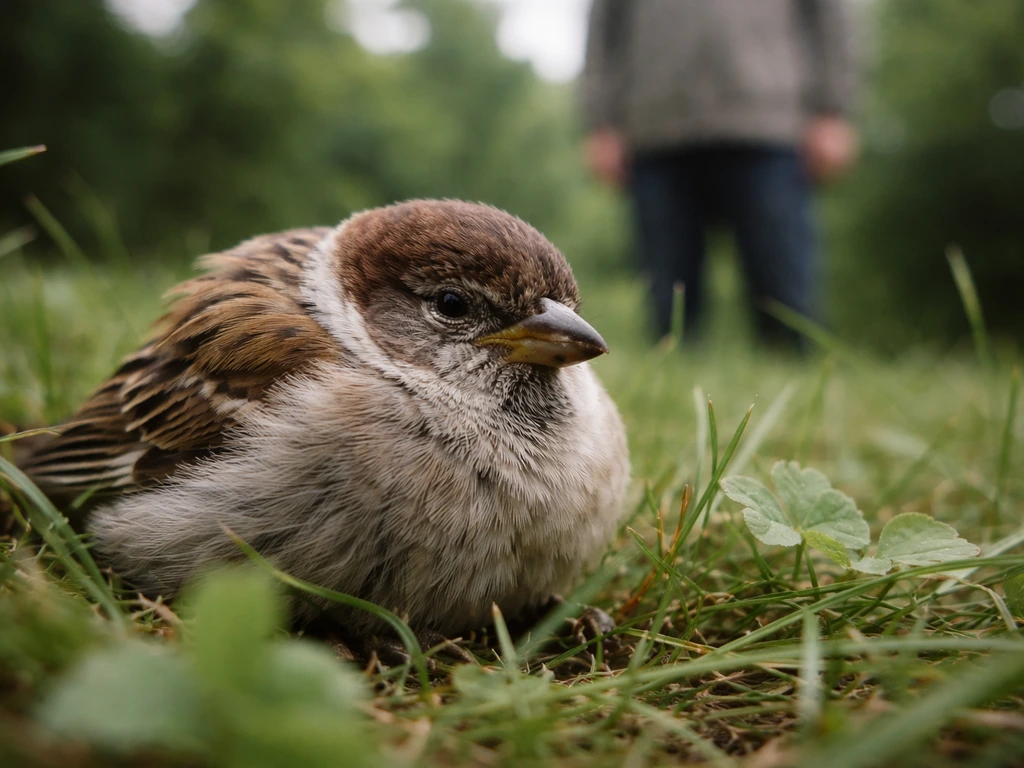
Before you touch any bird, take 30 seconds to assess it from a short distance. What you see tells you a lot about what kind of help it needs.
Signs of a window collision (bird strike)
A bird that has hit a window often looks stunned rather than obviously injured. It may be sitting on the ground or a low surface, fluffed up, not moving much, or blinking slowly. It may have been seen flying directly into the glass. These birds frequently go into shock and can recover on their own within 20 to 30 minutes if left undisturbed in a safe, dark, quiet space. However, window strikes can also cause internal bleeding, head trauma, or broken bones, so you need to watch carefully.
Signs that tell you something is seriously wrong
- Visible bleeding from any part of the body, beak, or eye.
- Open-mouth breathing or breathing you can see and hear (labored).
- Tail bobbing rhythmically with each breath, which signals respiratory distress.
- A wing or leg hanging at an unnatural angle.
- The bird is collapsed and cannot right itself.
- Eyes are closed, partially closed, or the bird appears semiconscious.
- Shivering or trembling that doesn't stop.
- The bird allows you to walk right up and pick it up without any attempt to flee (healthy wild birds won't let you do this).
Any of those signs means the bird needs professional help. It is not 'just resting.' Keep reading for what to do right now while you arrange that help.
Safe first aid you can do right now
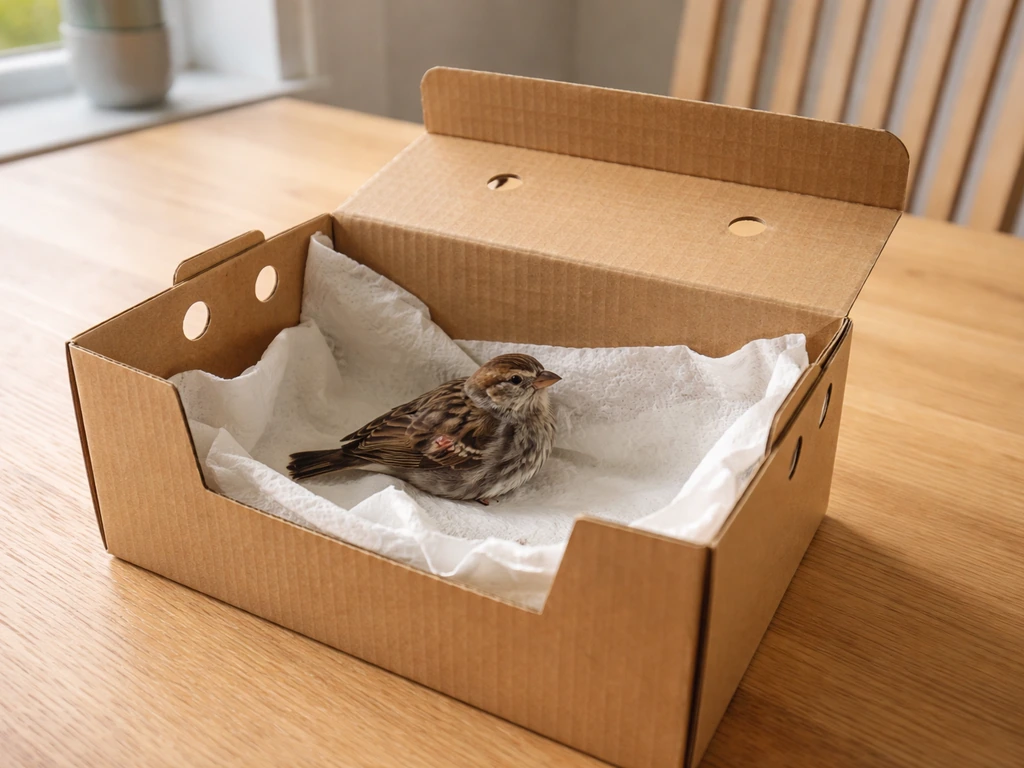
Your goal with first aid is to stabilize the bird, not to treat it. You are buying time until you can get it to a professional. Here is what you can safely do at home.
Contain the bird safely
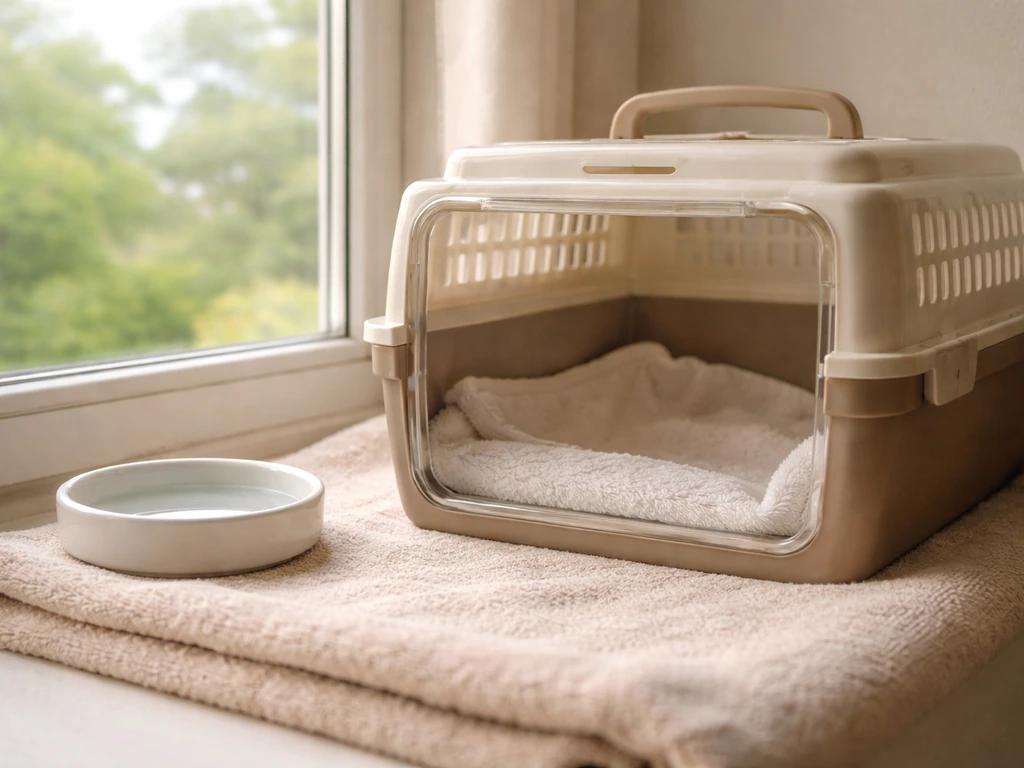
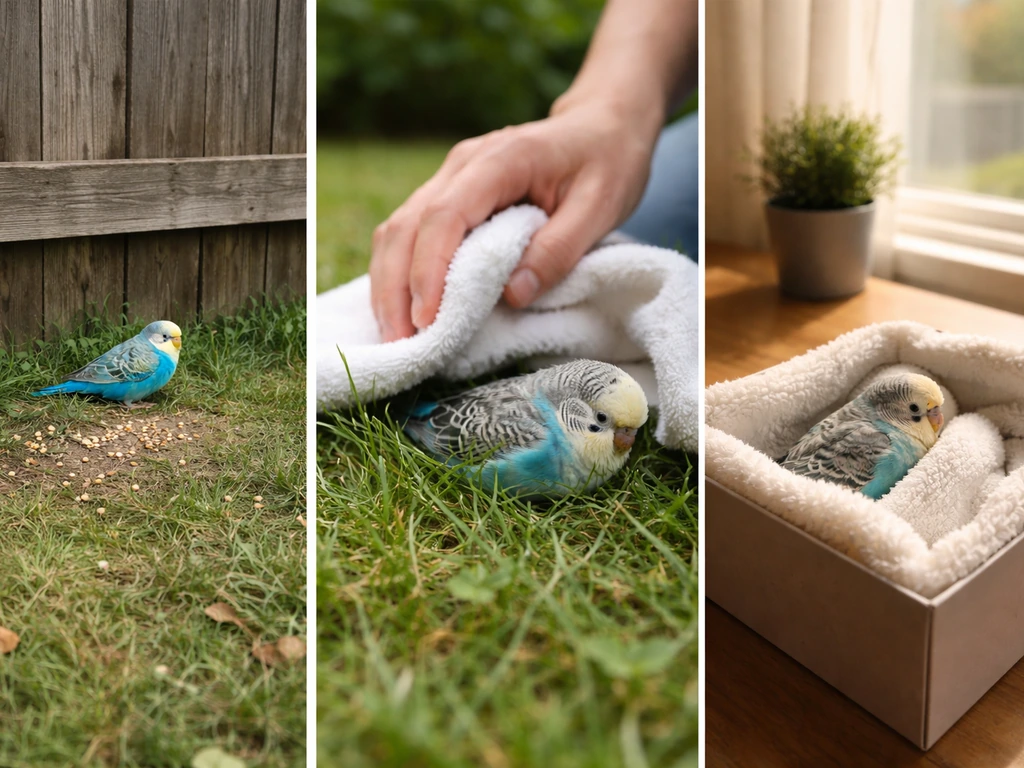
blank" rel="noopener noreferrer">Place the bird gently into a cardboard box or a small pet carrier lined with a clean towel or paper towels. The box should be big enough that the bird isn't cramped but small enough that it can't thrash around and hurt itself more. Punch small air holes in the sides if using a closed box. Put the lid on. Darkness reduces panic and helps the bird calm down, which conserves energy and reduces shock.
Keep it warm, but carefully
Warmth helps with shock in most cases. You can place a heating pad on the lowest setting under one half of the box so the bird can move away from the heat if it gets too warm. Never wrap a heating pad around the entire container. One important exception: if the bird hit a window or has any suspected head trauma, do not apply supplemental heat, as warmth can increase swelling around the brain.
If you suspect poisoning or that your bird ate something toxic, check the steps for what should i do if my bird ate avocado so you know whether to call a vet or watch for specific symptoms. In that case, just keep the bird at a comfortable room temperature, away from drafts and air conditioning.
Control bleeding if present
If the bird is bleeding, apply gentle direct pressure with a clean cloth or gauze. For a broken blood feather (a pin feather that is actively bleeding), apply styptic powder or gel directly to the site and hold gentle pressure for one to two minutes. If bleeding does not slow significantly within five minutes, do not wait any longer. Get the bird to an avian vet or emergency exotic animal clinic immediately. Uncontrolled bleeding is life-threatening and is beyond what home care can fix.
Do not do these things
- Do not offer food or water. An injured or shocked bird cannot safely swallow and can aspirate liquid into its lungs, which can be fatal.
- Do not try to splint or bandage a broken wing or leg yourself unless you have been trained to do so.
- Do not handle the bird more than necessary. Every time you pick it up, you stress it further.
- Do not place the bird with other animals or birds.
- Do not leave it in a bright, noisy environment.
When you need professional help right now
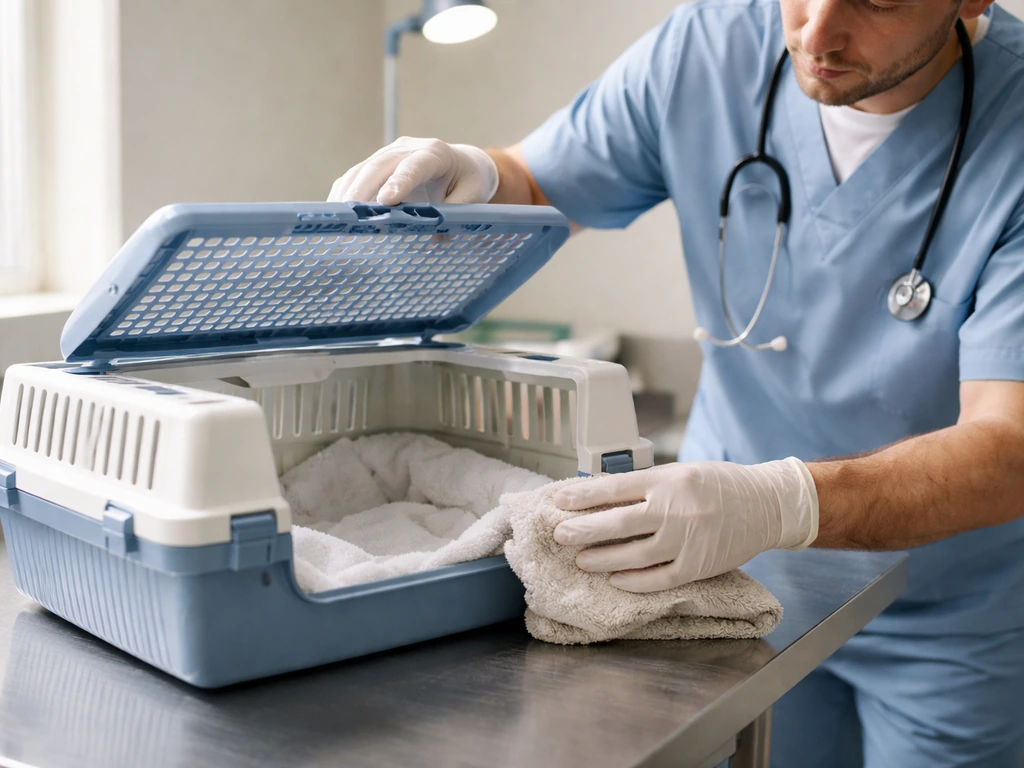
Some situations cannot wait and should not wait. If you see any of the following, your next call is to an avian veterinarian or a licensed wildlife rehabilitator, not tomorrow, right now.
- Bleeding that doesn't stop within five minutes of pressure.
- Open-mouth breathing, labored breathing, or tail bobbing.
- The bird is unconscious or collapsed and unresponsive.
- A visibly broken limb or wing hanging at an abnormal angle.
- The bird has been in a cat's or dog's mouth, even briefly. Cat saliva contains bacteria that cause fatal infection within hours even when the bird shows no visible wounds.
- Suspected poisoning or exposure to fumes (nonstick cookware fumes are toxic to birds).
- The bird flew into a window and hasn't improved after 30 minutes in a dark, quiet box.
To find help fast, search 'wildlife rehabilitator near me' or 'avian vet emergency near me.' The National Wildlife Rehabilitators Association and state wildlife agency websites maintain searchable directories. Many areas also have 24-hour exotic animal emergency clinics. Call ahead so they can prepare for the bird's arrival.
Baby bird on the ground: reunite or rescue?
Finding a baby bird is one of the most common situations that sends people searching for answers. The single most important thing to figure out is whether you're looking at a nestling or a fledgling, because those two situations call for completely different responses.
Nestling (no or very few feathers)
A nestling has little to no feather coverage, often has closed or barely open eyes, and cannot hop or perch. It should not be out of the nest. If you can see or locate the nest nearby, the right move is to gently place the bird back in it. The myth that parent birds will reject a chick because a human touched it is false.
Birds have a very limited sense of smell and most will absolutely continue caring for a nestling you return to the nest. If the nest is too high to reach or has been destroyed, you can make a substitute nest from a small container like a margarine tub with drainage holes, line it with dry grass or the original nesting material, and attach it to the original tree as close to the original nest location as possible.
Then watch from a distance for at least an hour to see if the parents return.
Fledgling (fully or mostly feathered)
A fledgling is fully or mostly feathered, can hop, and may be able to flutter short distances. This is a normal life stage. Fledglings leave the nest before they can fully fly, and their parents continue to feed and watch over them from nearby. If you find a fledgling that appears healthy, the best thing you can do is leave it exactly where it is.
Move it only if it's in immediate danger, like in the middle of a road, and place it in nearby cover like a shrub. Keep cats, dogs, and children away from the area so the parents can safely approach and continue feeding. Removing a fledgling that doesn't need help almost always does more harm than good.
If your cat caught a bird, you should treat it as an urgent injury scenario and contact an avian vet or licensed wildlife rehabilitator right away my cat caught a bird what should i do.
When a baby bird definitely needs rescue
- It is featherless or sparsely feathered and you cannot locate or reach the nest.
- It is visibly injured: bleeding, a drooping or twisted limb, or open wounds.
- It is shivering, lethargic, or has its eyes closed.
- A parent bird has been found dead nearby.
- The parents have not returned to check on a fledgling after one to two hours of you watching from a distance.
- The bird has been touched by a cat, even if it looks fine.
In those cases, contain the bird in a dark, quiet box as described above and call a licensed wildlife rehabilitator or your state wildlife agency immediately. Do not feed it anything. No water, no bread, no worms you found in the garden. A wildlife rehabber can tell you over the phone exactly what to do while you get the bird to them.
What to do in the hours and days that follow
After a window strike or injury
If a bird recovers from a window strike and you released it, monitor the area for a day or two. A bird that seemed fine can sometimes decline hours later from internal injuries. If it reappears looking fluffed, lethargic, or unable to fly well, treat that as a new emergency. For pet birds recovering from injuries under veterinary care, follow your vet's instructions exactly on cage rest, diet, and follow-up visits.
After a missing bird situation
Keep searching for a minimum of three to five days. Maintain the cage outside (or just food and familiar items near the last known location) during daylight hours. Continue posting and updating social media. Expand your search radius each day. Some pet birds have been reunited with owners weeks after going missing, so don't stop too soon.
Preventing this from happening again
Window collisions are one of the most preventable bird emergencies. Apply anti-collision decals or window film to the outside surface of your glass, not the inside. Research from the American Bird Conservancy recommends spacing decals no more than 2 inches apart in a grid pattern, because birds try to fly through any gap they perceive as clear. Decals or film applied only to the inside of the glass are significantly less effective during daylight, according to U.S. Fish and Wildlife Service guidance. External films, screens, or closely spaced markers on the outside surface are the most reliable options.
For pet birds, always double-check that windows and doors are closed before allowing any free-flight time indoors. Supervise any outdoor time in a secure enclosure. If you have cats, keep them indoors or well supervised around any bird activity in your yard. If your cat killed or seriously injured a wild bird, contact a licensed wildlife rehabilitator or avian vet for guidance right away cats.
If your cat caught or killed a bird, keep the bird area and your cat separated and check for signs of injury or illness, since this can quickly become an emergency my cat ate a bird should i be worried. If your cat ate a bird, treat it as a serious situation and follow the same urgent, vet-first guidance you would for other cat-related bird emergencies If you have cats.
A cat attack, even without visible wounds, is a medical emergency for a bird and needs a vet the same day. If your cat ate a bird or killed one, treat it as urgent and contact a vet for guidance the same day, because pet and wild birds can be injured even when they appear okay at first cat attack. If you have cats, treat it as serious and follow the same urgent, vet-first guidance my cat killed a bird what should i do. Keeping cats and dogs separated from areas where wild birds or baby birds are present also gives parent birds the clear access they need to keep feeding their young.
Recovery timelines vary. A stunned window-strike bird can bounce back in 20 to 30 minutes. A broken wing requires weeks of professional rehabilitation. A pet bird that flew away may return the same day or not at all. What you do in the first hour matters more than almost anything else. Stay calm, assess the situation, take the right immediate steps, and get professional help whenever there's any doubt. Birds are more resilient than they look, but they need the right kind of help at the right time.
FAQ
My pet bird escaped, will my bird come back on its own at night, or should I keep searching nonstop?
Most returns happen when the bird is able to recognize familiar sounds and routine, especially during daylight when it can navigate toward home. At night, keep searching in a safer way, use familiar calls or a cage setup near the last seen spot, and avoid loud chasing that can stress the bird. If you hear wingbeats or see movement near the home, pause and let the bird approach instead of moving toward it.
How can I tell if my bird that landed outside is waiting for me versus sick or injured?
Look for body language and movement quality from a short distance. A frightened but healthy bird often stays low and alert, may call, and may reorient when you move slowly. A bird that is truly unwell tends to look fluffed for long stretches, cannot perch, has drooping wings, or shows labored breathing, and should be contained and treated as an emergency if you can do so without chasing it.
Will my bird come back if I open the cage door and just wait, or should I bring the bird’s cage outside?
If your bird is still able to see and hear home, placing its cage outside near the last known location can improve odds, because it provides a safe reference point and familiar cues. Use a calm setup (cover partially if the bird seems panicked), and do not leave food that attracts other animals. If the bird does not approach within the daytime search window, expand outward and keep updating your posting.
I saw my bird fly into a window and then it flew away, will my bird come back or is it okay to stop checking?
Stop only after you monitor for delayed trouble. Even when the bird flies off, internal injuries can show up hours later, so check the area again later that day and the next day. If it reappears fluffed, lethargic, or unable to fly normally, treat it as a new emergency and contact an avian vet or wildlife rehabilitator immediately.
Should I capture a window-strike bird that seems mostly fine, or leave it alone to recover?
If it is awake and responsive and you can see it flying or moving normally within a short period, leaving it undisturbed in a safe, quiet spot can help it recover from shock. However, if it is still sitting fluffed, blinking slowly, unable to coordinate, or you suspect head trauma, containing it in a dark, quiet box and arranging professional care is safer than waiting.
If I find a baby bird, will my bird come back, and should I put it back even if it fell out of the nest?
If the bird is a nestling (bare or sparse feathers, little mobility), placing it back into a nearby nest is the best action, even after a human touched it. If the nest is unavailable or destroyed, creating a temporary substitute nest and attaching it close to the original site increases the chance parents return. If it is a fledgling (feathered, hopping), returning it to the nest usually harms more than helps, and the parents typically keep feeding nearby.
I found a fledgling, will my bird come back, or did I ruin it by removing it from the street?
If the fledgling is fully or mostly feathered and can hop, it is usually in a normal stage and parents are nearby. If you moved it only because it was in immediate danger, placing it in nearby cover (like a shrub) and stepping back is the least disruptive option. After that, keep pets away and avoid repeated handling, since frequent interference can reduce feeding opportunities.
What if I’m not sure whether the baby bird is a nestling or a fledgling?
Use mobility and eye status as the tie-breakers. Nestlings generally cannot hop or perch and often have closed or barely open eyes. Fledglings are mostly feathered and can hop and may flutter short distances. When in doubt, prioritize safety by minimizing handling, keeping it warm and contained only if immediate danger exists, and contacting a wildlife rehabilitator for guidance.
If my bird is bleeding, should I wait to see if it stops, will my bird come back later, or get help immediately?
If bleeding does not significantly slow within about five minutes of gentle pressure, you should not wait. Uncontrolled bleeding can become life-threatening quickly, and that is the difference between a chance to recover with professional care versus an avoidable emergency outcome. Arranging immediate avian emergency care is the safest path.
My bird hit a window, should I use a heating pad to help, or will my bird’s head injuries get worse?
If you suspect head trauma, do not apply supplemental heat. Instead, keep the bird at a comfortable room temperature and focus on containment, darkness, and quiet while you arrange professional help. Heat can worsen swelling around the brain in suspected head injuries.
If my bird is missing, will my bird come back if I stop searching early because it’s far away?
Do not stop after the first day. Continue searching and expanding your radius for at least three to five days, and maintain a steady posting cadence with updates. Some pet birds are reunited weeks later, so persistent, location-based searching matters more than a single early sighting.
What’s the safest way to search outdoors without making my bird harder to catch?
Search by method, not by chase. Use the cage or familiar items near the last known location during daylight, keep your presence calm and predictable, and avoid running toward the bird if it appears. Move slowly, pause often to let the bird approach on its own, and keep other animals secured.
If a cat is involved, will my bird come back if there’s no visible wound?
Treat cat contact as a same-day medical emergency even if you do not see bleeding. Bird injuries can be internal or present as delayed infection, and infection risk is high after cat saliva. Get the bird to an avian vet or emergency clinic immediately.