
Stay calm, stop moving toward the bird, and don't chase it. Most pet birds stuck in a tree are panicked, not physically trapped. Your first job is to slow everything down, reduce noise and movement, and give the bird a reason to come to you. In the majority of cases, a quiet approach with a familiar cage, favorite food, and patient luring will get your bird down safely within minutes to an hour. If the bird looks injured, can't grip the branch, is breathing with its mouth open, or has been up there in heat for hours, that changes the urgency and you'll need professional help fast.
Pet Bird Stuck in Tree: Safe Step-by-Step Rescue Guide
Marcus Chen
6 Jun 2026
Quick safety check and injury triage
Before you do anything else, spend 60 seconds just watching. You need to know whether you're dealing with a scared but healthy bird, or one that's already hurt. These are two very different situations and they call for different responses.
Look for these warning signs that mean the situation is already urgent:
- Open-mouth breathing or visible tail bobbing with each breath — this is a respiratory emergency
- One wing drooping lower than the other, or an awkward leg position that isn't changing
- Active bleeding from the wing, beak, foot, or body
- The bird is fluffed up, barely moving, or looks glassy-eyed and unresponsive to your voice
- It's been in direct sun or high heat (above 85°F) for more than 30 minutes and looks lethargic
- It can't grip the branch and keeps slipping or hanging off it
If you see any of those signs, don't wait and see. The retrieval steps below still apply, but you'll also want to be calling for professional help while you attempt to get the bird down. If the bird looks alert, is vocalizing, is watching you, and is gripping the branch normally, you're almost certainly dealing with a frightened but healthy bird. That's the more common scenario, and patience will probably solve it.
What to do immediately to calm and protect the bird
The single biggest mistake people make is rushing the bird. A panicked parrot or cockatiel that feels cornered will fly further, higher, or into a dangerous space. Everything you do in the first few minutes should be about lowering the bird's stress level, not increasing it.
- Stop, stand still, and speak quietly. Use the bird's name in a calm, normal tone — the voice it knows from home. Don't shout or whistle frantically.
- Clear the area of other people, pets, and noise. Send bystanders away or ask them to stay back at least 20 to 30 feet. A crowd makes birds feel threatened.
- Don't look directly at the bird. In bird language, a direct stare from below is a predator posture. Turn slightly sideways and keep your movements slow.
- If the bird is reachable and starts to calm, crouch down rather than reaching up toward it. Birds are more comfortable coming down to a lower level than they are being grabbed from above.
- If it's hot outside, get some shade near the base of the tree if you can — a garden umbrella, a blanket over a chair, anything that signals a cooler, quieter spot.
This calming phase can take anywhere from two minutes to 20 minutes. Don't skip it. A bird that's been given a few minutes to settle will often start making its way back toward familiar sounds on its own.
How to retrieve a pet bird from a tree without hurting it
The goal here is to make coming down feel safe and rewarding for the bird. You're not retrieving it, you're convincing it to retrieve itself.
Luring with familiar cues
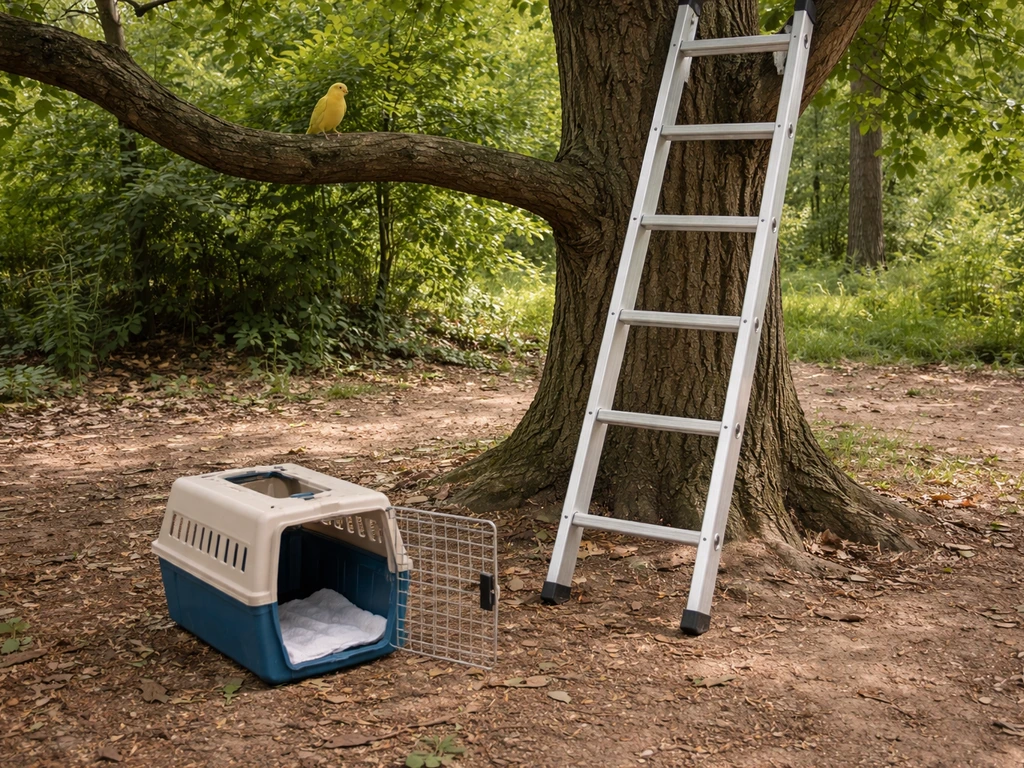
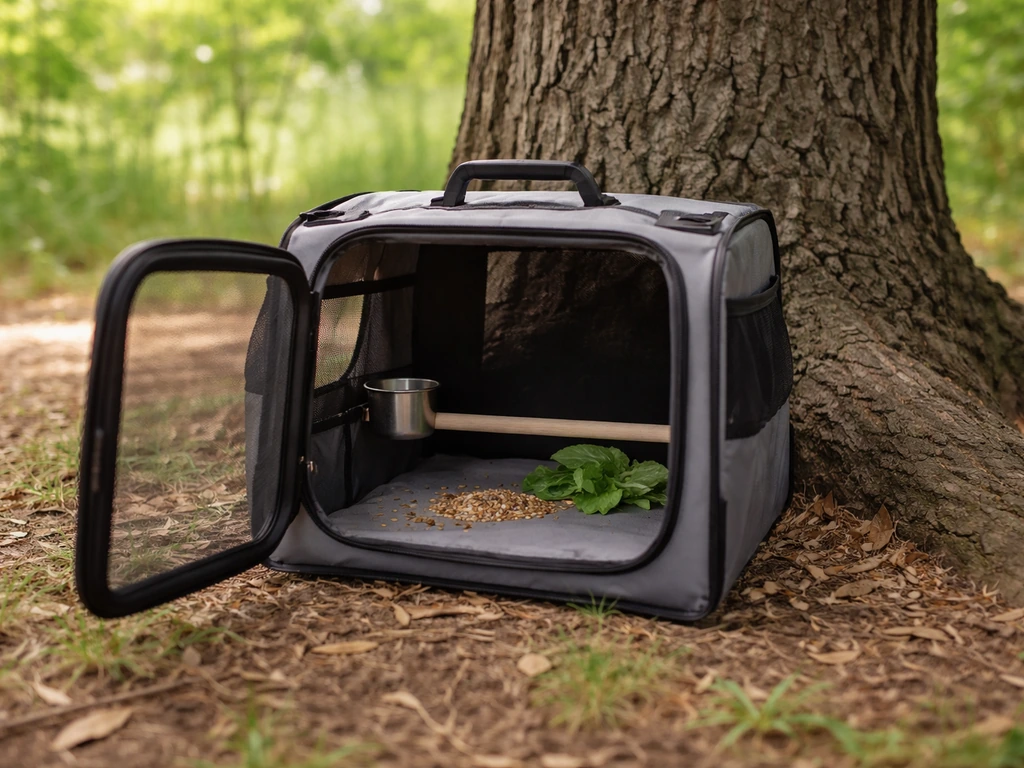
Go get the bird's own cage or travel carrier and place it at the base of the tree or as close as safely possible. Leave the door open. Put its favorite food inside, a piece of millet, a walnut, a chunk of banana, whatever it goes crazy for at home. The sight and smell of its own cage is genuinely reassuring to a pet bird. If the bird can hear or see the cage, it may simply fly down on its own.
You can also try bringing out a favorite perch stand and placing it at a height that's between the bird and the ground. Sometimes giving the bird an intermediate landing point helps it feel safe enough to descend in stages rather than all at once.
Using height to your advantage
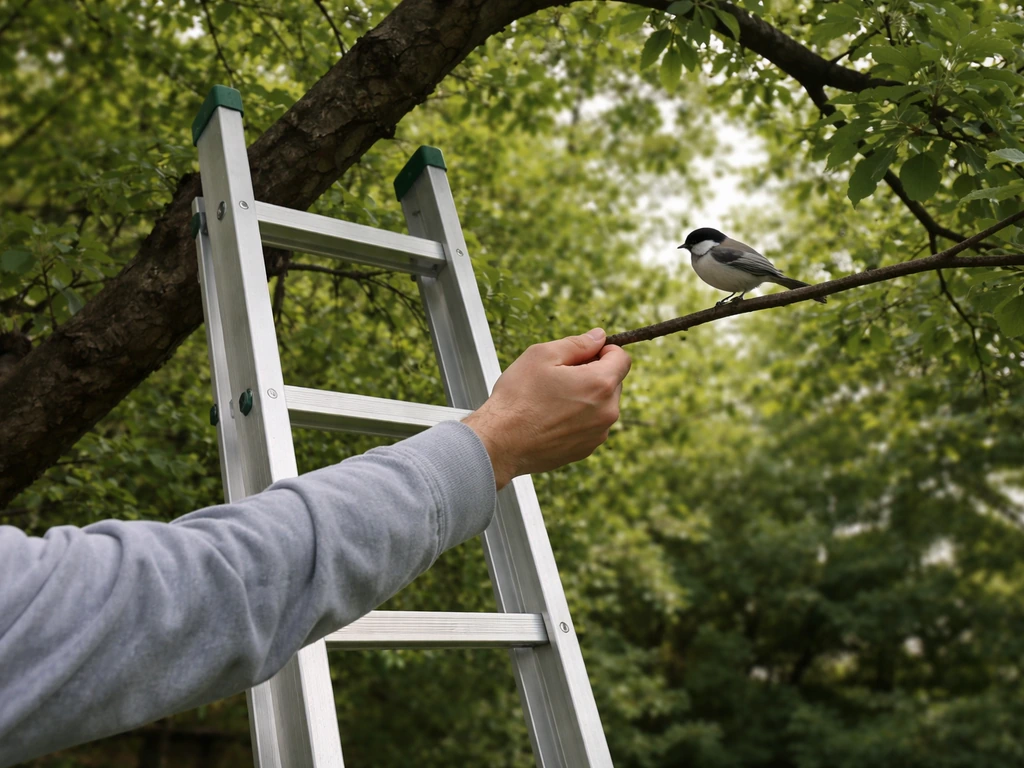
If the bird is on a branch you can reasonably reach with a ladder (say, 8 to 12 feet up), you can try offering your forearm or a familiar perch stick at branch level and letting the bird step onto it. Do this slowly and without grabbing. If you need a ladder, have another person hold it and move up carefully without sudden jolts or noise. Only do this if you feel confident and the ladder is stable on the ground, rushing a ladder retrieval and falling is a worse outcome for everyone.
For birds that are genuinely tangled in foliage or wedged in a crevice (as opposed to just sitting there), you'll need to gently part branches with one hand while guiding or supporting the bird's body with the other. If a foot or feather is physically caught, work slowly to free it rather than pulling, a broken blood feather or toe from a forceful yank will create a new emergency. If a foot or feather is physically caught, Merck advises working slowly to free it rather than pulling, because a forceful yank can create a new emergency broken blood feather or toe from a forceful yank will create a new emergency. If you can't see exactly what's caught, stop and call for help rather than guessing.
What not to do
- Don't chase the bird around the tree or try to corner it between branches — this almost always results in a longer flight to a harder location
- Don't spray water at it or shake the tree to dislodge it
- Don't have someone else approach from the other side while you approach from yours — two people converging reads as a predator ambush
- Don't attempt to retrieve it from a power line — that's a job for the fire department or utility company, full stop
- Don't reach above your comfort level on an unsecured ladder; a ladder fall is a much bigger emergency than a bird in a tree
- Don't force the bird to fly if it appears injured — a bird with a broken wing that's forced to attempt flight can worsen the fracture significantly
If the bird won't come down on its own
Set up the open cage with food right at the base of the tree. Stay nearby but stop actively trying. Birds often come down when humans back off and they stop feeling watched. Check every 5 to 10 minutes. If it's been more than an hour and the bird is healthy-looking, keep monitoring but also start making phone calls (see the section below) so you have help ready if needed. If the bird is very high up, top of a large tree, canopy level, and you can't safely reach it, that's when calling a local wildlife rescue or even a tree service that can work at height may be the right move.
When to call an avian vet or wildlife rescue (and what to tell them)
You should be making these calls right now, while attempting the retrieval, if you observed any of the injury warning signs above. If a bird gets stuck in a chimney, the safest approach is to call a professional rescue rather than trying to force it out. Don't wait until you have the bird in hand to start looking for help, because finding an avian vet or bird rescue that's available today can take time.
Call immediately if:
- The bird is breathing with its mouth open or the tail is pumping with each breath
- There is active, ongoing bleeding from any part of the body
- The bird cannot grip the branch or is hanging upside down and not recovering
- The bird looks fluffed, glazed, or unresponsive to familiar voice cues
- It's been in high heat and appears limp or lethargic
- You cannot safely reach the bird at its current height
- The bird appears to be physically tangled and you can't safely free it
To find help, search for an avian veterinarian or a bird-specific wildlife rehabilitation center in your area. The Association of Avian Veterinarians has a vet locator on their website. Your local humane society or animal control can usually refer you to a licensed bird rehab contact. In some areas, the fire department will assist with tree retrievals, especially if the bird is on or near power infrastructure, it's worth a quick call.
When you call, tell them: what species the bird is (parrot, cockatiel, conure, etc.), how long it's been in the tree, what height it's at, and exactly what symptoms you're seeing. Be specific, 'open-mouth breathing' is much more useful to a vet than 'it looks sick.' They can triage over the phone and tell you whether to wait for your appointment, come in right away, or get to an emergency facility.
Basic first aid after you get the bird down
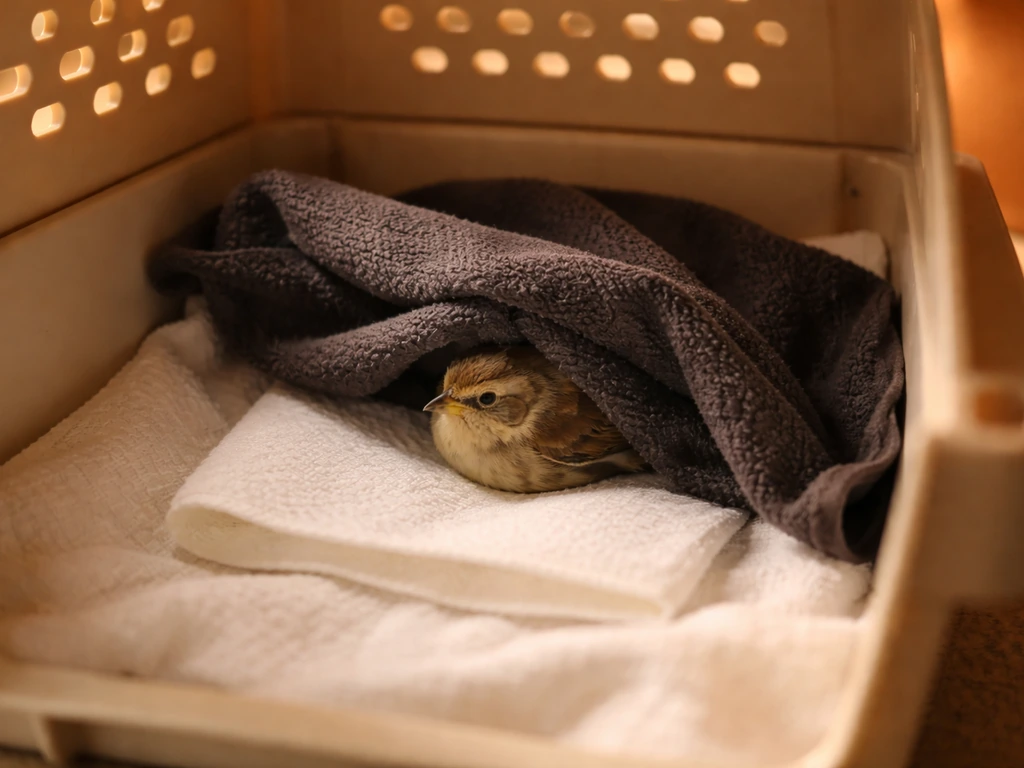
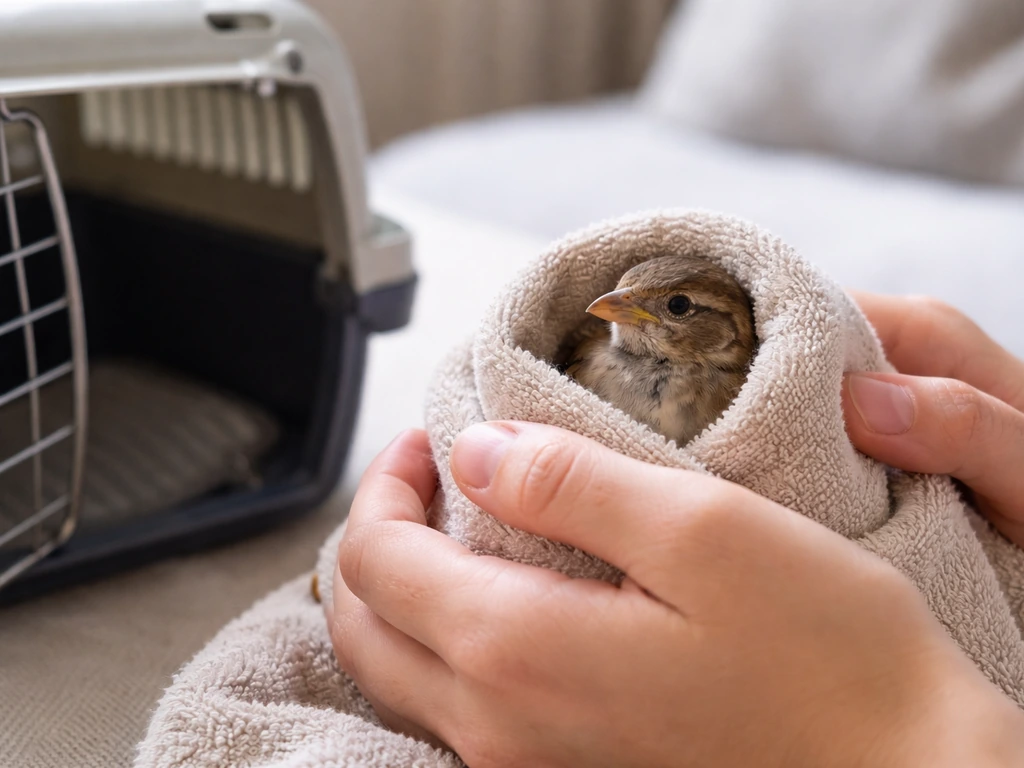
Once you have the bird in hand or in the carrier, your immediate job is warmth, quiet, and darkness. AZ Wildlife Resource also recommends keeping the animal warm, dark, and quiet during transport and not giving food or water your immediate job is warmth, quiet, and darkness. Birds in any kind of stress, even a non-injured scare, are at risk of shock. Their normal body temperature runs between 103 and 106°F, and they lose heat fast outdoors, especially in wind or after physical exertion.
- Place the bird in a carrier or a small box lined with a clean cloth or paper towel. Make sure there are air holes.
- Put the carrier somewhere warm (75 to 85°F is the target range), dark, and completely quiet — away from other pets, children, and noise. A bathroom with the door closed or an interior room works well.
- For extra warmth, place a heating pad on the lowest setting under half of the carrier (not the whole bottom — the bird needs to be able to move away from the heat if it gets too warm). A warm water bottle wrapped in a towel works too.
- Do not offer food or water until the bird is clearly stable and alert. Giving fluids to a bird in shock or with breathing difficulties risks aspiration.
- If there is active bleeding from a nail or small wound, apply gentle, steady pressure with a clean cloth for several minutes. Do not use a tourniquet. For blood feathers that are actively bleeding and won't stop, this requires a vet — don't try to pull the feather yourself unless you've been instructed to do so.
- Do not wrap the bird's body tightly. Birds breathe by expanding their chest, and any pressure on the torso can make breathing impossible. If you need to hold the bird to keep it still, wrap it loosely in a light towel around the wings and back only.
If the bird is unconscious or barely responsive, keep it warm and dark and get to an avian vet or emergency animal hospital immediately. Don't wait for it to 'come around.' Birds in shock can deteriorate very quickly.
Aftercare and monitoring, what recovery should look like
Even a bird that came down safely and looks fine should be monitored closely for 24 to 48 hours. The stress of an escape and outdoor exposure takes a real toll, and some signs of trouble don't show up immediately.
For the first few hours after retrieval, keep the bird in a quiet, warm space. Don't immediately return it to a large open cage with lots of stimulation. A smaller carrier or travel cage with perches, a small amount of familiar food, and access to water is ideal. Check on it every 20 to 30 minutes.
Signs the bird is recovering normally:
- Feathers are smooth and flat (not puffed out)
- The bird is alert, responsive to sound, and tracking movement with its eyes
- It's eating and drinking within a few hours
- Normal droppings are resuming
- It's vocalizing or showing interest in its surroundings
Signs something is still wrong and you need a vet:
- Feathers stay fluffed several hours after retrieval
- The bird is sitting at the bottom of the carrier rather than on a perch
- Breathing is still labored, fast, or involves open-mouth breathing
- It refuses food and water for more than a few hours
- Droppings are absent, bloody, or extremely watery
- One eye is closed, enlarged, or appears damaged
Once the bird is clearly stable, eating, alert, behaving normally, you can return it to its regular cage setup. Prepare that cage first (perches in place, food and water dishes set up) before you move the bird out of the recovery carrier, so the transition is quick and calm. A vet check the next day is still a good idea even for birds that seem fine, just to rule out internal injuries or stress-related issues that aren't visible.
Preventing escape and tree-related incidents next time
A bird that's escaped once is statistically more likely to escape again if nothing changes. This is worth addressing while the experience is fresh.
For outdoor time, the safest option is a fully enclosed aviary or a well-fitted harness with training. Harness training takes time and patience but gives you a way to safely take a bird outside without the risk of an uncontrolled flight. Never leave a harnessed bird unsupervised outdoors, hawks and cats are real threats.
Inside the house, check windows and doors before allowing free flight. When there is a bird stuck in my wall, the goal is the same as other indoor emergencies: keep it calm, reduce movement, and make it easy for the bird to exit safely Inside the house, check windows and doors before allowing free flight.. Screen doors are a common escape route because birds can push through or around them. If your bird is clipped, remember that even clipped birds can glide a significant distance in a panic, especially outside where there's wind. Wing clips should be maintained by an avian vet and rechecked every time the bird molts.
Recall training is genuinely worth the investment. A bird that's been trained to come to a target, a specific command, or the sound of a clicker has a much better chance of returning to you even after a fright. Basic recall takes only a few weeks to establish with consistent short sessions and positive reinforcement.
It's also worth noting that the 'stuck in a tree' scenario is just one version of an outdoor bird emergency. Birds can end up in equally difficult situations involving walls, air conditioning units, and chimneys, all of which share some of the same triage and retrieval principles, but with their own specific complications. The core rule is the same everywhere: calm first, retrieve carefully, and know when to call for backup.
| Situation | Try at home first? | Call for help immediately? |
|---|---|---|
| Bird is alert, gripping branch, vocalizing | Yes — lure with cage and food | No, but keep the number handy |
| Bird is very high up (canopy level) and unreachable | Partial — set up lure at base | Yes — contact wildlife rescue for height retrieval |
| Bird shows open-mouth breathing or tail bobbing | Attempt calm retrieval only | Yes — call avian vet right now |
| Active bleeding visible on the bird | Apply gentle pressure if bird is in hand | Yes — needs vet assessment |
| Bird appears limp, fluffed, or unresponsive | Keep warm and dark immediately | Yes — treat as emergency |
| Bird is physically tangled in branches | Gently free if safely reachable | Yes if tangled beyond safe reach |
| Bird is on or near a power line | Do not attempt retrieval | Yes — call fire department or utility company |
FAQ
How long should I try luring before I call for help if my pet bird isn’t coming down?
If your pet bird is still in the tree and appears alert, keep using the quiet-lure approach, but change tactics if there is no progress. A practical rule is to reassess every 5 to 10 minutes, and after about an hour of no movement or no clear engagement with the cage, start calling for help while continuing from a safe distance.
Is it okay to keep talking to my bird and urging it to come down?
Not usually. For a scared but healthy bird, loud voices, waving, and repeated “encouraging” can make it feel cornered and fly higher or into unsafe areas. If you need to reposition or check progress, do it quietly, then stop actively trying so the bird can calm.
What should I avoid using or doing, like nets or grabbing my bird?
Bring the cage and favorite food, but avoid placing large ladders, nets, or your hand directly under the bird if it’s panicking. Nets can tangle toes or wings, and reaching upward can trigger another burst of flight. Use ladders only if you can do it safely and slowly, and consider an intermediate landing perch if the branch is high.
What if my bird shifts to another branch while I’m trying to lure it down?
If the bird lands on a different branch, treat it as a new “starting point.” Keep the same calm approach, reposition the carrier toward the new position if you can do so safely, and offer an intermediate perch at a height between the bird and the ground.
Does direct sun or heat change how I should rescue a pet bird stuck in a tree?
Yes, but use caution. A bird in a heat-stressed situation can deteriorate quickly, especially if it has been up there for hours. If it seems very hot to the touch, is panting, has open-mouth breathing, or has been exposed to direct sun for a long time, prioritize professional help promptly rather than waiting for it to “work itself down.”
Can I climb closer or should I only use a ladder from a safe height?
If the bird is on a low branch you can reach safely without climbing, letting it step onto your forearm or a familiar perch is reasonable. If you must climb, don’t do it alone if the ladder setup is uncertain, and avoid sudden jolts or banging the tree, which can trigger another flight.
What’s the best first-care routine once the bird is safely in the carrier?
After you get the bird into the carrier, keep it warm, dark, and quiet, then offer access to water. You still want to avoid immediate loud stimulation or a big open cage right away. Check every 20 to 30 minutes at first, then reassess based on alertness and breathing.
What symptoms should I watch for in the next day or two after a rescue?
Monitor for delayed problems for 24 to 48 hours, even if your bird looks fine. Pay extra attention to breathing effort, unusual tail bobbing, weakness or inability to grip, reduced appetite, and abnormal droppings, since stress-related issues may not show immediately.
Do I still need a vet check if my bird seems normal after coming down?
Yes, especially if your bird had open-mouth breathing, seemed unable to grip, was wedged or tangled, or was up there in conditions like heat or wind for a long time. Even if it seems to recover, a vet visit helps rule out internal injury and stress effects that are not obvious externally.
How can I set up the scene if the tree is tall or I can’t safely reach the branch?
A good target is a familiar, low-stress exit path, typically the bird’s own cage at the base and a safe perch at an intermediate height if needed. If the bird is above reach or in a location you cannot access safely (for example, at canopy level or near hazards), focus on contacting a tree service or wildlife professionals rather than taking risky steps.
What should I do if I suspect the bird’s foot or feather is caught but I can’t clearly see the problem?
If the bird is tangled or wedged, don’t pull without seeing exactly what’s caught. Stop and call for help if you cannot identify the entanglement, because forceful pulling can cause a new injury. If you do have to part branches, do it gently and keep steady body support, so you do not twist the bird.
How do I reduce the chance my bird gets stuck or escapes again after this experience?
If your bird survives the tree incident, treat the escape as a training opportunity. While the experience is fresh, adjust your safety routine for outdoor time, upgrade window and door checks indoors, and consider structured recall training so the next fright doesn’t end in another uncontrolled flight.