
Yes, a bird can absolutely get stuck in or around an air conditioner, and it happens more often than most people realize. Birds enter through unscreened exhaust vents, gaps around ductwork, and openings in outdoor unit housings, and once inside they often can't find their way back out. If you're reading this because you can hear scratching, flapping, or chirping near your AC unit right now, the good news is that there are clear steps you can take immediately to help, and just as clear signals for when to stop and call a wildlife professional instead.
Can a Bird Get Stuck in an Air Conditioner? What to Do
Marcus Chen
28 May 2026
How birds end up inside or trapped near AC units
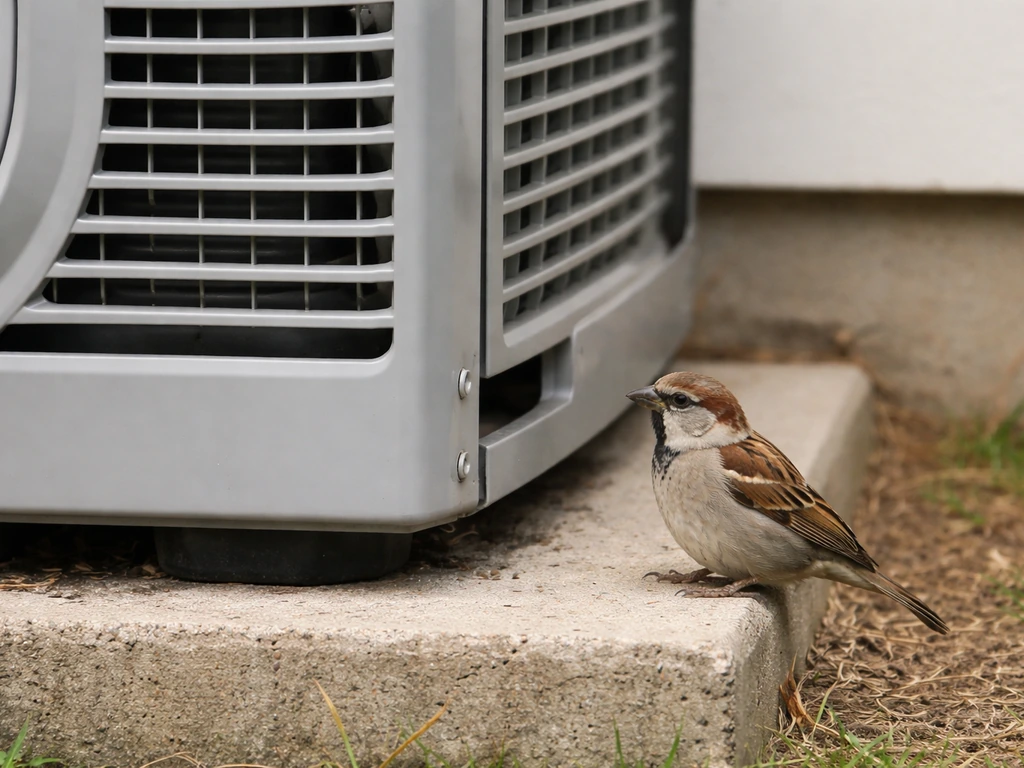
Outdoor condenser units, window AC units, and the ductwork connected to indoor systems all have openings that look like reasonable entry points to a bird looking for shelter or a nesting spot. Bathroom and kitchen exhaust vents are among the most common culprits because they often have flaps that can be pushed open from outside. If the screening is missing or damaged, a bird can walk or fly straight in. Gaps where duct pipes pass through walls or ceilings are another frequent entry point, especially in older homes.
Once inside, the bird usually panics. The space is dark, disorienting, and the surfaces offer little grip. A bird in ductwork may travel surprisingly far before it gets wedged or exhausted. Near an outdoor unit, a bird might fly into the fan housing or get a wing or foot caught in the grille. In some cases the bird manages to reach a vent cover on the inside of your home and you'll find it in a room, dazed and disoriented rather than still physically stuck.
Signs that tell you a bird is involved: repetitive scratching or rustling sounds near vents, faint chirping or distress calls coming from inside a wall or ceiling, feathers near an exterior vent opening, or a bird visibly wedged in or against a grille. If you can hear activity but can't see anything, check exterior vent covers first before assuming the worst.
What to do the moment you find a bird near the AC
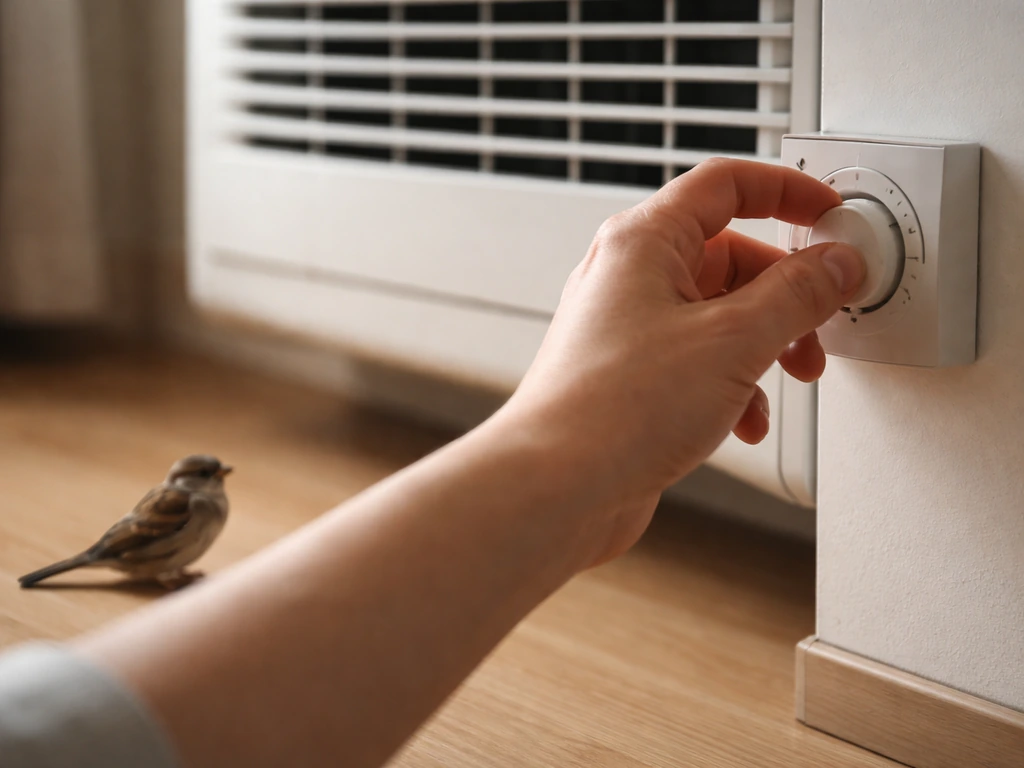
The very first thing to do is turn off the air conditioner. This is non-negotiable. A running fan can injure a bird that's already close to the blades, and even the airflow in ducts adds stress. Turn the unit off at the thermostat and at the breaker if you can do it quickly. Then take a breath and observe before you touch anything.
- Switch off the AC unit immediately, both at the thermostat and the breaker if accessible.
- Give yourself 60 seconds to observe the bird's condition before reaching for it. Is it moving? Breathing? Responding to your presence?
- Keep other people, pets, and loud noises away from the area. A panicked bird will injure itself further trying to escape.
- If the bird is visibly outside the unit or has emerged into a room, dim the lights. Birds calm down faster in low light.
- Grab a small cardboard box, a shoebox, or any container with a lid. Line it loosely with a cloth or paper towel. This is your holding container if you need it.
- Do not offer food or water at this stage, and don't try to handle the bird until you've read through the removal steps below.
How to safely remove the bird without making things worse
The method depends on where exactly the bird is. There are three main situations you'll likely face: the bird is in an accessible vent or grille opening, it's loose inside a room after escaping the ductwork, or it's wedged deeper inside the system where you can't reach it by hand.
Bird visible and accessible at a vent or grille
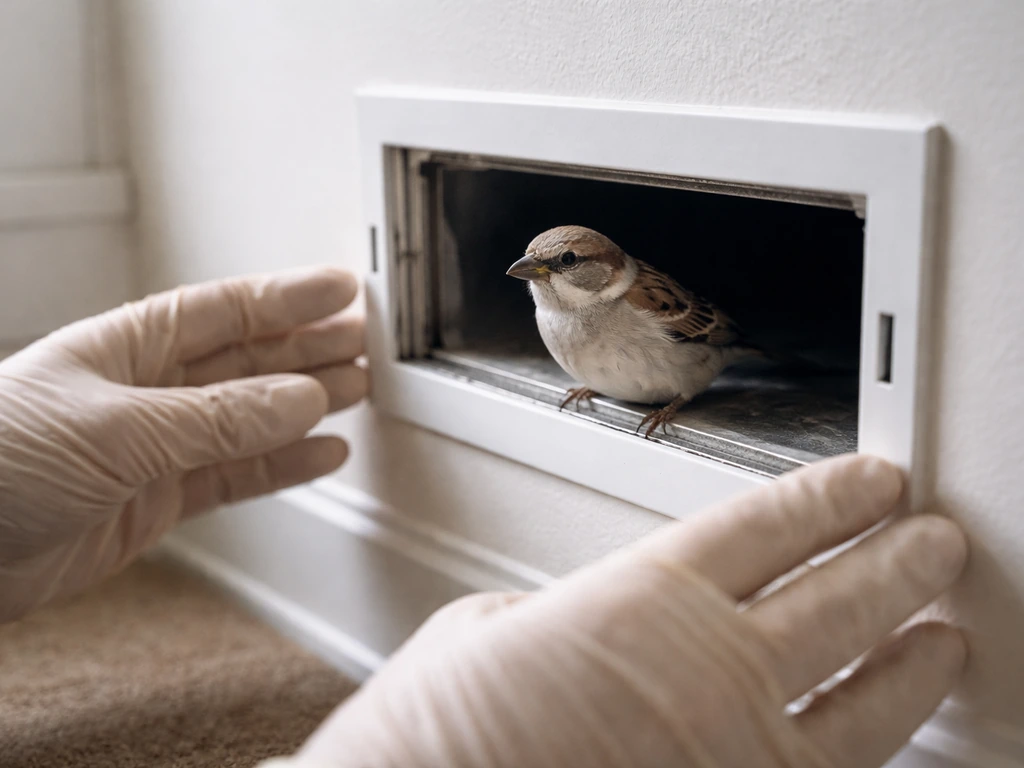
Put on a pair of light gloves if you have them, not because the bird is dangerous but because gloves reduce the warmth and scent transfer that stress the bird. Approach slowly and quietly. Place your open hand or a small folded towel over the bird to gently cup it without squeezing. The goal is to scoop rather than grab. Once you have the bird loosely enclosed in your hands or the towel, lower it directly into your prepared box and put the lid on. Leave a small air gap.
Bird loose inside a room
Close the room off from the rest of the house, close curtains on all but one window, and open that one window fully. Many birds will find their own way out if you just give them a clear exit and stop crowding them. If the bird is clearly injured and not flying, use the towel-and-box method described above: lay the box on its side near the bird, gently guide it in using a towel held behind it, then right the box and place the lid on loosely.
Bird stuck deeper in the duct system
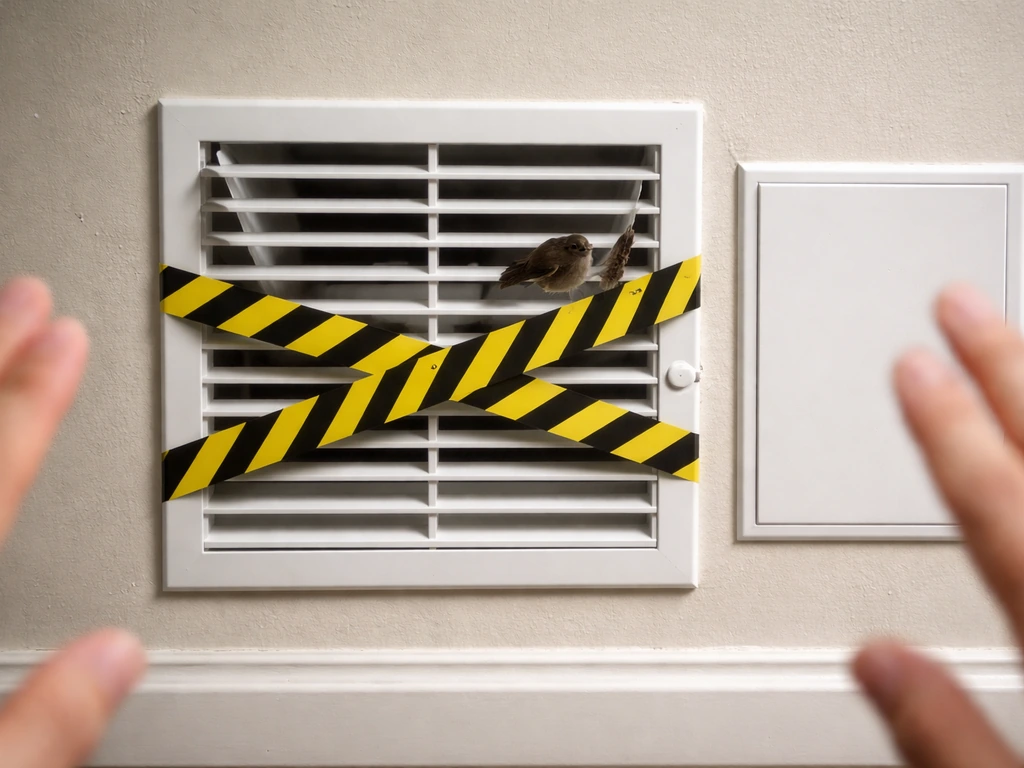
If you can hear the bird but can't see or reach it, do not start removing duct panels or cutting into walls yourself. If you are dealing with a pet bird stuck in a tree instead of near your AC unit, use a calmer approach and focus on safe retrieval rather than taking apart vents or duct panels pet bird stuck in tree. If you suspect there is a bird stuck in my wall, start by turning off the AC so it does not get injured further. You risk injuring the bird, causing damage to your HVAC system, and getting lost in terms of where the bird actually is. This is the scenario where you call for professional help (more on that in the next section). What you can do in the meantime: remove the nearest interior vent cover and lay a lighted path using a flashlight pointed into the duct from outside. Sometimes a bird will move toward the light and exit on its own within an hour or two.
A quick note on larger birds: if the bird in or near your AC is a hawk, crow, or any bird significantly larger than a robin, do not attempt to handle it yourself. Large birds have powerful talons and beaks and can cause real injury when frightened. Step back and call animal control or a wildlife rehabilitator directly.
When to stop and call a professional
There's a real difference between a bird that's temporarily trapped and a bird that's injured and needs medical care. Knowing which situation you're in changes your next move. Call a wildlife rehabilitator or avian vet if you see any of the following:
- Visible bleeding that doesn't stop within about 5 minutes
- A wing or leg hanging at an unnatural angle
- The bird is unresponsive or only weakly responsive to your presence
- The head is tilted sharply to one side, twisted, or the bird is circling or falling over
- The bird is gasping, breathing with an open beak, or the tail is pumping with each breath
- Vomiting or repeated regurgitation after the incident
- The bird has been stuck for more than a couple of hours and is visibly exhausted
- You cannot reach the bird safely and it is still trapped in the ductwork
While you wait for help, blank" rel="noopener noreferrer">keep the bird in that dark, quiet box in a warm room away from pets, children, and noise. Do not feed it, do not give it water, and minimize how often you open the box to check on it. The goal of everything you're doing right now is stabilization, not treatment. Treatment is the professional's job. If you're in the US, searching for your state's wildlife rehabilitator directory or calling your local animal control line will get you to the right person quickly. If you’re dealing with a case like “my bird is stuck in a tree,” the same idea applies: get local wildlife help as soon as you can. Many rehabilitation organizations have emergency lines.
Injuries to expect from an AC or vent incident
AC-related entrapment combines the physical hazards of tight spaces, hard surfaces, and moving parts with the stress of being unable to escape. That combination produces a fairly predictable set of injuries, and knowing what to look for helps you give accurate information when you call for help.
| Injury type | What it looks like | Urgency level |
|---|---|---|
| Wing injury | Wing drooping below the body, held out at odd angle, or bird unable to fold it properly | Call a rehabilitator; do not attempt to splint at home |
| Leg or foot injury | Limping, inability to grip or stand, leg twisted or dangling | Call a rehabilitator; keep bird contained and still |
| Head trauma / concussion | Disorientation, circling, tilted head, brief loss of consciousness, change in vocalizations | Urgent; call avian vet or wildlife rehab immediately |
| Bleeding | Visible blood on feathers, skin, or beak | If not stopped in 5 minutes, seek immediate professional help |
| Breathing distress | Open-mouth breathing, tail bobbing, gasping, labored movement | Urgent; can indicate internal injury or shock |
| Beak injury | Cracked, chipped, or misaligned beak | Needs professional assessment; avoid food/water attempts |
Head trauma deserves special attention in AC incidents because a bird moving through ductwork or striking a fan housing can hit its head hard against a metal surface. Signs of concussion in birds include brief loss of consciousness, sudden change in behavior or vocalization, vomiting, and a head that tilts or rotates involuntarily. These signs can also indicate internal bleeding or a skull fracture, so a bird showing any neurological symptoms should be treated as a medical emergency and transferred to professional care as quickly as possible. This is very similar to what happens in window collision cases, where the impact to the head is the primary concern.
Aftercare and making sure this doesn't happen again
If the bird you found was not seriously injured and either flew away on its own or was cleared by a rehabilitator, spend a little time figuring out how it got in. That's the most useful thing you can do for any future bird in your neighborhood, and for your peace of mind.
Securing your vents and AC unit
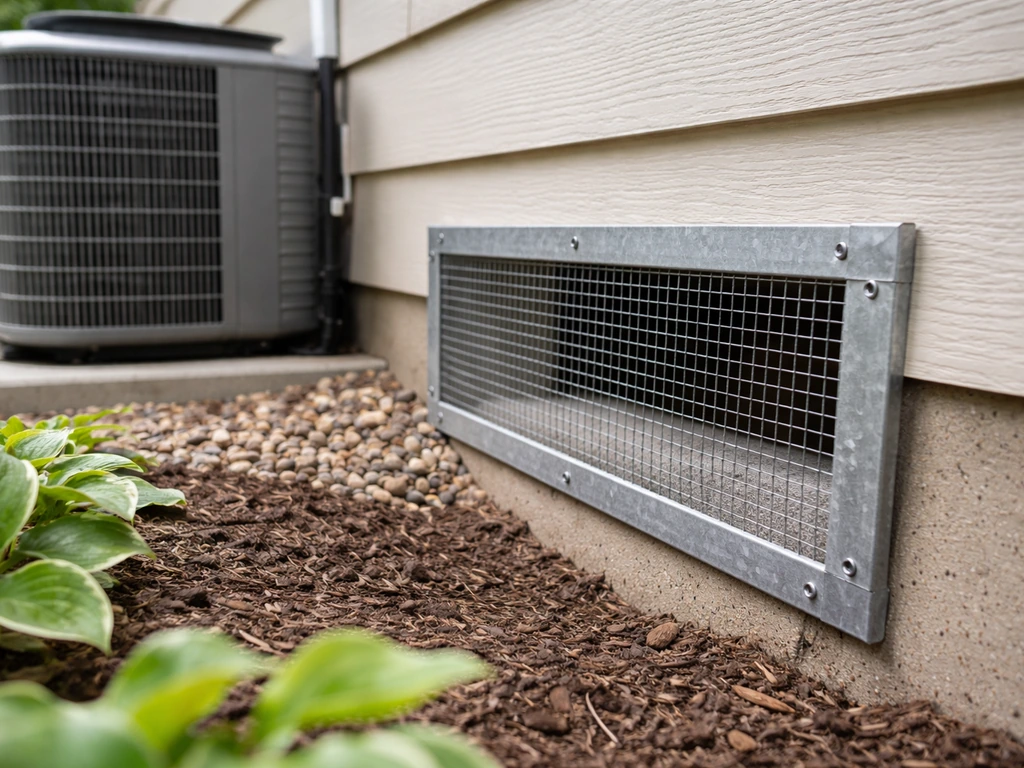
- Inspect all exterior exhaust vent covers (bathroom, kitchen, dryer) and replace any with missing or broken flaps. Hardware cloth or vent covers with a mesh backing are inexpensive and widely available.
- Check where HVAC pipes and ducts exit through exterior walls. Any gap wider than a centimeter is a potential entry point. Seal with weatherproof foam or metal flashing.
- If you have a window AC unit, check the foam side panels regularly. Birds and other animals can work these loose. Replace degraded foam and use a supplemental bracket or tape to keep panels tight.
- For outdoor condenser units, the grille openings are generally too small for most birds, but check for any damaged or missing sections of the outer casing and replace them.
- Avoid leaving any vent cover off for more than a few hours during inspections or renovation work, especially during spring nesting season.
Discouraging birds from nesting near vents
Some birds, particularly starlings and sparrows, are strongly attracted to exhaust vents as nesting sites because they're warm, sheltered, and elevated. If you notice nest-building activity near any vent opening, address it early in the season before eggs are laid. Once a nest contains eggs or chicks, many species are protected and removal requires contacting your local wildlife agency. The easiest prevention is simply a properly fitted vent cover with a functional flap that closes when the vent is not in use.
It's also worth knowing that birds getting trapped inside structures is a broader problem. The same instincts that send a bird into an AC vent can lead one into a chimney, a wall cavity, or an open window. If you've dealt with an AC incident, you're now better equipped to handle similar situations quickly and calmly if they happen again.
The bottom line: turn off the AC, stay calm, contain the bird in a dark quiet box if it needs help, and don't hesitate to call a wildlife rehabilitator if anything looks serious. Transport the bird to a rehabilitator as soon as possible and keep it in a quiet, dark, warm or dry carrier, and avoid handling the head or mouth due to bite risk. You don't need to fix the bird yourself. Your job is to keep it safe and get it to someone who can.
FAQ
How long can a bird stay in an air conditioner before it becomes dangerous?
There is no safe time window. If it is fully trapped, stress and exhaustion can escalate quickly, and head trauma or overheating can occur sooner than you might expect. If you cannot locate and contain it within an hour or so, switch from DIY searching to calling a wildlife rehabilitator or animal control.
Should I use gloves or a towel even if the bird seems calm?
Yes. Even a “calm” bird can panic when handled, and gloves or a towel provide a slight temperature and scent barrier that reduces sudden thrashing. Avoid thick pressure on the bird’s body, focus on cupping to minimize squeezing.
Is it okay to spray something near the AC to make the bird move?
Avoid sprays, perfumes, insecticides, or smoke. These can irritate a bird’s respiratory system and may complicate medical care later. Stick to quiet observation, turning off the AC, and providing a clear exit from a safe room if the bird is loose.
What if I can hear the bird but I see nothing, should I remove more vent covers?
Only remove the nearest accessible interior vent cover to create a lighted path and improve visibility into the duct run. Do not remove multiple duct panels or begin disassembly, because you can injure the bird, damage HVAC components, and still not reach the correct location.
Can a bird be stuck in the outdoor unit fan area, and is that harder to handle?
It can, especially if the bird flies into the grille or gets against the fan housing. This scenario is higher risk because the bird may be close to moving parts, so the priority is to shut off power and keep people back, then involve a wildlife pro for retrieval.
What should I do if the bird is actually coming from inside a wall or ceiling near the AC?
Treat it as a medical and access uncertainty issue. Turn off the AC, do not cut drywall or open walls, and document clues like exact sound location and whether you hear chirping versus scratching. Then call a wildlife rehabilitator so they can advise safe extraction options.
How can I tell if the bird is injured versus just trapped?
Look for neurological or severe trauma signs such as vomiting, sudden balance problems, uncontrolled head movement, bleeding, or a lack of alert movement. If it is breathing normally but is not trying to escape once you offer an exit, that still warrants professional guidance, especially if the bird cannot stand or fly.
Should I give water or food while waiting for help?
No. Do not feed or give water. Stress and improper feeding can worsen injuries, and birds may aspirate fluid. Keep it warm, quiet, and contained, and let a wildlife rehabilitator determine appropriate care.
What’s the safest way to capture the bird if it is on the floor or near a vent?
Use a small folded towel or your open hands to scoop without pinching. Place the bird directly into a prepared, ventilated box and lid it loosely with an air gap. Minimize the time spent with lights on and avoid chasing, which increases exhaustion.
Do I need to keep the bird warm, and how?
Yes, warm and stable is better than overheating. Place the box in a warm room away from drafts, but do not use direct heat sources like heating pads inside the box. A wildlife professional can advise exact temperature needs based on the bird’s condition.
Can I run the AC again after I relocate the bird outdoors?
Do not immediately restart the system if there is any chance the bird is still inside ductwork or the outdoor unit. Confirm the bird is fully accounted for, then consider checking for entry gaps and damaged vent covers before turning power back on.
What prevention steps actually stop birds from getting into AC vents?
Use properly fitted vent covers with functional flaps, repair damaged screens, and seal gaps around ductwork where pipes pass through walls or ceilings. For active nesting behavior, address it early before eggs or chicks are present, since removal may be restricted once nesting begins.