If your bird is stuck in a tree right now, stop and watch before you do anything else. Most birds that end up high in branches are not permanently trapped. They may be stunned, scared, or resting after a scare. Your first job is to figure out whether you are looking at a bird that will come down on its own in the next hour, or one that is injured and needs you to act faster. That distinction changes everything you do next.
My Bird Is Stuck in a Tree: Immediate Steps Today
Marcus Chen
30 May 2026
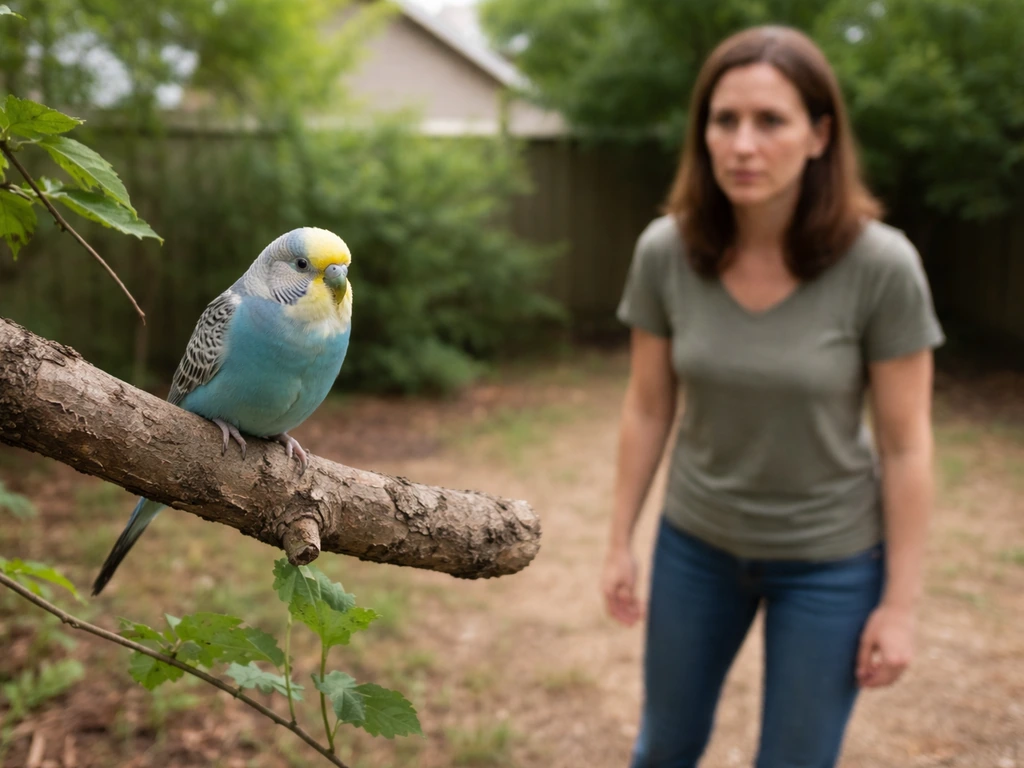
First: Is it actually stuck, injured, or just scared?
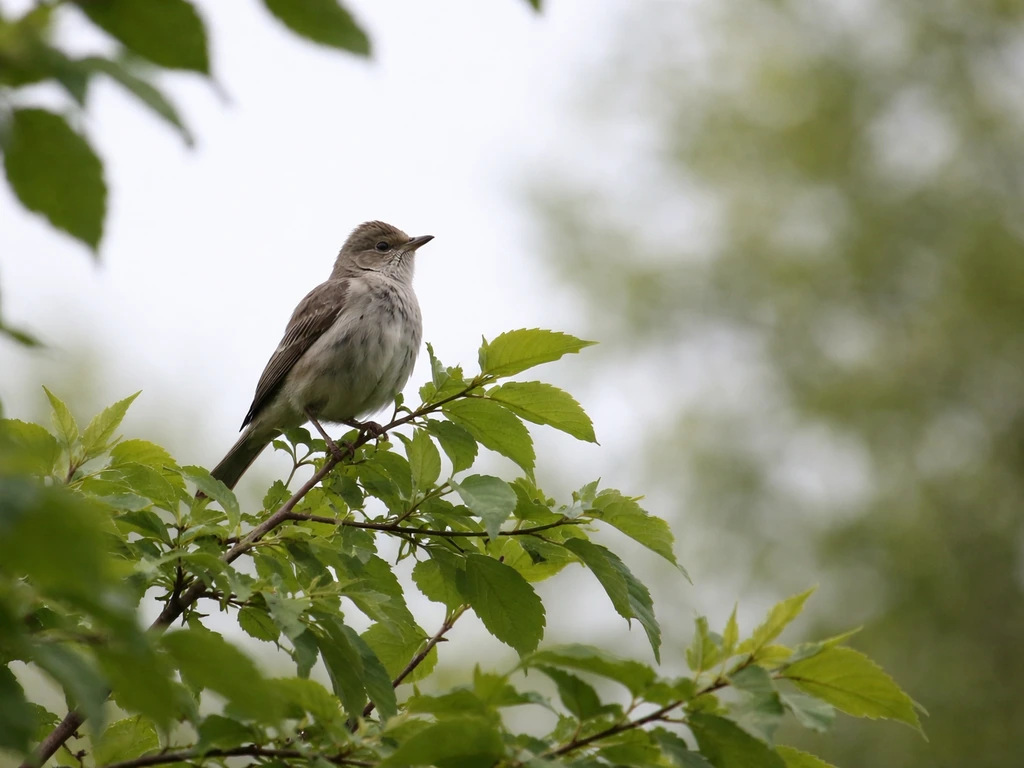
From a safe distance, watch the bird for two to three minutes before approaching. You are looking for specific signs that tell you how serious the situation is. A bird that is simply startled or temporarily grounded will usually hold itself upright on the branch, keep its head up, and respond to movement nearby by shifting position or flapping. That bird is probably fine and just needs time.
A bird that is injured or in real trouble will show you something different. These are the signs that should put you on alert:
- Visible blood or an open wound anywhere on the body
- A wing hanging lower than the other, or held at an odd angle
- A leg dangling or bent in the wrong direction
- Fluffed-up feathers combined with eyes that are partly or fully closed
- Open-mouth breathing, tail bobbing with each breath, or audible wheezing
- Unable to grip the branch properly, slipping or toppling
- Flies or maggots visible near the bird (a sign it has been stuck for a while)
- Complete unresponsiveness to noise or movement around it
If you see any of those signs, skip ahead to the first aid and rescue sections below. If the bird looks alert and upright but just is not flying, give it time first and keep reading.
Make the scene safe and reduce stress right now
Stress alone can kill a bird that is already in a fragile state. Before you do anything else, get everyone and everything away from the base of the tree. That means dogs, cats, children, and curious neighbors. Predators nearby can send a stressed bird into fatal panic, so this step matters more than most people realize.
Stand back at least 10 to 15 feet and keep voices low. Do not shake the tree, throw objects to try to dislodge the bird, or make repeated sudden movements. Every one of those things spikes the bird's stress response, burns its energy, and can cause it to move deeper into the branches or lose its grip entirely. Quiet and distance are your best tools at this stage.
If this is a pet bird, resist the urge to call to it excitedly. A calm, low, familiar voice is fine from a distance, but repeated loud calling can agitate it further. If you have a family dog or outdoor cat, bring them inside now and keep them inside until this is resolved.
How to help the bird come down on its own
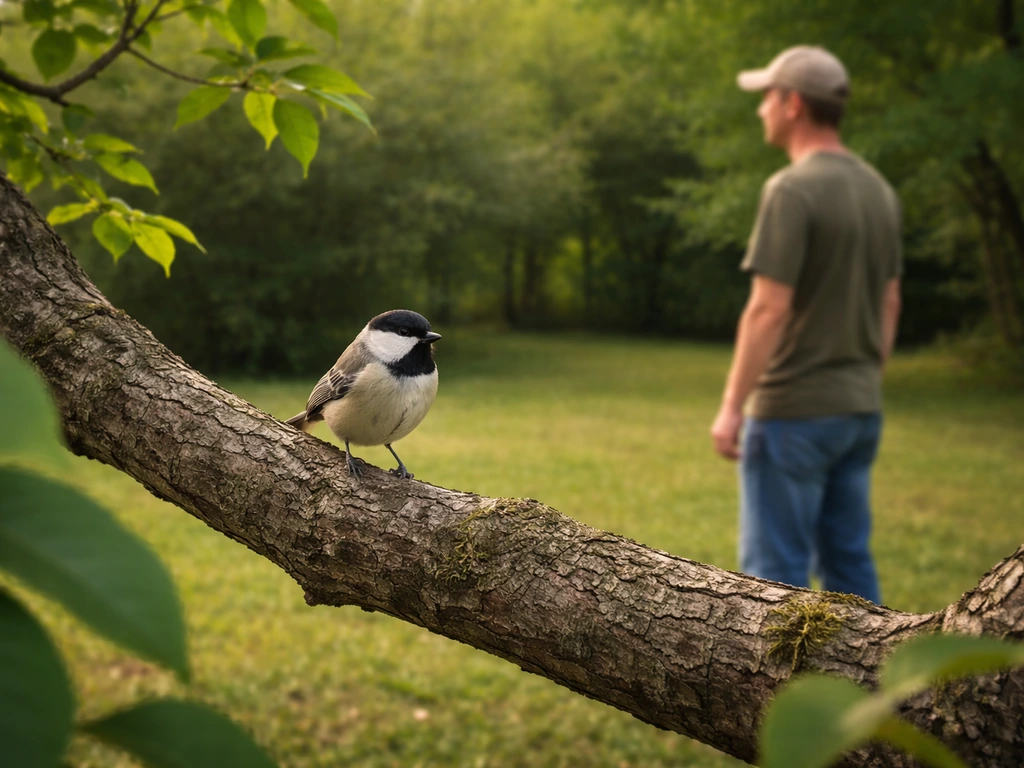
For a bird that appears alert and uninjured, giving it about an hour of quiet is the right move. Audubon's guidance on this is straightforward: if a bird does not fly away within roughly an hour, that is your cue to escalate. But do not just stand there staring at it. Create the conditions that make coming down easier.
- Move away from the tree and give the bird genuine quiet. Human presence nearby keeps a bird from relaxing enough to fly down.
- If it is a pet bird, place its familiar cage or carrier at the base of the tree, open and visible, with food inside. A bird that recognizes its own cage will often work its way toward it.
- If you have a favorite perch, toy, or treat the bird responds to, place it nearby. Familiar scent and sight can be a powerful draw.
- Do not place food or water directly under the tree for a wild bird. The goal is to let it fly down when ready, not to encourage it to stay stuck longer.
- Check back every 15 to 20 minutes without lingering. If you hover, you delay the bird's own confidence in coming down.
If it is a wild bird and you are past the one-hour mark with no movement, or if conditions are changing (heat, rain, approaching darkness, or a predator in the area), it is time to think about safe intervention or calling for help.
Safe retrieval options and when not to climb
Here is something I want to be direct about: climbing a tree to retrieve a bird is rarely a good idea, and it usually makes things worse. The bird will almost always move higher or deeper into the canopy when it senses you getting closer. You also risk a fall, and an injured bird that gets startled out of your hands from height has a very poor outcome.
Low-risk retrieval only makes sense when the bird is within easy reach from the ground, is clearly unable to move on its own, and you can approach it without a ladder. If those three conditions are all true, here is how to approach it safely:
- Wear light gloves if you have them. Even a small bird can bite or scratch when scared, and gloves also protect the bird from the oils and bacteria on bare hands.
- Approach slowly from the side, not from directly below or above. Coming from directly overhead triggers a predator response.
- Cup both hands gently around the bird's body, with its wings held lightly against its sides. Do not squeeze.
- Move smoothly and avoid sudden changes in direction once you have the bird in hand.
- Place it into a ventilated box or pet carrier lined with a soft cloth immediately. Do not hold it in your hands longer than necessary.
If the bird is a raptor (hawk, owl, falcon), do not attempt to handle it without guidance. Raptors have powerful talons that can cause serious injury to an unprotected hand, and handling them incorrectly can worsen their injuries. Contact a raptor center or licensed rehabber and describe the exact location while you wait for a trained person.
For birds that are genuinely wedged in branches or tangled in foliage, the same rule applies: call for professional help rather than forcing the bird free yourself. If the bird is stuck inside a wall, the safest move is to avoid poking or tearing into the structure and call wildlife help as soon as possible bird stuck in my wall. Tangled limbs or feathers can be more fragile than they appear, and pulling can cause additional injury.
Immediate first aid if the bird is hurt or bleeding
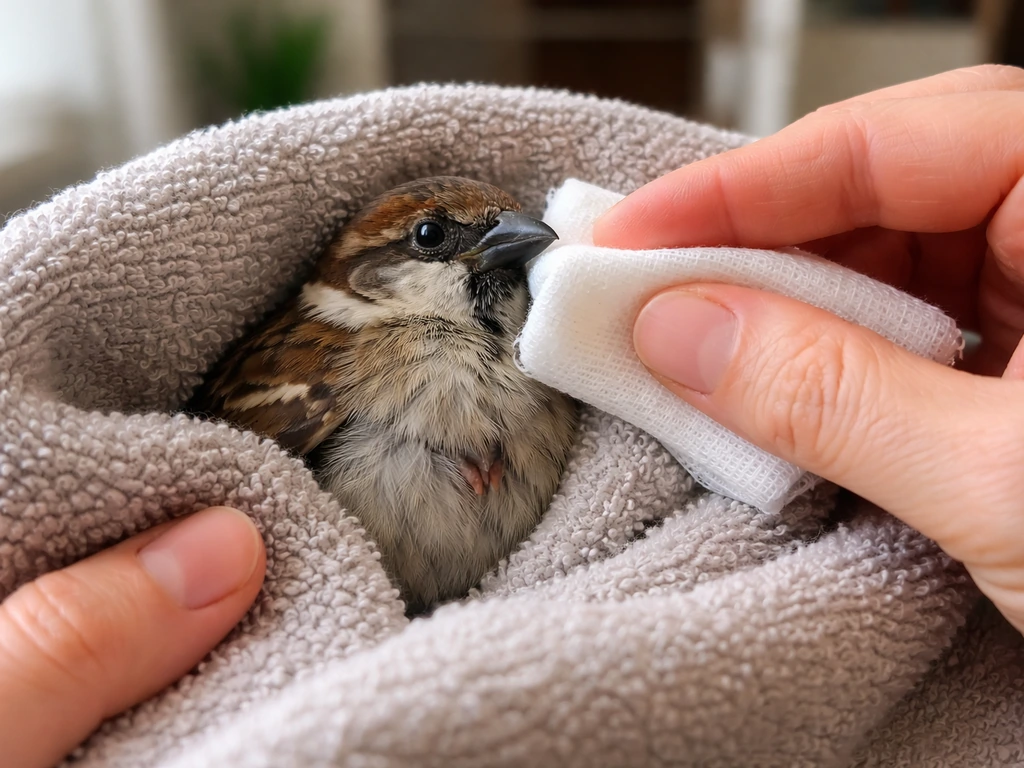
First aid for birds is supportive care only. It is not treatment, and it is not a substitute for getting the bird to a qualified avian vet or wildlife rehabilitator. With that said, there are a few things you can do in the short window between finding an injured bird and reaching professional help.
If the bird is bleeding, apply gentle, firm, continuous pressure to the wound using a clean cloth or gauze. Hold it steadily for at least five minutes without lifting to check. If bleeding has not slowed after five minutes, keep pressure on and get moving toward a vet or rehabber immediately. Do not attempt to pull out a damaged or broken feather. Do not apply antiseptic, hydrogen peroxide, or any topical medication without guidance from a vet.
Once bleeding is under control or if there is no active bleeding, the priority is warmth and darkness. Place the bird in a cardboard box or pet carrier (not a wire cage) lined with a soft cloth or paper towels. Put the box somewhere warm, dark, and genuinely quiet. Away from air conditioning vents, away from music, away from other pets. A warm room is ideal. Do not use a heat lamp directly on the bird.
Do not give the bird food or water. The Wildlife Trusts also advise not to offer food or water unless you have been told to by an expert. This is one of the most consistent pieces of guidance from every major wildlife organization, and it is worth repeating clearly. Water given incorrectly can go into a bird's lungs. Food given without knowing the species' needs can cause harm. The bird does not need either in the short term nearly as much as it needs warmth, quiet, and proper professional care.
Do not wet the bird's feathers. Soaking feathers in cold weather can trigger hypothermia rapidly, even in a bird that seemed stable moments before.
When to call wildlife rescue or an avian vet urgently
Some situations do not wait for the one-hour observation window. If you see any of the following, treat it as an emergency and call for help right now, not after trying other steps:
- Active bleeding that is not stopping with pressure
- Open-mouth breathing, wheezing, or tail bobbing with every breath
- A wing or leg that is clearly broken or hanging at the wrong angle
- Evidence of a cat or dog attack, even with no visible wounds (internal injuries and bacterial infection are serious risks from puncture wounds)
- Flies or maggots near the bird, indicating it has been immobile for an extended period
- The bird is completely limp or unresponsive
- The bird is in a dangerous location (near traffic, power lines, or in extreme heat or cold) and cannot move itself
- It has been stuck for more than an hour with no sign of improvement
A licensed wildlife rehabilitator is the right first call for wild birds. For pet birds, your avian vet is the priority. Do not assume a general practice vet has the expertise to treat a bird. Look specifically for an avian vet or a vet experienced with exotic animals.
Who to call and how to find help near you today
The fastest way to find a licensed wildlife rehabilitator near you right now is to use Animal Help Now, available at ahnow.org or as a free app. It connects you with the closest wildlife emergency helpers and provides direct contact information. This is the tool I recommend first because it works across the United States and gives you local results immediately.
Other reliable ways to find help quickly:
- Search your state's fish and wildlife agency website for a licensed wildlife rehabilitator directory. Many states like Wisconsin and Washington maintain searchable maps by species and location.
- Call a local wildlife center, nature center, or bird sanctuary. Even if they cannot take the bird, they almost always know who can.
- Contact your nearest animal shelter or humane society. They often have referral lists for wildlife situations.
- For pet birds, call your avian vet directly. If it is after hours, most avian vet practices have an emergency line or a referral to an emergency animal hospital.
- In a serious emergency with a badly injured bird, driving to the nearest animal hospital and calling ahead on the way is a reasonable step if you cannot reach a rehabber.
When you call, have this information ready: the species if you know it (or a description), where the bird was found and what it was doing, any visible injuries, how long it has been in the tree, and what you have already done. That saves time and helps the rehabber or vet give you the right instructions immediately.
Note that in the United States, most wild migratory birds are federally protected. Handling them without a permit is technically restricted under the Migratory Bird Treaty Act, which is one more reason to get a licensed rehabilitator involved rather than attempting extended at-home care.
Aftercare and what to do while you wait for help
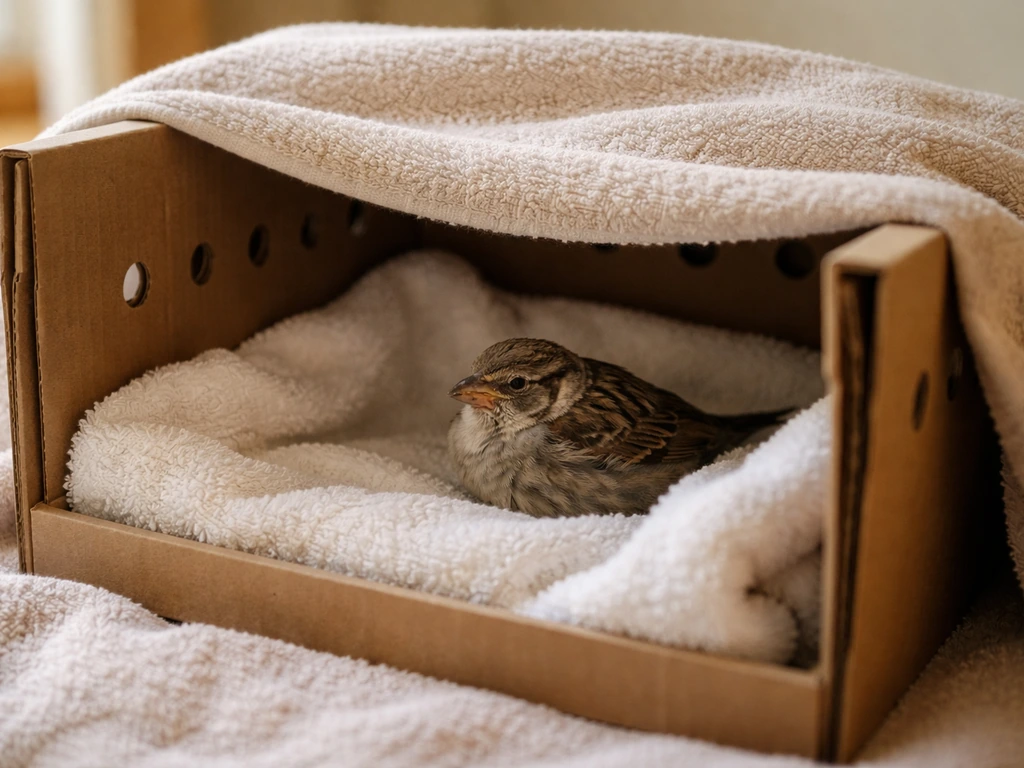
Once you have made the call and help is on the way, your job is to keep the bird stable. That means: box it in a ventilated, lined container, keep it warm and dark and quiet, keep all other animals and people away, and resist the urge to check on it constantly. Every time you open the box you add stress. Set a timer and check only when necessary.
If you retrieved the bird from the tree, place the closed box somewhere in your home away from air conditioning, heaters blowing directly, and noise. A quiet bathroom or spare bedroom works well. Room temperature, around 70 to 75 degrees Fahrenheit, is appropriate for most birds in interim care. Do not place it in a garage or car unless it is the last option and you are actively driving to get help.
If the bird is still in the tree and you are waiting for a rehabber to arrive, keep the area quiet, keep pets and people away, and watch from a respectful distance. For a pet bird stuck in a tree, keeping the area quiet and safe is often the most important step while you wait for help pet bird stuck in tree. Update the rehabber if the bird's condition changes, especially if it falls from the tree or stops responding to stimuli.
Tree situations are stressful, but they are also one of the more manageable scenarios compared to a bird trapped inside a structure. If you are dealing with a bird trapped in a chimney, the same calm, safety-first approach still applies before you involve qualified help a bird trapped inside a structure. If you have dealt with or are also facing situations like a bird stuck inside a wall or a bird caught in a chimney or air conditioner, the core principles are the same: observe first, reduce stress, contain safely if needed, and get professional help for anything beyond a minor temporary grounding. The bird's welfare always comes before speed or convenience, and a calm, organized response gives it the best possible outcome.
FAQ
My bird is in the tree but seems awake and responsive. Should I try to tempt it down with food or its favorite perch?
No. Even for a bird that looks alert, avoid offering food or water to lure it down. In the short window, the safer approach is quiet, distance, and watching for the next hour, then escalate if it does not fly away or if you notice any injury signs.
How close is “safe distance,” and what should I do with my camera or flashlight?
Stay at least 10 to 15 feet back, keep voices low, and avoid hovering over it. Use only minimal light, and avoid shining bright flashlights or repeatedly moving lights, because sudden light and motion can increase panic and cause it to burn energy or drop unexpectedly.
What if it is getting dark or it is raining, and the bird still will not fly?
Treat changing conditions as a reason to escalate rather than waiting for a full hour. Darkness, rain, and heat can rapidly worsen a stressed or injured bird’s condition, so call a licensed wildlife rehabilitator (wild birds) or an avian/exotics vet (pet birds) as soon as you can.
Is it okay to shake the branches a little or bang lightly to get it to grab?
Do not shake the tree or make repeated sudden movements. Those actions spike stress, can cause the bird to lose grip and fall, and can push it deeper into the canopy or into worse tangles.
Can I gently cover the bird with a towel from the ground to calm it?
Only attempt contact if it meets the low-risk retrieval conditions (easy ground reach, clearly unable to move on its own, no ladder needed, and you can approach without escalating its panic). If you cannot do that, focus on containment and professional help, because towel attempts often lead to sudden flapping from awkward heights.
If the bird is wedged in branches, how do I know whether it is safer to pull limbs off its body?
Avoid pulling on feathers, limbs, or tangled foliage. Instead, call for professional help, because feathers and fragile tissues can tear with surprisingly little force, and you can turn a minor snag into a serious injury.
What if the bird falls or drops while I am waiting, but it looks mostly okay?
Treat the fall as a possible injury even if it seems alert. Place it in a warm, dark, lined container and contact the appropriate professional (avian vet for pets, licensed rehabilitator for wild birds). Update them that it fell and how it is behaving now.
Should I try to bandage the wing or wrap a broken leg myself?
Do not attempt improvised bandaging or splinting unless instructed by a qualified avian professional. Incorrect wraps can restrict breathing, worsen circulation, or prevent natural positioning needed for transport to care.
If there is bleeding, for how long should I keep pressure before deciding it is not stopping?
Apply gentle, firm, continuous pressure for at least five minutes without lifting to check. If bleeding has not slowed after five minutes, keep pressure on and start moving toward professional help immediately.
Can I use antiseptic or peroxide to clean the wound?
Avoid topical medications unless you are told to by a vet or rehabilitator. Substances like antiseptics and hydrogen peroxide can damage tissue, delay healing, and increase stress during an already critical time window.
The bird seems cold. Is it safe to use a heat lamp to warm it faster?
Do not place a heat lamp directly on the bird. Use warmth and darkness by keeping it in a lined cardboard box or pet carrier in a genuinely warm, quiet area, away from vents. Heat lamps can overheat or create dangerous hot spots.
Is it okay to give the bird a drink or small amount of water to prevent dehydration?
No. Do not give food or water. Water can be aspirated into the lungs, and dehydration can be managed by professionals after the bird is stabilized and assessed.
Should I remove debris from the bird’s feathers or try to pre-clean it?
No. Do not wet the feathers and do not attempt to groom or clean. Keep it warm, dark, and quiet, then let a rehabilitator or avian professional handle cleaning and any feather or skin issues.
I cannot identify whether it is a wild bird or a pet. What should I do first?
If you are unsure, treat it as potentially wild until proven otherwise and get professional help. Describe the bird and location to the responder, but avoid extended at-home care and avoid handling beyond the low-risk retrieval conditions.
What information should I tell the rehabber or vet when I call?
Share the species if known (or a clear description), exact location, what the bird was doing before you found it, any visible injuries, how long it has been in the tree, and what actions you already took (such as watching time, whether it fell, and whether you placed it in a box). This helps them give immediate, specific next steps.
Can I keep checking the bird by opening the box frequently to see if it is improving?
Avoid constant checking. Openings add stress, so set a timer and check only when necessary, then keep it warm, dark, and quiet in between checks until professional care takes over.