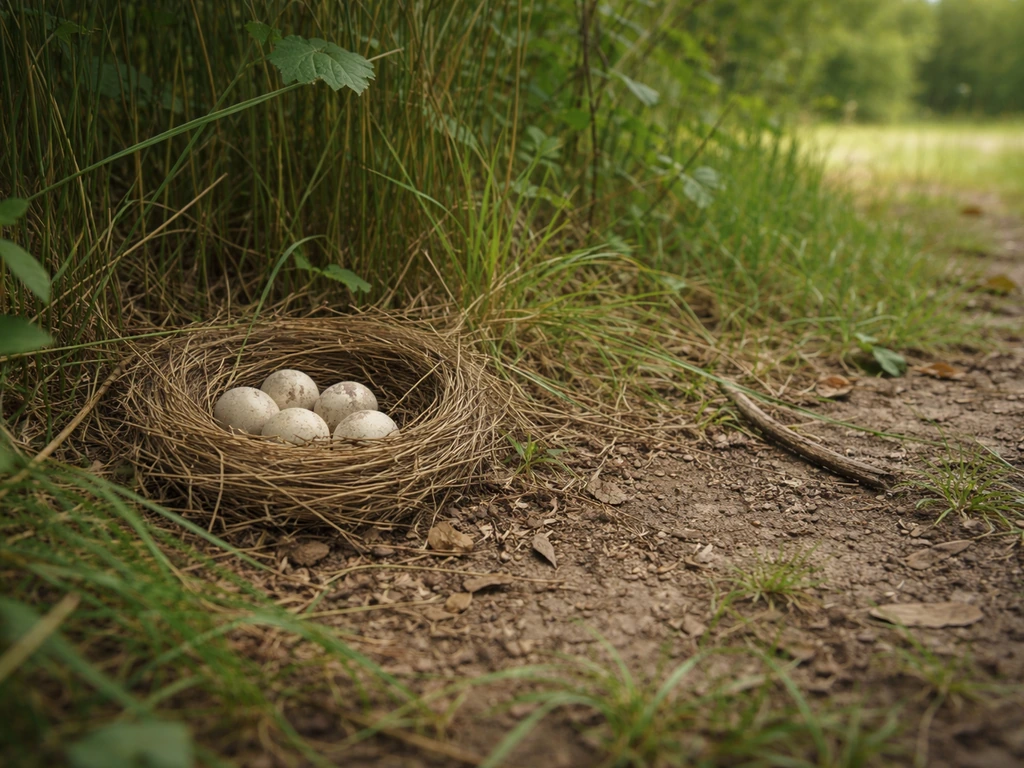
If you've just found a bird on the ground that fell out of a nest and can't fly, here's the most important thing to know right now: most of the time, that bird does not need you to rescue it. It needs you to leave it alone and keep your pets away. But sometimes it genuinely does need immediate help, and knowing the difference is everything. This guide will walk you through exactly how to tell which situation you're in, what to do in the next hour, and when to pick up the phone.
Bird Fell Out of Nest and Can’t Fly: What to Do Now
Marcus Chen
20 Apr 2026
First, figure out what you're actually dealing with
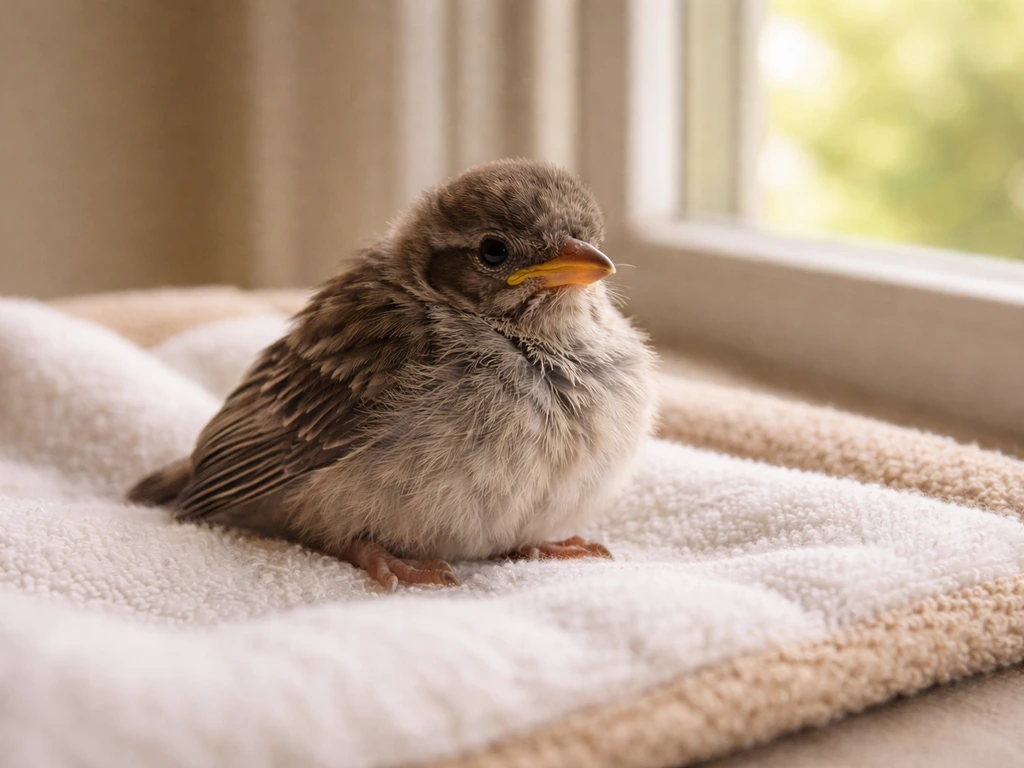
Before you touch anything, take thirty seconds to look at the bird from a few feet away. The single biggest mistake people make is assuming a bird on the ground is in trouble. In spring and early summer, it's completely normal to find young birds sitting on the ground or hopping around in low shrubs. These are fledglings, birds that have left the nest intentionally and are in the middle of learning to fly. Most fully feathered fledglings spend two to three days on the ground before they can actually get airborne. Their parents are almost always nearby, watching and still bringing food.
So step one is identifying what stage the bird is at. A nestling is small, mostly naked or with just a few tufts of down, eyes possibly still closed, and completely helpless. That bird fell out too early and does need your help getting back. A fledgling is fully or mostly covered in feathers, has its eyes open, can grip with its feet, hops or shuffles around, and may even flap its wings.
WDFW also notes that a bird on the ground with full but fluffy feathers is most likely a fledgling that has left the nest and is still being cared for by its parents full or mostly covered in feathers. If the bird has fallen out of nest and you are unsure whether it is injured or just learning to fly, use the triage steps above to guide your next move.
That bird is supposed to be on the ground. The RSPCA, Audubon, and the Wildlife Trusts all emphasize the same point: a fully feathered young bird found on the ground during nesting season is usually fine and should be left alone.
| Feature | Nestling (needs help) | Fledgling (likely normal) |
|---|---|---|
| Feathers | Mostly bare or just a few tufts | Fully or mostly feathered |
| Eyes | Closed or just opening | Open and alert |
| Movement | Cannot stand or grip | Hops, grips, moves around |
| Size | Very small, fragile | Close to adult size |
| What to do | Return to nest if possible, call a rehabber | Leave it alone, watch from distance |
Quick triage: is the bird actually injured or just a fledgling doing its thing?
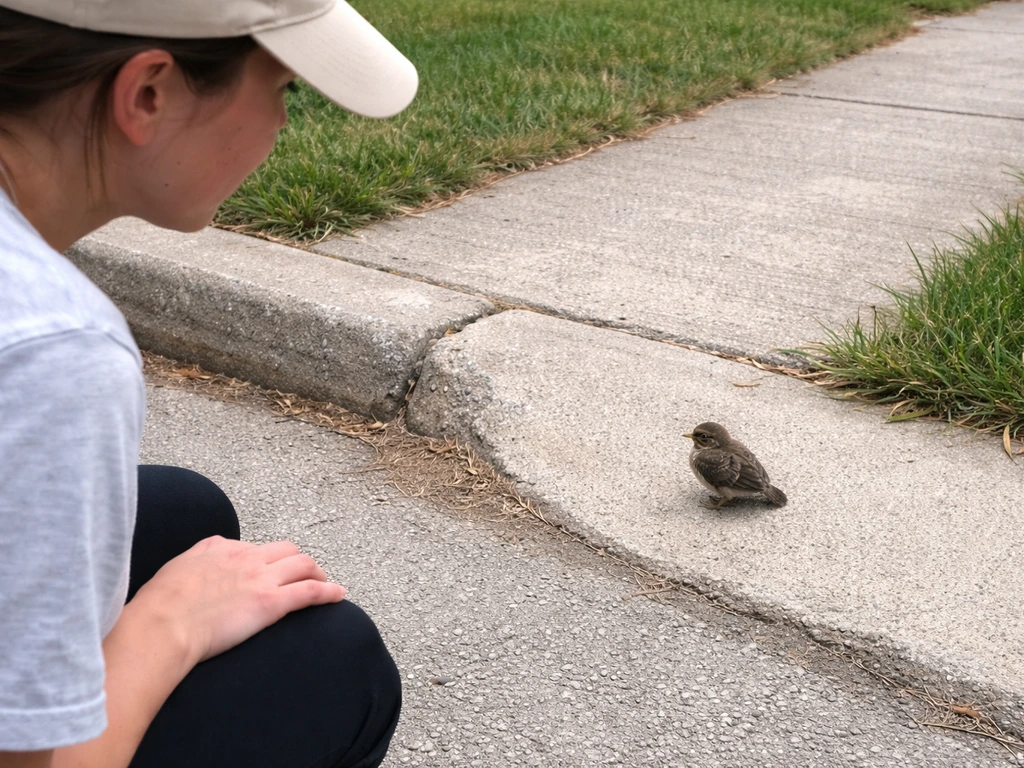
Watch the bird from a distance of at least 10 to 15 feet for a few minutes. Do not stand right over it. You're looking for two things: signs of injury and signs that parents are coming back. If parents are visiting within an hour or two, even if you can't see them the whole time, the bird is almost certainly fine.
The U.S. Fish and Wildlife Service says to step in when a bird shows visible signs like a broken limb, bleeding, shivering, or when a deceased parent is nearby. If the bird is not showing any of those things, and it's feathered, and it's moving around on its own, the best action is to leave it and keep the area calm. The Wildlife Care Association's 2025 Hotline Manual recommends watching and checking back within 4 to 8 hours if you don't see parents, rather than immediately intervening.
One useful test: if you walk calmly toward the bird and it moves away from you, hops, or flaps, that's a good sign. A bird that sits completely still and doesn't react, or that lets you pick it up without any resistance, is more likely to be injured, stunned, or sick. A healthy fledgling will at least try to get away from you.
How to tell a broken wing or leg from normal fledgling behavior
You don't need to be a vet to spot the red flags. From a distance, look at the bird's posture. A bird standing upright, holding both wings symmetrically against its body, and using both feet is almost certainly not injured. A bird with one wing drooping lower than the other, or one that's dragging a wing along the ground, likely has a wing injury. Tufts Cummings School of Veterinary Medicine lists these as clear injury indicators: a drooping wing, inability to stand or hop normally, lameness, visible wounds, blood, or any sign of flies around the bird (which can indicate an open wound).
Breathing problems are another serious red flag. If the bird's beak is open and it's visibly laboring to breathe, that's an emergency. A bird that's lying flat on its side and not righting itself needs help immediately. A bird that's just sitting quietly on the ground with good posture, watching you with both eyes, is far more likely to be a fledgling taking a break than a bird in crisis.
- One wing drooping or held at an odd angle compared to the other
- Unable to stand, keep falling over, or lying flat on its side
- Visible blood, open wound, or flies circling the bird
- Obvious bone deformity or limb at an unnatural angle
- Breathing with mouth open, labored or gasping breaths
- Shivering or trembling
- Eyes closed or sunken, bird unresponsive to your approach
- Dead parent bird nearby
If you see any of those, the bird needs professional care. If you don't see any of those and the bird is feathered, you're probably looking at a normal fledgling.
What to do (and what not to do) right now
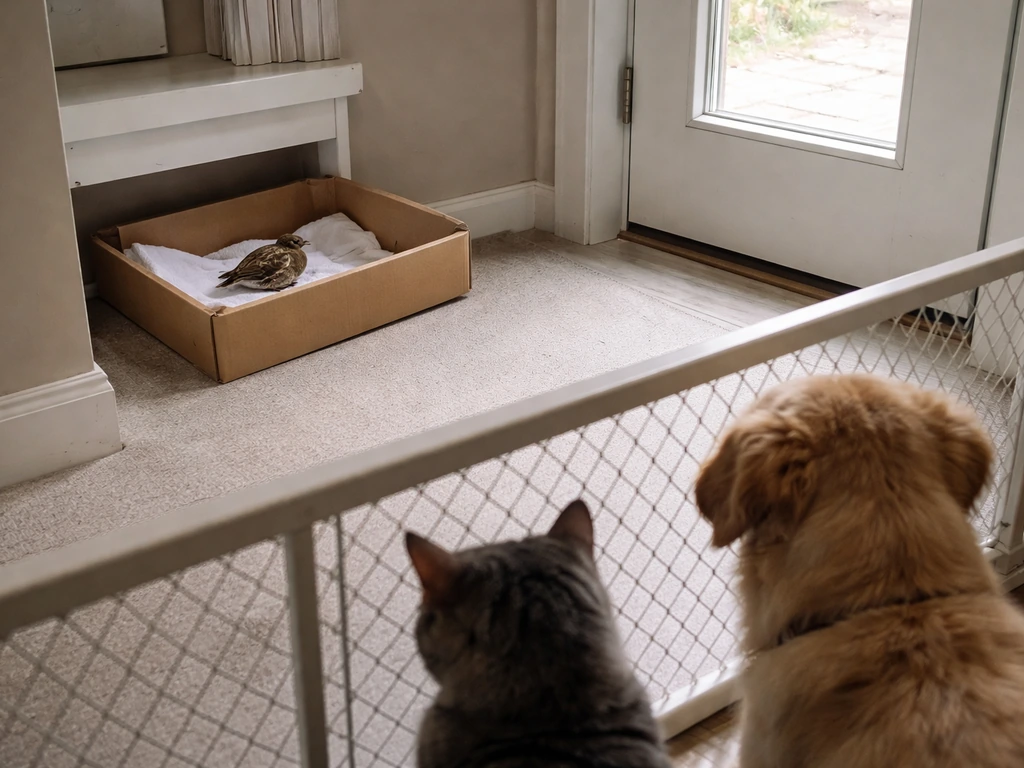
If you've determined the bird is a fledgling with no visible injuries, your job is simple: do as little as possible. Keep your distance, bring any cats or dogs inside, and ask children to stay back. Audubon specifically recommends keeping pets away until the fledgling has left the area on its own. The Washington Department of Fish and Wildlife says keeping cats, dogs, and curious children away allows the mother to continue feeding her young on the ground. Parents will not abandon a chick just because humans have been nearby, but they will stay away as long as threats are present.
If the bird is a naked nestling that clearly fell from the nest, and the nest is visible and accessible, you can put it back. The old belief that a mother bird will reject a chick if humans have touched it is a myth. Birds have a poor sense of smell and will not reject their young because of your scent. The Wild Bird Fund recommends placing the baby back in the nest and then watching from a distance to confirm parents return.
Now, here's the part most people get wrong: do not feed the bird, and do not give it water. This applies whether it's a nestling or a fledgling. Audubon, Tufts, the Avian Wildlife Center, and the American Eagle Foundation all give the same instruction. Birds have a very specific airway anatomy that makes it easy for liquid to go into their lungs rather than their stomachs. Giving water can drown a bird from the inside. Giving the wrong food can make things significantly worse. Even well-meaning feeding with bread, milk, or worms can cause serious harm. Feeding is a job for trained wildlife rehabilitators, not for the hour you spend waiting to reach one.
- Do: watch from a distance of at least 10 to 15 feet
- Do: keep pets and children well away from the bird
- Do: if the nest is accessible and the bird is a naked nestling, gently return it
- Do: call a wildlife rehabilitator or avian vet if you see injury signs
- Don't: offer food or water under any circumstances
- Don't: handle the bird more than necessary
- Don't: put the bird in a wire cage (it can damage feathers and feet)
- Don't: keep the bird warm under a heat lamp or in direct sunlight
- Don't: leave it overnight without contacting a rehabber if parents haven't returned
Setting up a safe temporary space if the bird needs it
If the bird is injured, genuinely orphaned, or in immediate danger and you need to contain it while you find help, the setup matters. The goal is warmth, quiet, darkness, and safety. Use a cardboard box or a plastic pet carrier, not a wire cage. Wire cages can damage feathers and injure toes and beaks. Line the bottom with paper towels or a soft cloth so the bird can grip. Poke several air holes in the lid if it's a box. Put the box somewhere quiet, away from pets, children, direct sunlight, air conditioning vents, and noise.
Warmth is critical, especially for nestlings. Baby birds can go into hypothermia quickly. The Avian Wildlife Center and DFW Wildlife Hotline both recommend placing a heating pad set to LOW under half of the box, not the whole bottom, so the bird can move away from the heat if it gets too warm. Alternatively, fill a sock with uncooked rice, microwave it for about 30 seconds, wrap it in a thin towel, and place it next to (not on top of) the bird. Check it every 20 minutes to make sure it stays warm but not hot. The Wild Bird Fund says a hand warmer wrapped in a towel works too. The idea is gentle background warmth, not direct heat.
Do not put the bird in a completely sealed or airtight container. Do not cover the air holes. And remember: this is a temporary measure while you get the bird to a professional, not a long-term solution. The quieter and darker you keep it, the less stressed it will be.
When to call wildlife rescue or an avian vet right away
If any of the injury signs listed earlier are present, don't wait. Call now. The same applies if a cat or dog has had the bird in its mouth, even for a second (more on that below). Also call immediately if the bird is a naked nestling and you can't find or reach the nest, if it's getting dark or cold and parents haven't returned after watching for a couple of hours, or if the bird is in an unsafe location where you can't protect it from predators.
Tufts specifically notes that if it's getting dark and parents haven't returned, don't leave babies overnight without calling for guidance. Hypothermia and predation risk go up significantly after dark. The 2025 Wildlife Care Association Hotline Manual puts the check-back window at 4 to 8 hours when parents are not observed, and recommends bringing the bird in if you're genuinely unsure.
To find help near you, search for 'wildlife rehabilitator near me' or use the National Wildlife Rehabilitators Association (NWRA) or Wildlife Rehabilitator Directory tools online. You can also call your local animal control office, humane society, or a local avian vet, as they often keep lists of licensed rehabilitators. In the U.S., most wildlife rehabilitators are licensed by their state and operate under strict standards. Many take calls around the clock or have hotlines. When you call, describe what the bird looks like, what species you think it is, what you observed, and whether it was found near a nest or in the open.
Special situations that change everything
Cat or dog bites
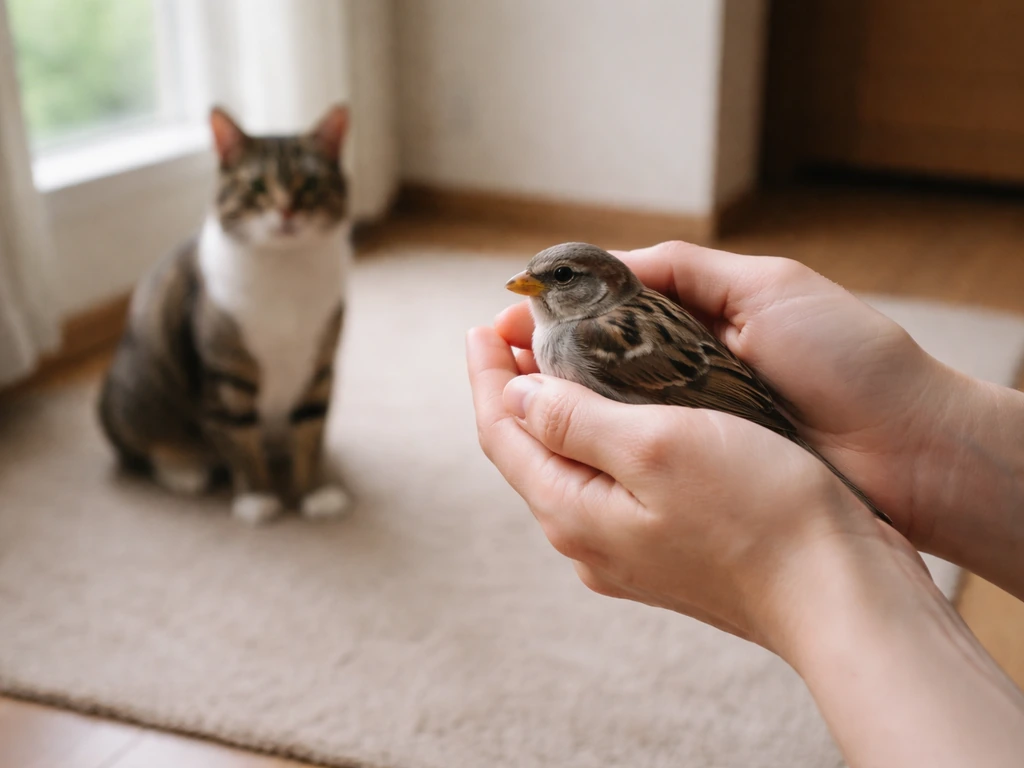
This is a hard rule: if a cat or dog has had the bird in its mouth, even briefly, treat it as an emergency regardless of whether you can see injuries. Cat saliva in particular carries bacteria (Pasteurella multocida being the most common) that can cause fatal sepsis in birds within hours, even from a puncture wound too small to see. A bird that looked fine after a cat grabbed it can be dead by evening. Contact a wildlife rehabilitator immediately and tell them there was animal contact.
For you personally: if you were bitten or scratched by the bird while handling it (which can happen when birds are stressed), clean the wound thoroughly with soap and water for several minutes. MedlinePlus recommends seeking medical attention within 24 hours for any bite that breaks the skin. VCA Animal Hospitals notes that a doctor may recommend antibiotics and a tetanus booster. It's worth a quick call to your doctor or urgent care, just to be safe.
Window strikes
If you saw the bird hit a window, assume it needs help even if it looks okay externally. The OVWBCC specifically instructs that witnessed collision events should be treated as emergencies. Internal injuries and brain trauma from window strikes don't always show up immediately on the outside.
Place the bird gently in a ventilated box with paper towels for grip, keep it in a quiet, dark, warm place for up to an hour, and listen for wing-fluttering sounds that signal recovery. St. Francis Wildlife suggests releasing it outdoors once you hear it moving around actively. But if it's still sitting still after an hour, or shows any other symptoms, call a wildlife rehabber.
Audubon notes that rehabilitators can provide anti-inflammatory medication and expert assessment that a lay person cannot.
Parasites and possible infection
Nest-fallen birds, especially nestlings, sometimes have mites, lice, or other parasites. This is normal and not a reason to panic, but it is a reason to minimize direct contact and wash your hands thoroughly after handling. Use gloves if you have them. Do not try to treat parasites yourself with any kind of chemical or spray; that's something the rehabilitator will handle. If you see flies around the bird or any maggots, that signals an open wound that needs urgent professional attention.
What happens once a rehabber takes over
Once a licensed wildlife rehabilitator or avian vet has the bird, they'll do a full assessment, treat any injuries or infections, and start the bird on an appropriate diet. For nestlings and fledglings, that means species-specific food in the right quantities at the right intervals, something that requires training and equipment you almost certainly don't have at home. This is exactly why the 'no food or water' rule matters so much: getting it wrong in the first few hours can make rehabilitation much harder.
For a healthy fledgling that was simply found on the ground and brought in out of caution, the stay may be short. The California Wildlife Center notes that most feathered fledglings who can't fly yet typically learn to fly within two to three days of leaving the nest. If the bird is uninjured, the rehabber may assess it, confirm its health, and release it within a day or two, sometimes back near where it was found.
For birds with actual injuries, recovery timelines vary widely. A wing fracture may require weeks of restricted movement, splinting, and physical conditioning before the bird can be considered releasable. Release decisions are regulated by state wildlife rehabilitation permits and aren't made casually. Rehabilitators follow minimum standards and often need to document that the bird can fly, feed itself, and survive before release. The Rehabber's Den notes that some birds require extensive care and flight conditioning before they're ready, and fledglings in particular may still need time to develop perching and flight skills even after an injury heals.
The honest reality is that not every bird makes it, especially if injuries were severe or treatment was delayed. But getting the bird to a professional quickly gives it the best possible chance. Your job right now is triage and transport, and you've got this.
A quick summary of your decision path
- Look before you touch: observe the bird from a distance for a few minutes
- Is it feathered? If yes, it's likely a fledgling and probably fine — keep pets away and watch
- Is it naked or mostly bare? It's a nestling — try to return it to the nest if accessible
- Do you see injury signs (drooping wing, bleeding, can't stand, won't react to you)? Call a rehabber now
- Was there cat or dog contact? Call a rehabber immediately, no exceptions
- Was it a witnessed window strike? Box it up, keep it quiet and warm, monitor for one hour, call if not recovering
- No parents seen after 4 to 8 hours, or it's getting dark and cold? Call for guidance rather than leaving it overnight
- If containment is needed: cardboard box, paper towels, gentle warmth from a rice sock or low-heat heating pad, quiet and dark location, no food or water
If you're also dealing with a nest that fell from a tree, or wondering whether a parent bird will return after the area has been disturbed, those situations have their own specific guidance worth looking into, as they involve slightly different decisions about whether and how to intervene. If you suspect the nest fell from a tree and the eggs or nestlings were damaged, treat it as a special scenario and follow the nest-focused guidance nest that fell from a tree. If the nest has been disturbed, many species will still return once the area is calm and the parents can continue caring for the young parent bird will return. But for the bird in front of you right now, the steps above cover what you need.
FAQ
What should I do if I keep checking but never see the parents?
Even if you cannot see adult birds, reassess the situation using the bird’s behavior. If it is fully feathered, alert, and moving away when you approach, keep pets away and give it another check within 4 to 8 hours. If the bird is naked, not moving well, looks cold, or is getting dark with no parents returning, contact a wildlife rehabilitator for guidance that same day.
Is it okay to move a fledgling to a safer spot, like out of the road?
If it is injured, drooping a wing, bleeding, or struggling to breathe, don’t relocate it, instead contain it only if needed for safety and call for help. If it appears uninjured but is in immediate danger (traffic, heavy predators, pets), you can gently move it a short distance to a nearby safe cover using the box method, then keep watch from a distance to see if parents resume care.
How can I tell if a nestling is truly “too young” or just a small fledgling?
Use coverage and mobility. Nestlings are mostly naked or only partially covered, may have eyes closed, and cannot stand, hop, or grip steadily. Fledglings are fully or mostly feathered, have eyes open, can grip and hop, and often react by flapping or shuffling away.
Should I touch the bird to see if it has a broken wing or to test its strength?
No. Handling increases stress and can worsen injuries or dislodge feathers. If you suspect injury, look from a distance for drooping, dragging, lameness, blood, open wounds, or flies. If you must contain it to prevent predation or further harm, use the temporary box setup and do minimal contact.
Can I cover the bird with a towel to calm it while I wait?
Only loosely and briefly, and never in a way that blocks airflow. The priority is warmth plus ventilation, so use the ventilated box or carrier with paper towels for grip. Avoid wrapping it tightly, covering the head, or using plastic over the bird.
What if the bird is on a balcony or indoors, and I can’t keep it outside?
Treat it as an emergency if indoors due to cats, hazards, and temperature swings. Place it in a ventilated box in a quiet, dark, warm room, keep other animals away, and contact a rehabilitator promptly. Do not offer food or water, and do not release it until professionals advise or you are certain it is safe outside.
If the bird is making noises, is it okay to leave it alone?
Vocalizing alone is not a reliable sign of injury. Many fledglings call while parents are nearby. The more important indicators are posture, breathing effort, ability to hop or flap, and visible injury. If it is calling but has open eyes, good posture, and no red flags, leave it and monitor from a distance.
What should I do if flies are on or around the bird?
Flies or maggots are a strong warning sign of an open wound. Contain the bird using the ventilated box approach, keep it warm in the same low-heat manner, and contact a wildlife rehabilitator immediately. Do not try chemical treatments.
Is it ever acceptable to feed a bird “just a little” if I only have mealworms or bread?
No. Even small amounts of the wrong food can cause choking or digestive failure, and water can enter the lungs and drown the bird. Wait for a licensed rehabilitator or avian vet, since species-specific diets and feeding schedules matter a lot in the first hours.
What if I found the bird after it was already dark?
Don’t leave a nestling overnight without professional guidance. For feathered fledglings, you can still monitor briefly, but if parents do not return and the bird appears cold, lethargic, or at risk from predators, call for help right away and keep it warm and contained until you can reach a rehabilitator.
How do I contain the bird if it keeps flying or struggling when I try to pick it up?
Use the box or carrier strategy to avoid extended chasing. Approach calmly, gently guide it into the container, then close with ventilation and minimal handling. Keep the container in a quiet, dark spot, and avoid repeated attempts, since repeated stress can worsen breathing and injuries.
If I touched the bird, do I need to worry about disease or parasites for my family?
Reduce exposure by washing hands thoroughly after any contact. Parasites like mites are possible but are not usually a household health emergency. Avoid letting children handle the bird, and clean up the area afterward. If you brought the bird inside, ventilate the room and keep pets away until you have removed the container.
Should I call animal control or a wildlife hotline, and who is the best first contact?
If the bird is injured, has animal contact, or you cannot confirm parents in time, prioritize a wildlife rehabilitator or avian vet. If you cannot find one quickly, animal control or a humane society can often route you to the correct licensed service. When you call, mention species if known, feather stage (nestling vs fledgling), location found, and any cat, dog, or window strike.
What if the bird was injured by a cat but I never saw blood or punctures?
Treat it as an emergency regardless of visible injuries. Cat saliva can cause rapidly progressing infection, and small wounds can be easy to miss. Contain it, keep it warm and quiet, and tell the rehabilitator there was “mouth contact” even if it looked fine immediately after.
How long can I wait before transporting the bird if I’m not sure it needs help?
If it is a fully feathered fledgling with no red flags, a practical approach is to monitor and check back within 4 to 8 hours. If it is a nestling, shows breathing trouble, has bleeding or a drooping wing, or is in imminent danger, don’t wait, contact a rehabilitator right away.
Next Article
Will a Bird Come Back to a Disturbed Nest? What to Do
Learn if birds return after nest disturbance, how to monitor safely, and what to do if parents do not come back.