Wildlife rehabilitators are the best people to take an injured bird, and finding one near you is easier than most people expect. You can also bring the bird to an avian veterinarian, or blank" rel="noopener noreferrer">call your local animal control or state wildlife agency if you're stuck. The right choice depends on how badly the bird is hurt and how fast you can get help, but in almost every case, a licensed wildlife rehabilitator is your first call.
Who Will Take an Injured Bird? Get Help Today
Marcus Chen
3 Jun 2026
Decide if it's safe to approach the bird first
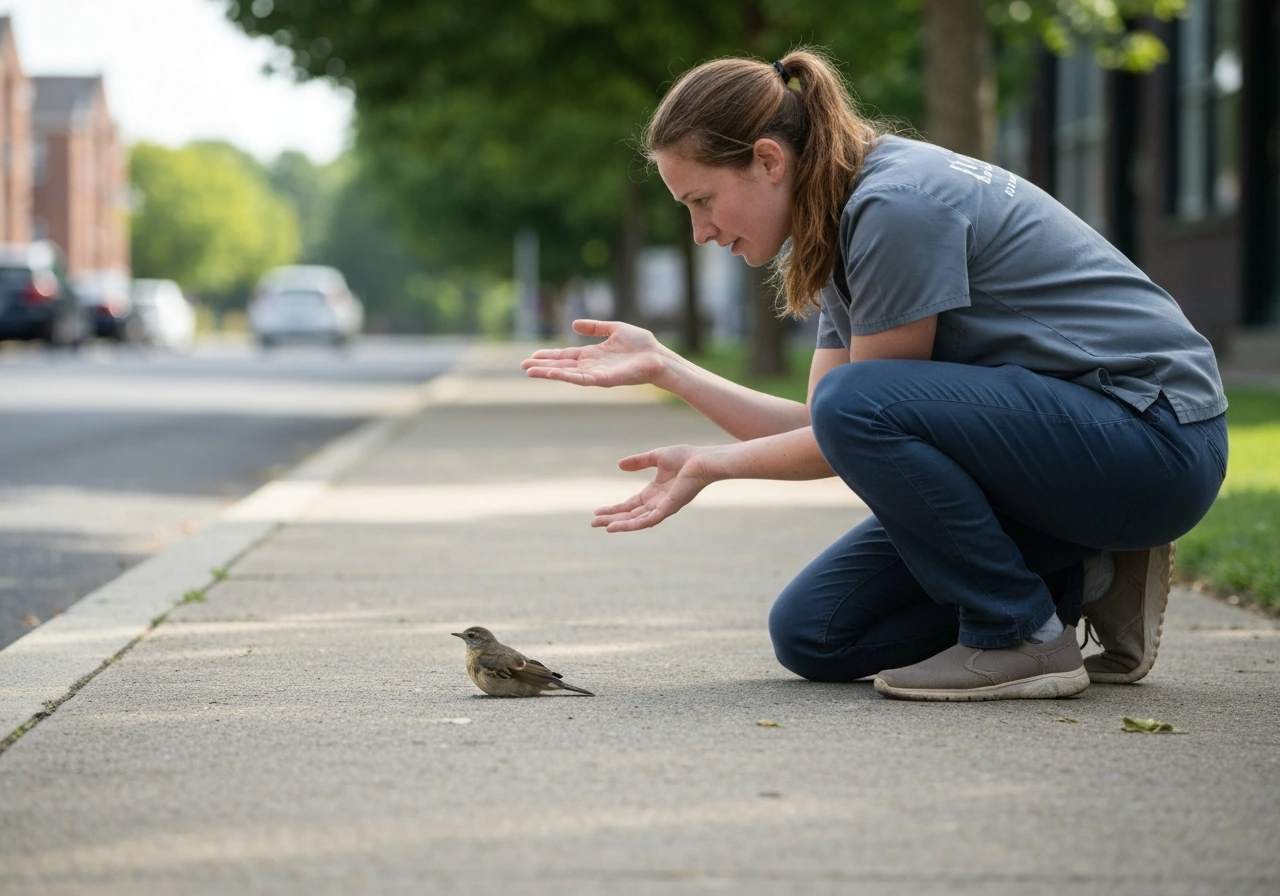
Before you do anything, take a breath and watch from a few feet away for a minute or two. A healthy bird that's just startled will fly off on its own. If the bird is on the ground and not moving, stumbling, or clearly can't fly, that's your signal to step in. Most common songbirds, pigeons, and small waterfowl are safe to approach carefully. Larger birds are a different story, raptors like hawks, owls, and falcons have sharp talons and beaks that can do real damage. If you're dealing with a bird of prey, do not grab it barehanded. Use a thick towel or jacket to cover it before handling.
Your own safety matters too. Bird bites and scratches can introduce bacteria, and while the risk is generally low for songbirds, it's worth protecting yourself. Wear gloves if you have them, or use a cloth barrier. If you're scratched or bitten by a larger bird or a wild mammal nearby, contact a medical professional, rabies is a serious consideration with any wildlife exposure, even if birds themselves aren't rabies vectors.
The Migratory Bird Treaty Act also means you legally cannot keep a wild bird without a permit, even temporarily with good intentions. This is another reason to move quickly toward getting the bird to someone licensed to care for it.
Who to call: wildlife rescue, avian vet, or animal control
Here's how to think about your options. They're not all equally equipped, so picking the right one upfront saves time.
| Who | Best for | Limitations |
|---|---|---|
| Licensed wildlife rehabilitator | Any injured wild bird — songbirds, raptors, waterfowl, baby birds | May have limited intake capacity; some are species-specific |
| Avian veterinarian | Obvious injuries needing immediate medical care (severe bleeding, broken bones, cat attack wounds) | Costs money; not every area has one; may refer you to a rehabber after stabilizing |
| Animal control / local humane society | When you can't reach a rehabber or vet, or need someone to pick up the bird | Often not trained in wildlife care; may transfer to a rehabber |
| State wildlife agency | Referrals to licensed rehabbers in your area; required contact for certain protected species | They refer rather than take the bird themselves in most cases |
Your fastest path to finding a licensed wildlife rehabilitator is to search online directories. If you need where to take a sick wild bird, a licensed wildlife rehabilitator is usually the best place to start. The Pacific Wildlife Project has a search tool where you enter your ZIP code and animal type. Your state's fish and wildlife agency usually maintains a regional contact list, for example, New York State DEC and Michigan's DNR both publish licensed rehabilitator directories.
New York State DEC offers a contact list of licensed wildlife rehabilitators for people seeking help for injured wild animals. In Massachusetts, you can call MassWildlife directly at (508) 389-6300.
If you're near a wildlife clinic, many have a main line to call for guidance even if you're not in their immediate area.
When you call, have this information ready so the intake person can help you quickly:
- What species or type of bird it is (or your best guess — 'small brown songbird,' 'large gray pigeon,' etc.)
- Where you found it (city, neighborhood, specific location if outdoors)
- What you observed: is it bleeding, can it stand, are its wings drooping, is it alert or unresponsive?
- How the injury likely happened if you know (window strike, cat attack, found in the road)
- Whether it's a baby, juvenile, or adult
- Your location and whether you can transport it
When the bird needs help right now vs. when you can wait
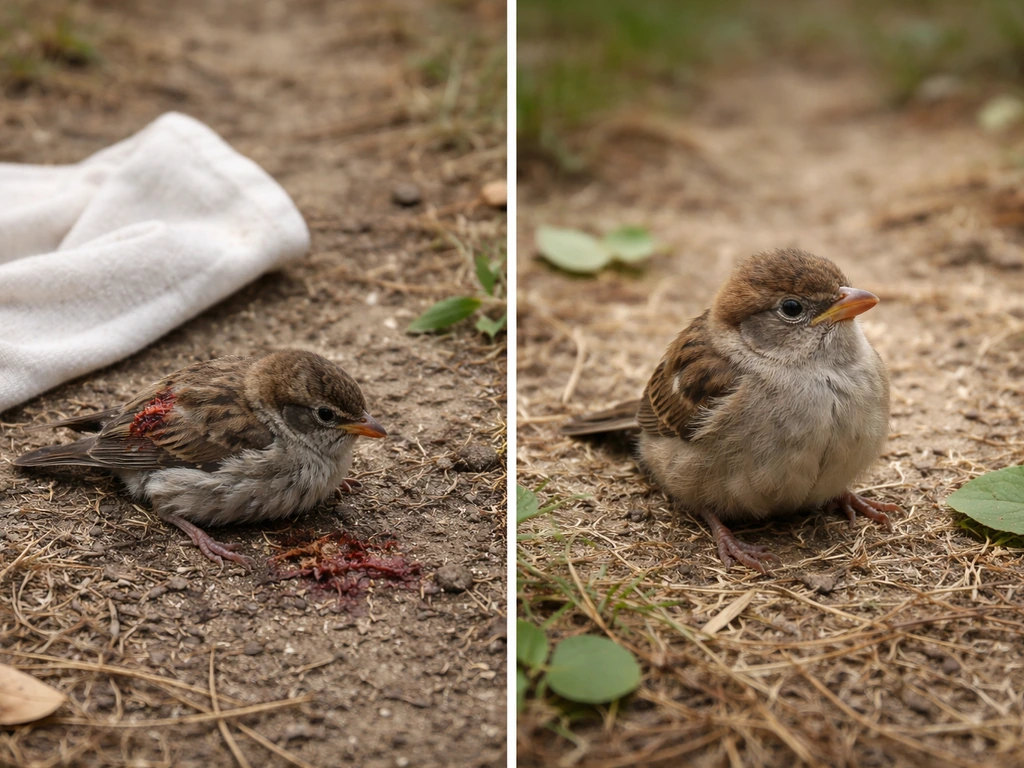
Not every bird you find is in crisis. Fledglings, young birds that have left the nest but haven't fully mastered flying yet, are often on the ground completely normally. They're covered in feathers, their eyes are open and alert, and their parents are usually nearby continuing to feed them. If that describes what you're seeing, the best thing to do is watch from a distance and leave the bird alone. The parents will return.
Call for help immediately if you see any of these:
- Visible bleeding or an open wound
- A wing or leg that is clearly broken or hanging at an odd angle
- The bird is featherless or has closed eyes (a true nestling that's fallen from the nest)
- It was attacked by a cat or dog — even if it looks okay on the outside, cat bacteria cause life-threatening infections within hours
- It's weak, shivering, puffed up, or unable to hold its head up
- It struck a window and hasn't recovered after a couple of hours
- A baby bird whose parents haven't returned in four to six hours
If the bird hit a window and seems just dazed but alert, Tufts Wildlife Clinic advises giving it up to a couple of hours in a dark, quiet container. If it hasn't recovered and flown off by then, it needs professional care. Any bird with obvious injuries should not wait, get it to a rehabilitator or avian vet the same day.
First aid basics until help arrives
The most useful thing you can do while you wait or arrange transport is contain the bird safely and keep it calm. That's genuinely it. The urge to do more, feed it, give it water, keep it out where you can watch it, will usually make things worse.
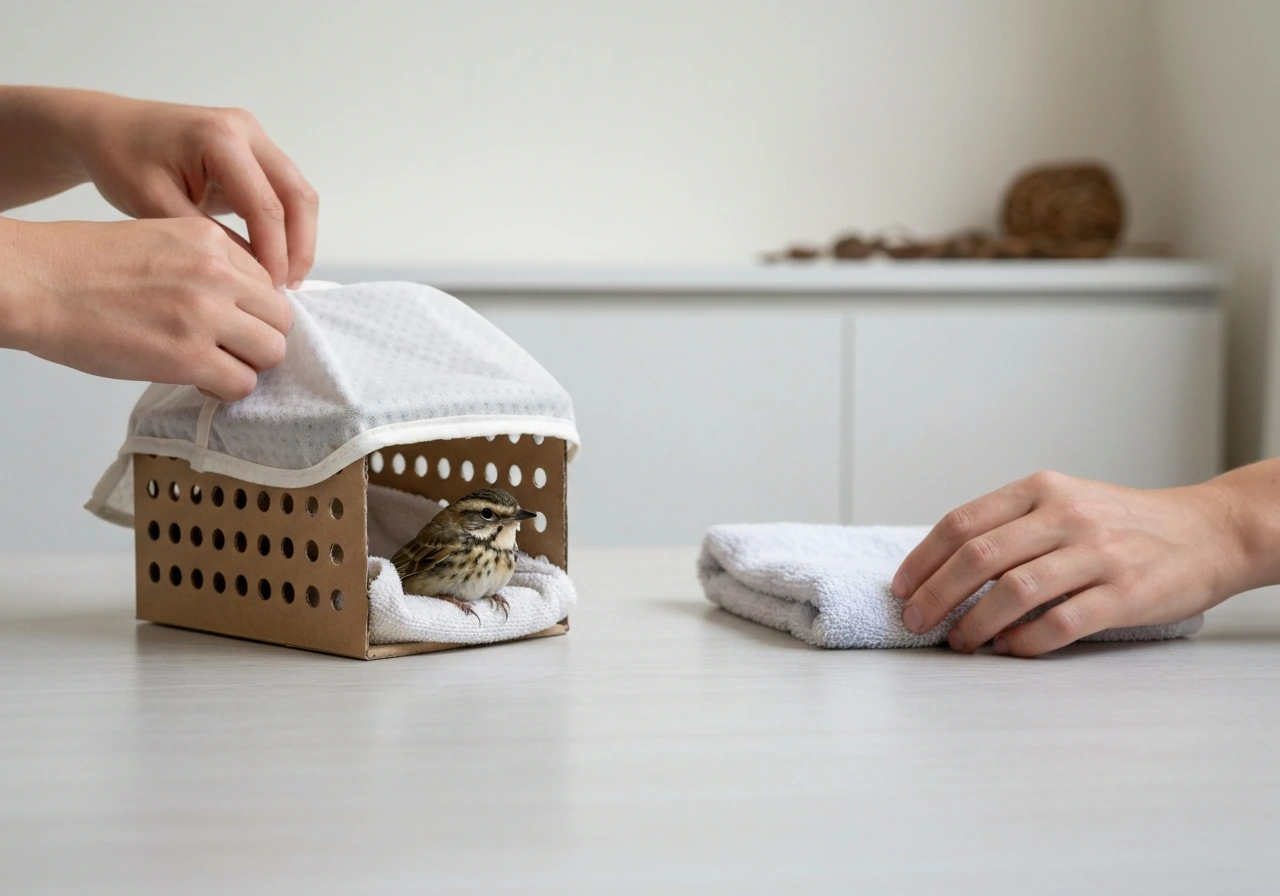
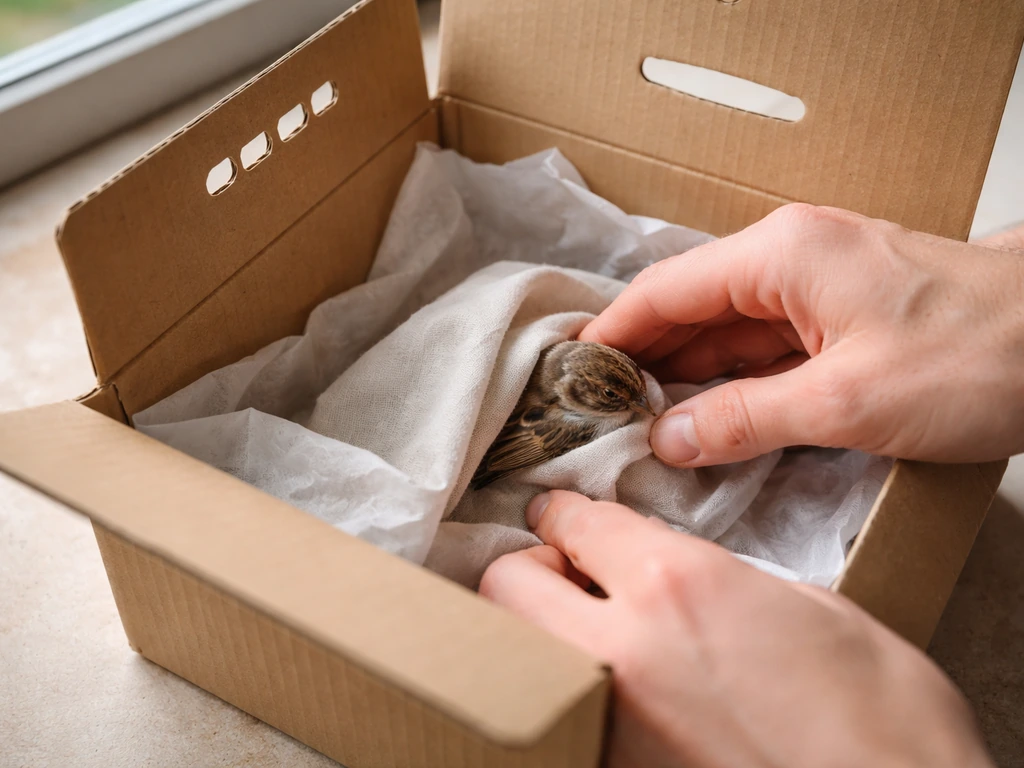
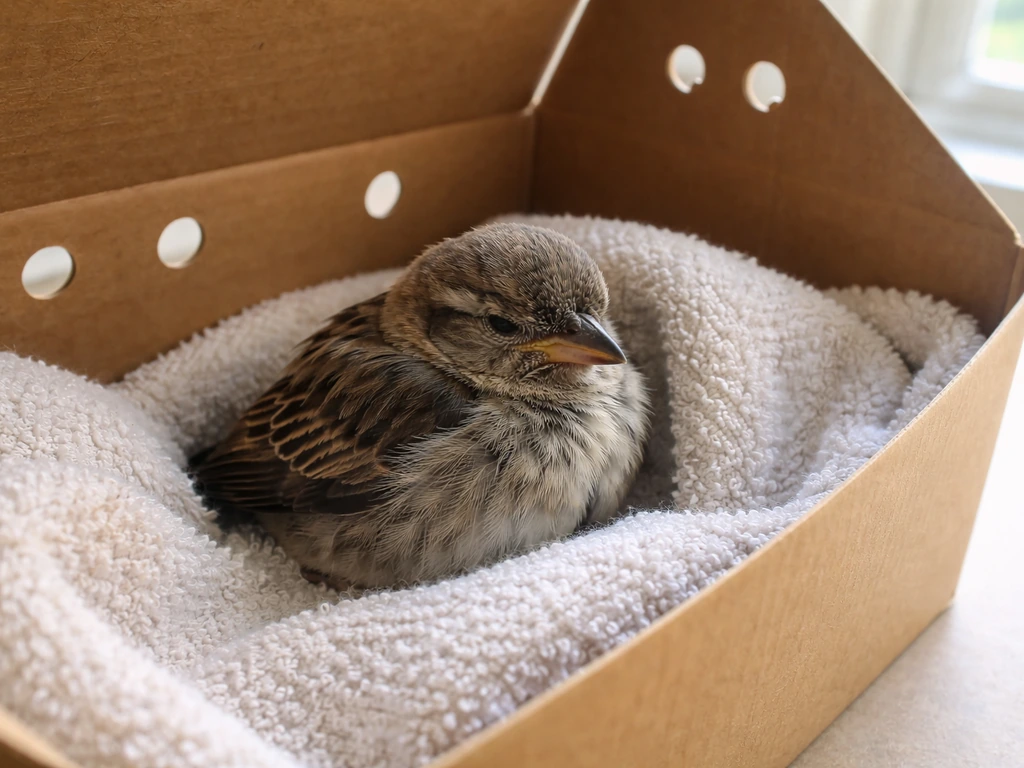
- Find a cardboard box or paper bag with a lid. Line it with a clean cloth or paper towels.
- If using a box, poke small air holes in the lid.
- Gently place the bird inside using a towel or cloth — minimize direct handling.
- Keep the container dark. Birds calm down significantly in darkness; they can't see out and don't panic as much.
- Put the box somewhere warm and quiet, away from pets, children, and loud noise.
- If the bird feels cold to the touch, place a hand warmer or a small rice sock heated in the microwave wrapped in a towel under one half of the box — the bird needs to be able to move away from the heat source.
- Do not feed the bird anything. Do not give water. Feeding the wrong food can injure or kill a bird, and force-feeding a stressed bird can cause aspiration. Only licensed rehabilitators should provide food and fluids.
- Contact a rehabber or avian vet and get transport moving as soon as possible.
If it's nighttime and no rehabilitation center is open, keep the bird in that dark, quiet, ventilated box indoors until morning and bring it to a clinic or rehabber as soon as they open. Don't try to care for it through the night beyond keeping it warm and contained.
What happens after you report the bird
When you contact a wildlife rehabilitator, the first thing they'll do is ask you the questions listed above, species, condition, location, how it was injured. From there, the path depends on your situation. If you're near a wildlife clinic, they'll usually ask you to bring the bird in directly. Some rehabilitators work from home and will ask you to transport to them. Others, especially in rural areas, may refer you to a closer contact or walk you through holding the bird safely until someone can reach you or you can make the drive.
At intake, a licensed rehabilitator will triage the bird, assess its injuries, hydration, and weight, and start appropriate care. This might include fluids, pain management, wound care, or setting a fracture, depending on what they find. They're trained and permitted to do things you legally and practically cannot do at home. After stabilization, the goal is always release back to the wild. The typical timeline from intake to release varies widely, a window-strike bird that recovers quickly might go back in a few days, while a bird with a broken wing might take weeks or months of care.
Don't expect updates the way you would from a vet with a pet. Wildlife rehab organizations are often volunteer-run and stretched thin. Dropping the bird off and trusting the process is the best thing you can do for it.
Special situations: window strikes, cat attacks, and baby birds
Window strikes
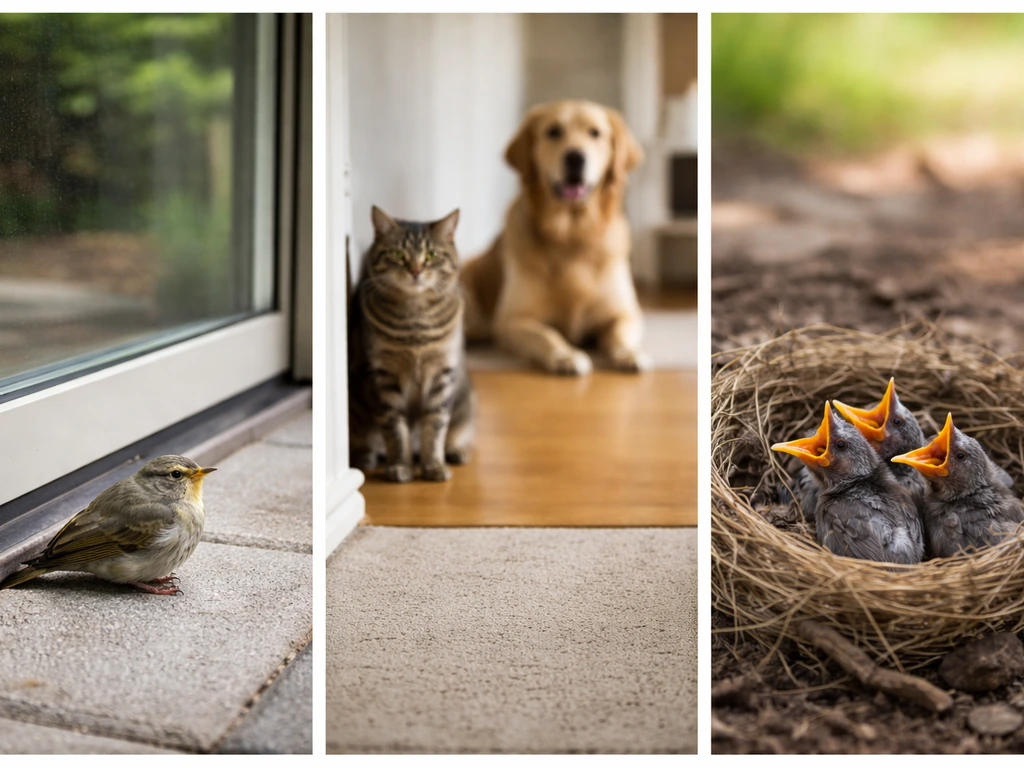
Window collisions are one of the most common reasons people find injured birds. The bird hits the glass, falls, and may look stunned or dead. Even if it appears to recover and seems okay, all window-strike birds should be seen by a wildlife rehabilitator. Internal injuries and brain trauma aren't visible from the outside.
The American Bird Conservancy is very direct on this: no matter how the bird looks after a strike, take it to a rehabilitator. If it's dazed, box it up as described above. Give it an hour or two in a dark, quiet spot, Audubon says some recover on their own, but if it doesn't fly off when you open the box outside after that window, it needs care.
Cat and dog attacks
This is a genuine emergency, even when the bird looks fine. Cat saliva contains Pasteurella bacteria that cause fatal infections in birds within 24 to 48 hours of exposure. If a cat or dog has had the bird in its mouth, or even scratched it, blank" rel="noopener noreferrer">the bird needs antibiotics from a licensed rehabilitator or avian vet today, not tomorrow. Don't wait to see if it 'seems okay.' Box it up, make your calls, and move fast. This is the one scenario where the clock is ticking the hardest.
Baby birds and nest emergencies
First, figure out what you actually have. A nestling is featherless or has just a few pin feathers, and its eyes may be closed, it genuinely cannot survive outside the nest. A fledgling is fully feathered, hopping around on the ground, and has open bright eyes. Fledglings are supposed to be on the ground. Their parents are almost certainly nearby, watching you. Back away, keep pets and kids away, and let nature do its job.
For a nestling that's fallen, look for the nest and try to return it, contrary to old myth, parent birds will not reject a baby because a human touched it. If the nest is destroyed or you can't reach it, keep the bird warm and get it to a wildlife rehabilitator quickly. If you're not sure whether the parents are returning, wait and watch from a distance for four to six hours before intervening. If the parents haven't appeared in that time, that's when you act.
And again: do not try to feed baby birds. Tufts Wildlife Clinic and virtually every rehab organization emphasize this strongly. The wrong food, delivered the wrong way, can choke or kill a bird that might otherwise have been fine.
How to find someone near you today
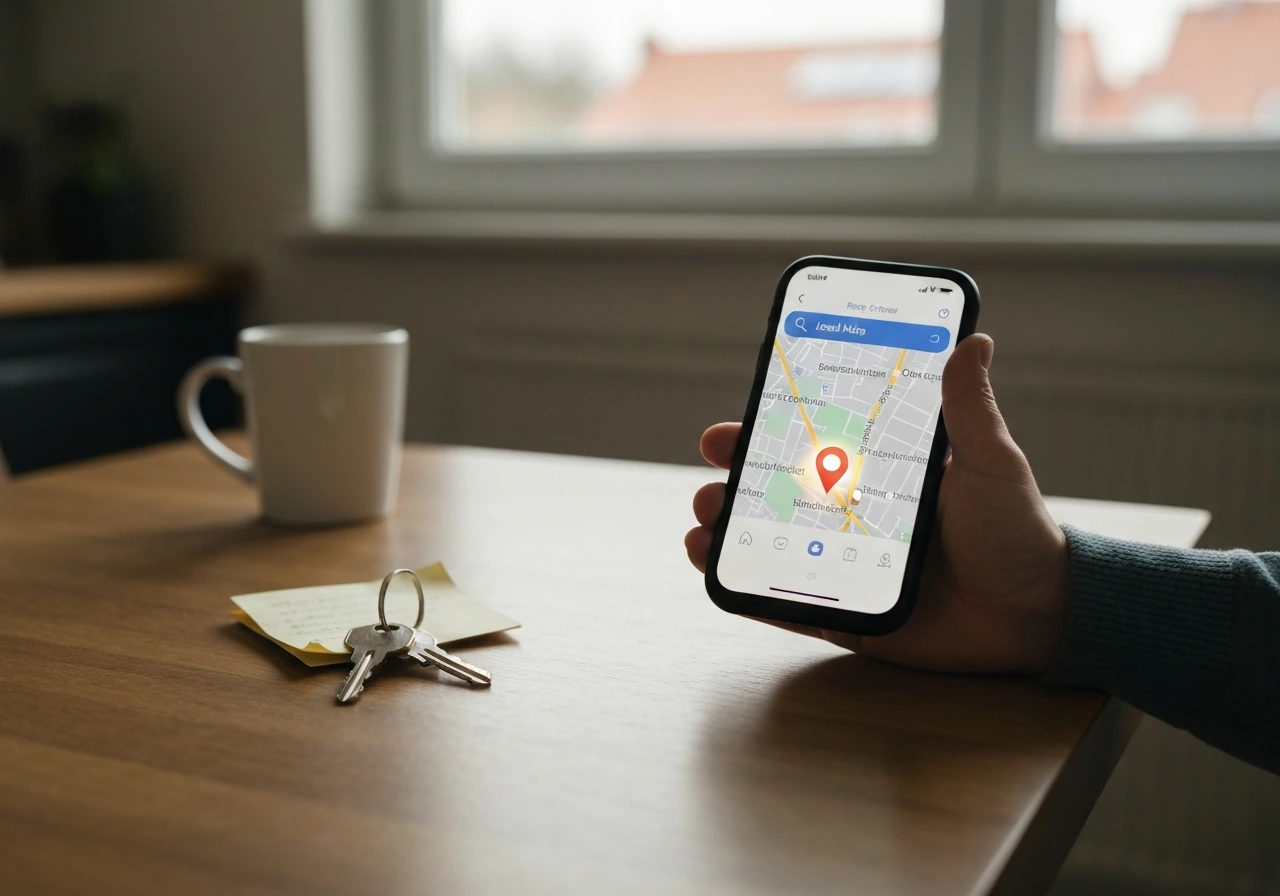
If you're searching right now, these are the fastest ways to find local help:
- Search 'wildlife rehabilitator near me' or 'bird rescue [your city]' — most licensed rehabbers have a web presence or are listed in local directories
- Visit the Pacific Wildlife Project's finder tool and search by your ZIP code and 'bird'
- Check your state's fish and wildlife agency website — most publish a regional directory of licensed rehabilitators
- Call your local humane society or animal control and ask for a wildlife referral
- If you're near a veterinary school or wildlife clinic, call their main line — they'll either take the bird or point you to someone who can
- Search for 'avian veterinarian near me' if you need immediate medical care and can't locate a rehabber fast
Finding where to drop off or take an injured bird can feel like the hardest part when you're stressed and holding a box with a hurt animal in it. Most places that take birds, wildlife clinics, avian vets, even some humane societies, will guide you through the process over the phone. If you're stuck on exactly where to take a hurt bird, start by calling a licensed wildlife rehabilitator or an avian veterinarian for guidance take an injured bird. You don't need to have all the answers before you call. Just call. If you are wondering where to take a sick wild bird, start by calling a licensed wildlife rehabilitator or an avian vet for instructions.
FAQ
What should I do if I cannot take an injured bird to someone right now?
If you cannot transport right away, keep the bird in a dark, quiet, ventilated container and minimize handling. Do not put food or water in the beak. Contact a wildlife rehabilitator as soon as possible and ask whether they can advise temporary containment at home until pickup. Transport delays matter most for injuries that affect breathing, bleeding, or exposure to cats and dogs.
Can I wait to take an injured bird if it seems alert or is still breathing normally?
In most cases, not. Even if the bird looks “fine,” some injuries like internal trauma after a window strike, and infection risk after a pet exposure, require professional care. The safest decision aid is this: if it is unable to fly normally, was hit by a window, has visible blood or deformity, or was bitten or held in a cat or dog’s mouth, get it to a licensed rehabilitator or avian vet the same day.
How do I safely hold an injured bird before help arrives?
For songbirds and most small birds, you can often cover and restrain gently with a towel to reduce movement, but you should not attempt to examine wounds closely or remove debris from eyes or feet. For raptors, use a thick towel or jacket to cover the bird before any handling, and avoid barehand contact entirely. If the bird is flapping, bleeding, or struggling to breathe, focus on containment and immediate help rather than “fixing” anything.
Does the guidance change if the bird is a fledgling or a nestling?
If the bird is a fledgling, leave it where it is and keep pets and kids away. If it has clearly injured itself or cannot hop, stand, or flap, treat it as needing care. If you find a nestling (featherless or mostly pin feathers), it usually needs warmer containment and faster rehab help, especially if you cannot return it to the nest.
Is it okay to feed or give water to an injured bird while I wait?
Do not attempt to feed, water, or give supplements. Improper food can choke or harm young birds, and even adult birds can be injured by incorrect liquids delivered to the airway. The immediate priority is calm containment in a dark ventilated box, then professional intake.
Why is a cat- or dog-exposure an emergency, and how quickly should I act?
If a cat or dog had the bird in its mouth or you see scratches or mouth contact, treat it as urgent. Box the bird up, keep it warm but calm, and contact a licensed rehabilitator or avian vet immediately, not later. Ask whether you should bring the bird yourself or if they can coordinate a pickup.
How can I tell whether I found a nestling or a fledgling if I am not sure?
If you are unsure whether you have a nestling versus a fledgling, use body clues rather than behavior alone. Nestlings are typically featherless or have only pin feathers and may have closed eyes, while fledglings are fully feathered with open bright eyes and are usually hopping on the ground.
What information should I have ready when I call to ask who will take an injured bird?
Yes. In many cases you can seek guidance by phone even if you cannot reach them quickly in person. When you call, have species (if you can see it), location, what you observed (dazed, bleeding, unable to fly), how the injury likely happened (window, cat, weather), and the bird’s condition (alertness, breathing, mobility). This helps them decide whether to direct you to bring it in, route you to a closer rehabber, or instruct safe holding.
What if the injured bird looks dead, should I still call someone?
If you suspect a bird is dead, verify that it is truly deceased before handling. If it shows any movement, breathing sounds, or responsiveness when placed carefully in a ventilated box, treat it as injured and call for help. For fully deceased birds, follow local agency guidance, since handling and transport rules vary.
Will I get regular updates after I drop off the bird, and how should I follow up?
Because wildlife rehab groups can be volunteer-run, updates are not always like a typical pet veterinary schedule. You can ask at intake when to expect a status check, and whether there is a preferred communication method. Dropping off the bird and following their instructions is usually more helpful than repeated calls that slow intake.
Next Articles
Where Can I Drop Off an Injured Bird? Call First Guide
Call first guide for drop-off: safety tips, who accepts injured birds, what to say, and emergency options.
Is There a Bird Rescue Near Me What to Do Now
Find bird rescue near you fast: triage injured bird, safe handling tips, and call script for local wildlife rehab or vet
Where Do I Take a Hurt Bird Near Me: Fast Steps
Quick steps to take an injured bird near you: who to call, transport prep, and when it’s urgent