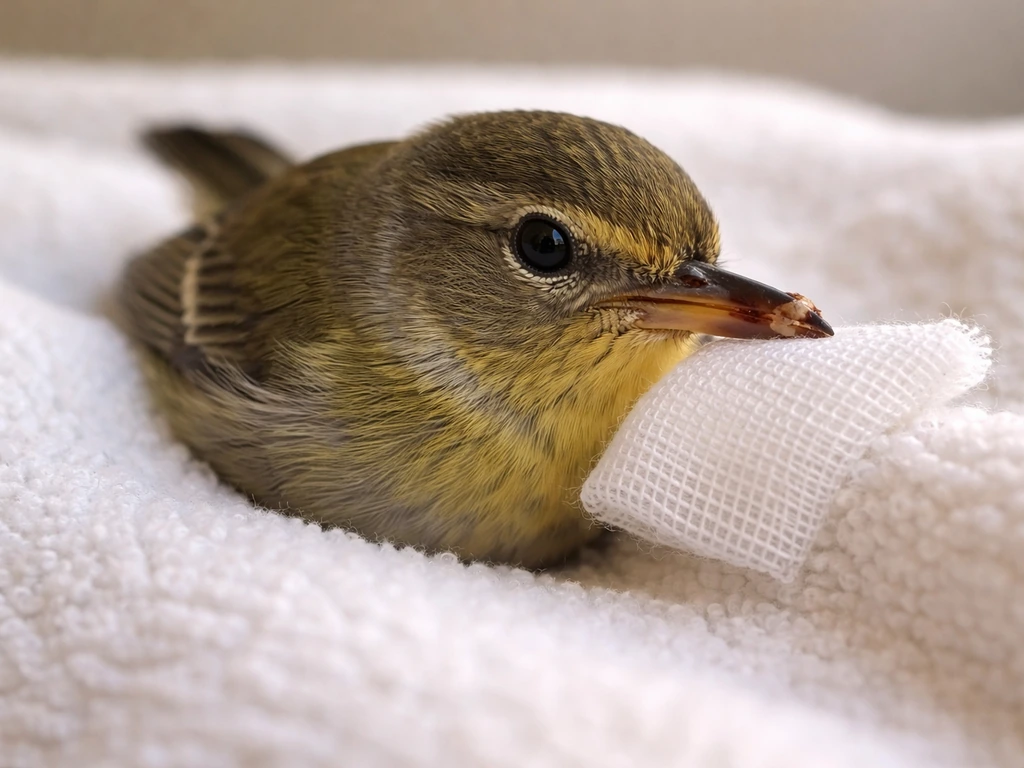
If you've found a bird lying on its side, with its head drooping at an odd angle, or completely unable to move, your instinct is probably right: something is seriously wrong. Whether it's a true neck or spinal injury, a concussion from a window strike, or shock from a cat attack, the first steps are almost identical. Do not pick it up and start manipulating it. Do not try to straighten its neck. Read this first, because the next few minutes matter.
Broken Neck Bird: What to Do Immediately and Next
Marcus Chen
5 Apr 2026
Is it actually a broken neck, or something else?
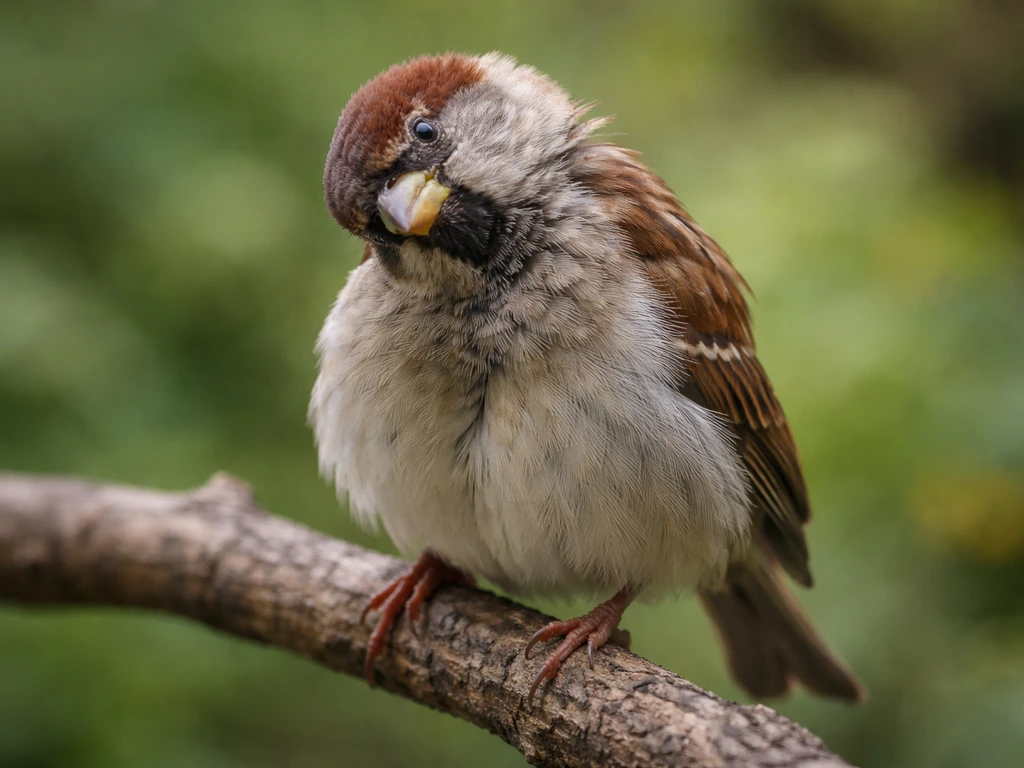
This is the hardest part, and honestly, you probably can't tell for certain without an X-ray. A true cervical (neck) fracture or spinal injury is rare compared to the conditions that look almost identical from the outside. Window collisions are by far the most common cause of a bird appearing to have a broken neck, and in the majority of those cases the bird is actually concussed or in neurological shock rather than having a structurally broken spine. That said, the difference in your handling should be minimal, because both situations demand extreme care and minimal movement.
A bird that looks like it has a broken neck will often show a head tilted sharply to one side (called torticollis), a neck that seems floppy or is held at an unnatural angle, legs that won't grip, or a complete inability to right itself. These signs can also appear with severe head trauma, inner ear damage, or full-body shock. If you want a deeper breakdown of what's actually happening inside the bird, the article on bird with broken neck covers the anatomy and injury types in more detail. The bottom line for right now: treat the bird as though its neck and spine are fragile regardless of the exact cause.
One thing that helps narrow it down: if the bird is alert, tracking you with its eyes, and trying to move but just can't seem to stand or hold its head up, there's more neurological function present than in a bird that is completely limp and non-responsive. Both are emergencies, but a responsive bird has a slightly better immediate outlook. A completely limp, unresponsive bird with a floppy neck is the most concerning scenario and needs professional help as fast as possible.
Reading the warning signs: shock, breathing, and spinal involvement
Before you do anything else, take about 10 seconds to observe the bird without touching it. You're looking for a few specific things that will tell you how urgent this is.
Breathing is your first priority. A bird breathing normally will show its chest and sides moving rhythmically. Open-beak breathing, tail bobbing with each breath, or what looks like the bird pumping its wings slightly just to breathe are all signs of respiratory distress. Birds must be able to move their chests freely to breathe, which is why you should never wrap or restrain a bird's body tightly around the torso. If you see labored or open-beak breathing, that bird needs oxygen support from a professional, not a cardboard box for an hour.
Shock is the next thing to assess. A bird in shock may feel cold to the touch, especially at its feet and legs. It will often look glassy-eyed, be non-responsive to your presence, and may be lying completely flat. Pale or tacky-looking mucous membranes around the mouth (if you can see them) are also classic decompensation signs. Shock in birds is treated initially with warmth and a low-stimulation environment, not with invasive handling or fluids. This is the same approach avian emergency stabilization protocols recommend across the board.
Signs that strongly suggest spinal or neck involvement include: a neck that flops when the bird is gently supported (not held upright on its own), legs that have no grip strength at all, or a bird that is lying on its side and cannot roll itself upright even when it appears conscious. Ongoing bleeding, extensive visible wounds, or limbs at clearly wrong angles are also emergency flags. Any one of these signs means this is not a "wait and watch" situation.
Immediate first aid: what to actually do right now
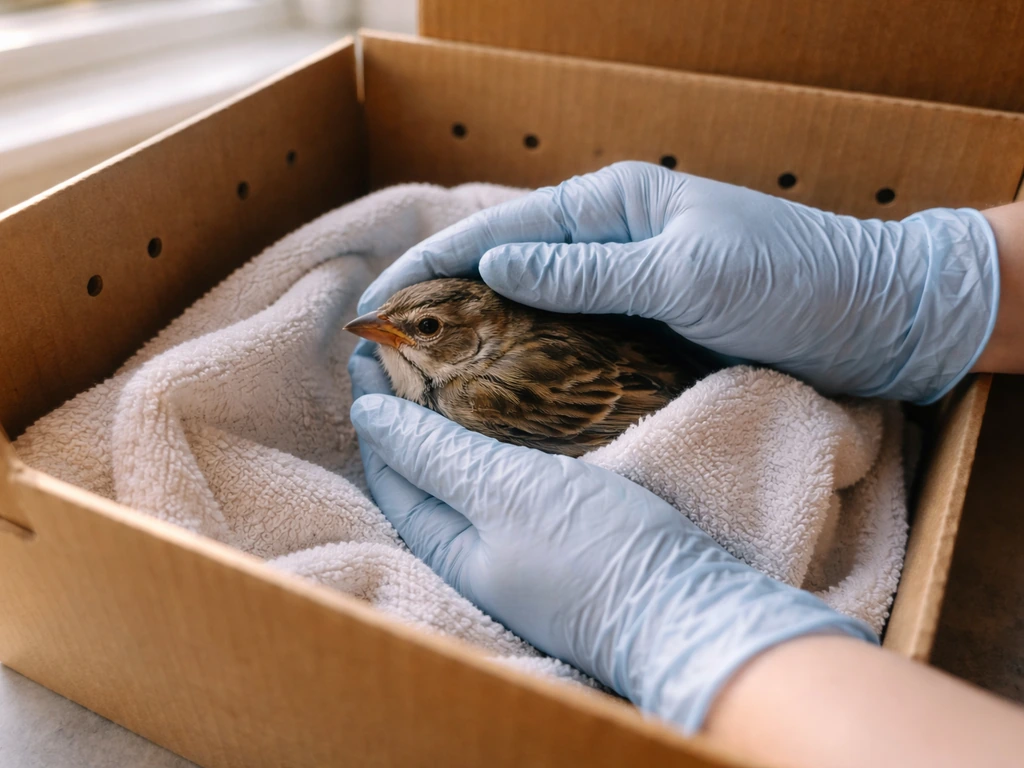
The goal of first aid here is not to fix the bird. It's to stabilize it, reduce additional stress and movement, keep it warm, and get it to someone qualified. That's it. Here's how to do that safely.
Safe handling and containment
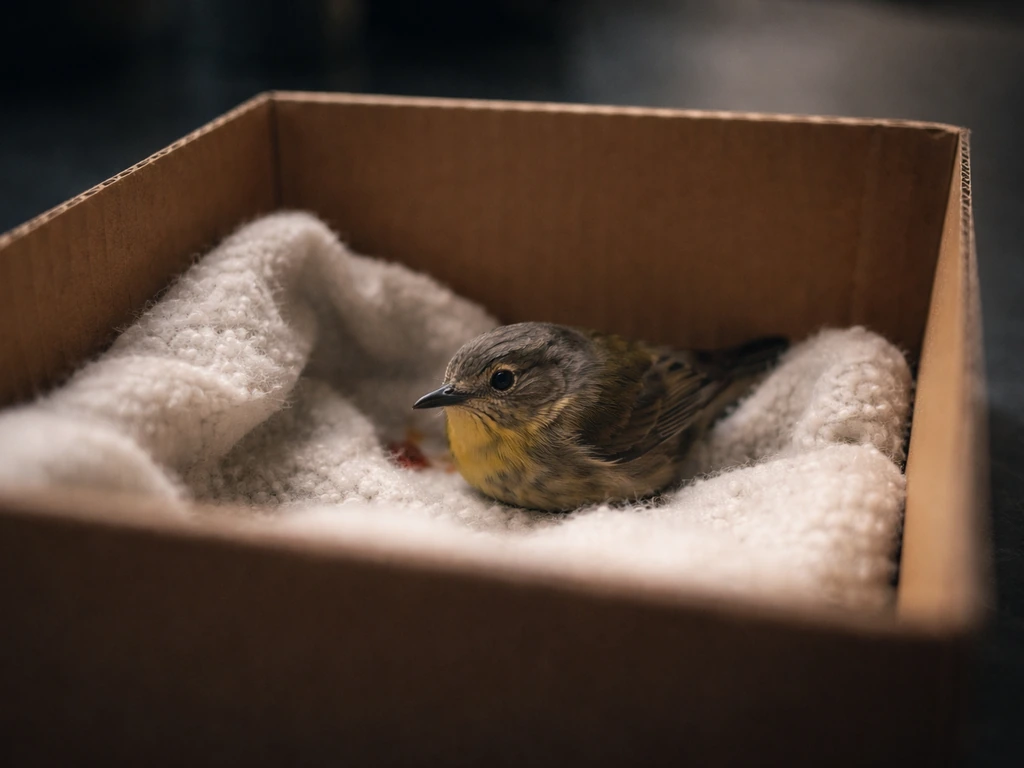
If the bird is in immediate danger (on a road, near a cat, in the rain), you need to move it. Use a light towel or cloth to gently scoop it up, supporting the whole body from underneath. Do not grab it by the neck or wings. Do not try to hold the head in what you think is a "correct" position. Let the neck rest naturally supported by the towel. Place it into a cardboard box or any container with ventilation holes. The box should be just large enough for the bird to sit in without a lot of extra space to thrash around, because movement causes additional injury.
Line the bottom of the box with a folded towel or paper towels so the bird has something to grip or rest on. If the bird is unconscious or completely limp, position it upright (or propped gently on its sternum) rather than on its side if possible, but do not force any position that requires manipulating the neck.
Keeping it warm
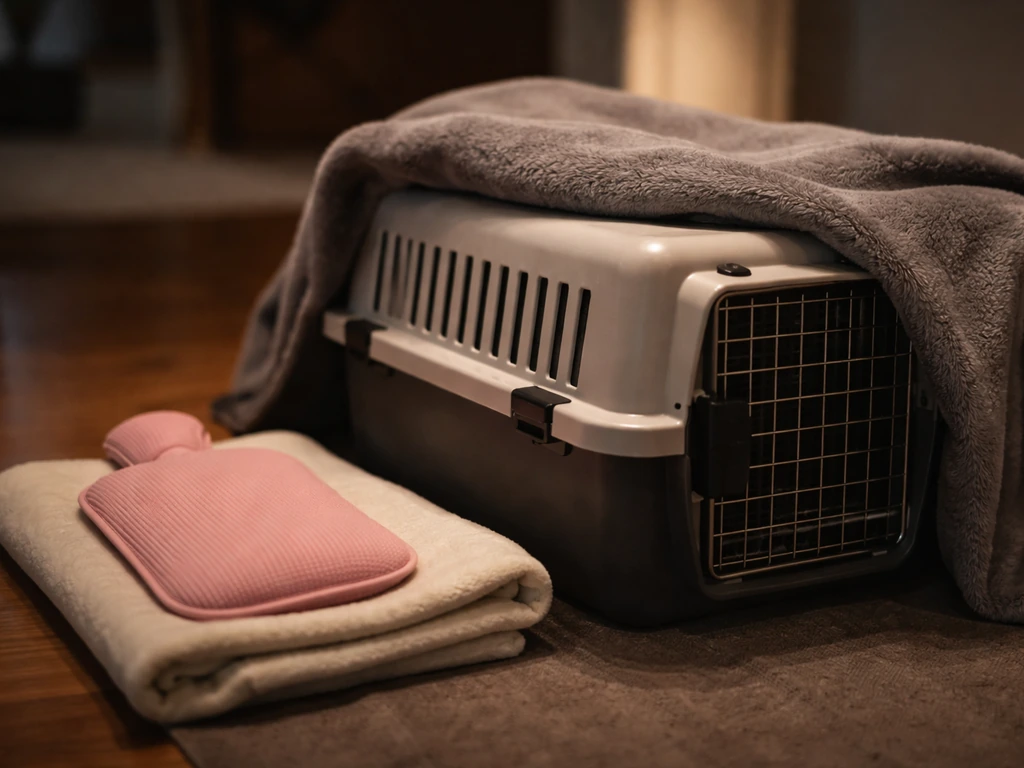
Warmth is one of the most important things you can provide. A bird in shock loses body temperature fast, and cold makes everything worse. Place a hot water bottle filled with warm (not boiling) water, wrapped in a towel, on one side of the box so the bird can move toward or away from it. Alternatively, hand warmers wrapped in a cloth work well. You can also place one half of the box on a heating pad set to low. The key is giving the bird a warm zone without overheating it. The environment should feel warm and slightly humid, not hot.
Dark and quiet
Once the bird is in the box, close or cover it and put it somewhere dark, quiet, and away from people, pets, and noise. This is not a step to skip. Stress alone can kill an injured bird, and darkness triggers a calming response. Do not keep checking on it every few minutes. Place it somewhere stable and leave it alone while you make phone calls. The American Bird Conservancy recommends about an hour in this environment while you arrange expert help, and that window is appropriate for a mildly stunned bird. Audubon similarly advises keeping the bird somewhere quiet for about an hour and not offering food or water, and then contacting a wildlife rehabilitator for help an hour in this environment. For a bird showing severe signs (non-responsive, open-beak breathing, visible trauma), you should be making calls immediately, not waiting.
What not to do (this list matters as much as the first aid)
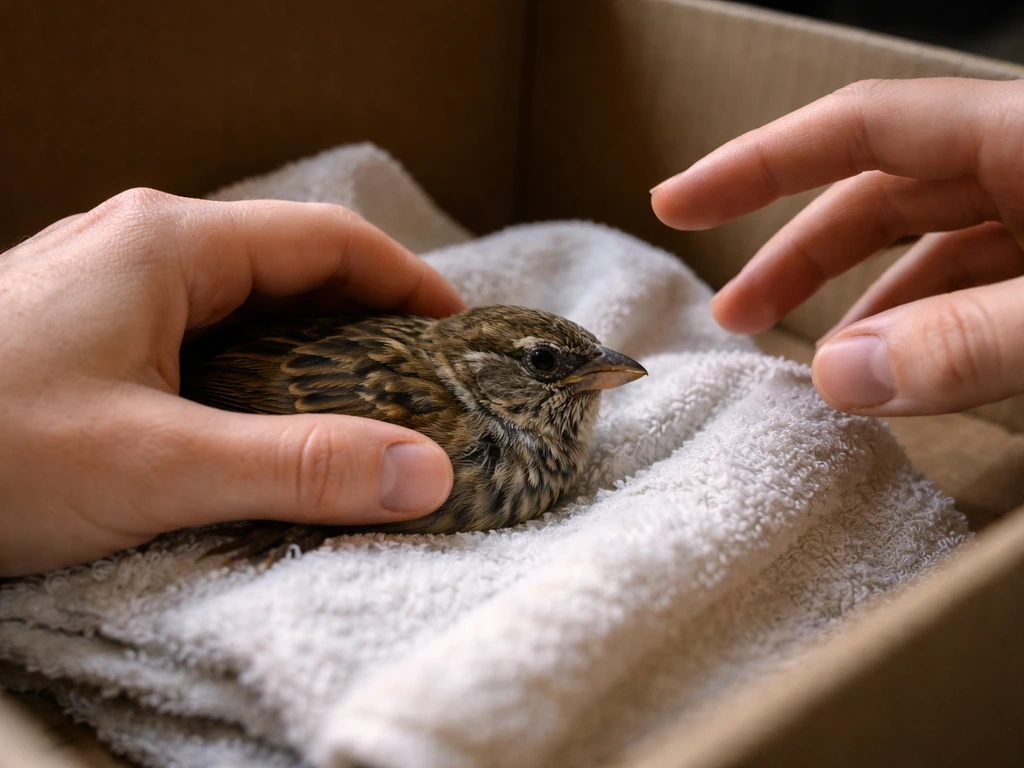
Well-meaning mistakes cause real harm to injured birds, and neck injuries in particular are easy to worsen. Wildlife In Need Center also advises not to feed or offer water to an injured bird, since it can aspirate or choke hard stops. Here are the hard stops:
- Do not try to straighten or reposition the bird's neck. If there's a fracture, any manipulation can cause further spinal cord damage or complete paralysis. Let the head and neck rest in whatever position they naturally fall while the bird is supported.
- Do not give food or water. This is one of the most universally agreed-upon rules across every wildlife rescue organization. Birds have airway anatomy that makes aspiration (fluid going into the lungs) very easy, especially when they're injured or unconscious. The Wild Bird Care Centre explicitly warns about this risk. A bird that can't swallow normally will inhale water directly into its lungs.
- Do not attempt to splint the neck or apply any DIY restraint. There is no field splinting for neck injuries. Any attempt to immobilize the neck manually is likely to cause more harm than help.
- Do not wrap the bird tightly around its body or chest. Birds breathe by expanding their chest wall, and constriction can cause suffocation. A loose towel cradle is fine; a tight wrap is not.
- Do not handle the bird more than necessary. Prolonged handling is stressful even for healthy birds, and stress accelerates shock in an injured bird. Minimal contact is always better.
- Do not offer any medication, including pain relievers. Human medications like ibuprofen or acetaminophen are toxic to birds.
It's also worth noting that some instincts that seem helpful, like propping the bird up against something or trying to get it to drink, can make things dramatically worse. If you're wondering more broadly what a severely injured bird needs versus what we often assume it needs, the article my bird is broken walks through that gap between instinct and safe care in more depth.
When to get help, and who to call
For any bird showing signs of true neck or spinal injury, the honest answer is: call now, not later. This is not a situation where you wait an hour and see if it improves. Here's how to triage who to contact:
| Situation | Who to contact | How fast |
|---|---|---|
| Non-responsive, limp, floppy neck, not breathing normally | Avian vet or wildlife emergency line | Immediately |
| Open-beak breathing, unable to stand, in shock | Avian vet or wildlife rehabilitator | Within the hour |
| Stunned but conscious, mild head tilt, no visible wounds | Wildlife rehabilitator | Within a few hours, monitor closely |
| Alert, sitting upright, mild disorientation after window strike | Wildlife rehabilitator for advice | Call for guidance, may recover on its own |
An avian veterinarian is the best option for the most severe cases because they can provide immediate diagnostics (X-rays, oxygen support, IV fluids) that a wildlife rehabilitator typically cannot. However, avian vets are not always accessible in rural areas or outside business hours. A licensed wildlife rehabilitator is your next best option and is often better equipped specifically for wild bird handling than a general practice vet. To find one, search the National Wildlife Rehabilitators Association database or call your state's fish and wildlife agency. Animal control dispatchers can also often connect you with emergency wildlife contacts after hours.
When transporting, keep the box in a warm spot in your car (not the trunk) and avoid talking loudly or playing music near the bird. Keep the box level and avoid sudden braking. The goal is the same as it's been from the start: warm, dark, quiet, and as still as possible.
How birds end up with neck and spinal injuries
Understanding the cause helps both with assessment and with prevention. The most common scenarios I see involve these situations:
Window and glass collisions
This is the most frequent cause by a significant margin. Birds can't see glass as a barrier, especially when it reflects sky or vegetation. The impact can cause concussion, internal bleeding, and in harder strikes, actual cervical fractures. If you found the bird near a window, that's likely what happened. Prevention involves window decals or external screens placed within 5 cm of the glass to break up the reflection, or UV-reflective window films that birds can see but humans can't.
Cat attacks and pet interactions
Even a brief cat bite or shake can cause severe neck and spinal trauma, internal injuries, and bacteremia (bacteria entering the bloodstream from puncture wounds). A bird that survived a cat attack may look relatively uninjured but have puncture wounds hidden under feathers and serious internal damage. These birds need antibiotics within hours, not just warmth. If you know or suspect a cat was involved, tell the wildlife rehabilitator or vet immediately because treatment urgency increases significantly.
Falls and nest emergencies
Young birds that fall from height, or adult birds that fall from a roost due to illness, can sustain neck and spinal injuries on impact. These situations are complicated because the bird may also be sick or underdeveloped, not just injured.
Entanglement and trapping
Birds caught in netting, wire, or fishing line often thrash violently trying to escape, which can cause muscle tears, dislocations, and spinal injuries. If you're cutting a bird free from entanglement, work slowly and support the body and neck as you release it. Never pull the bird free by force.
Vehicle strikes
Raptors and larger birds hunting along roadsides are particularly vulnerable to car strikes. The force involved often produces severe trauma including broken bones and spinal injuries.
A note on related injuries that look similar
Not every bird that appears to have a neck problem actually does. Beak injuries, for example, can cause a bird to hold its head at an odd angle due to pain or imbalance. If you notice the beak looks cracked, misaligned, or is bleeding, that's a different but still serious injury. You can learn more about what to do in that case by reading about bird beak broken situations, which have their own specific handling considerations. And if you're wondering about the severity of beak damage, the article on what happens if a bird breaks its beak gives a clear picture of outcomes and recovery.
There's also a question people sometimes ask when trying to understand what they're seeing: can a bird break its own neck through its own movement or behavior? The short answer is yes, in certain situations involving entanglement or severe thrashing, but it's far less common than trauma from external impact.
What to realistically expect
This is hard to say, but worth saying: true spinal cord injuries in birds carry a poor prognosis. The spinal cord does not regenerate effectively, and a bird that is fully paralyzed below the injury site is unlikely to recover the function it needs to survive in the wild. A wildlife rehabilitator or avian vet will assess whether the injury is a manageable bruise or swelling (which may improve) versus a structural break with cord involvement (which usually does not). Your job is not to make that call. Your job is to give the bird its best possible chance of reaching someone who can.
If you do everything right, place the bird in a warm, dark, quiet box, avoid food and water, minimize handling, and get it to a professional as quickly as possible, you've done everything a non-professional can do. That matters. Many birds that look like a lost cause when you find them make meaningful recoveries once they're in the right hands.
FAQ
Can I give a broken neck bird water or food while I wait for help?
No. Do not attempt to offer water, food, or medicines. Even if the bird seems responsive, swallowing can be unsafe if there is concussion, internal injury, or head and neck pain, and moving it to feed increases the risk of worsening a spinal injury.
Should I keep the bird in a shoebox or a towel on the floor at home?
Use a ventilated container that limits movement, not a loosely wrapped towel bundle or an uncovered box. A shoebox can work only if it has ventilation holes and you use a folded towel lining for grip, but avoid oversized containers because extra space lets the bird thrash.
Is it safe to transport the bird in my lap or hold it while driving?
No. Keep the bird in the box, warm and stable, and place the box on the passenger side floor or a seat surface that will not tip. Sudden starts, braking, and your shifting hands can cause painful neck movement.
How warm is too warm when I’m using a hot water bottle or heating pad?
Warm, not hot. Aim for a warm zone where the bird can move toward or away from the heat source. If the container feels uncomfortably hot to your hand, it is too hot for the bird, and overheating can worsen shock.
What if the bird starts flapping or thrashing after I put it in the box?
Light, brief movement can happen, but constant thrashing usually means the bird is stressed or needs more stabilization. Keep the container in darkness and minimize vibration and noise. If possible, prepare for immediate transfer to an emergency wildlife contact rather than trying repeated interventions at home.
The bird is breathing, so is it less urgent?
Breathing normally is a good sign, but urgency is still high if the bird cannot right itself, has an unnatural neck angle, or shows any spinal indicators like complete leg grip loss. Respiratory distress is one emergency sign, but neurological injury can still be life-threatening even if breathing seems okay.
Should I check the bird’s mouth or mucous membranes to see if it’s in shock?
Only if you can observe without handling. If you need to open the beak, that is extra stress and may be unsafe. Rely on safer indicators mentioned in the article, like cold feet, glassy eyes, and non-responsiveness, and focus on warmth and rapid professional contact.
What should I do if the bird is bleeding or has visible wounds?
Minimize handling and cover the bird with a light towel or place it into the ventilated box promptly. Do not clean deep wounds with random liquids, and do not apply topical ointments unless a professional instructs you. Visible bleeding increases urgency because punctures and tissue damage can exist even when the neck looks “only” odd.
Can I try to straighten the neck to help it breathe better?
No. Do not straighten, hold, or prop the head into what you think is a correct position. Let the neck rest naturally supported by the towel lining, because forcing alignment can worsen a fracture or spinal cord injury.
If it seems alert and responsive, do I still need an avian vet or rehabilitator?
Often yes, but timing and severity matter. A responsive bird may still have concussion or hidden trauma from a window strike or cat attack. If it remains unable to stand, holds its head at an extreme angle, or shows any spinal signs, treat it as an emergency and contact help right away.
What if I’m not sure whether it’s a neck injury or a beak injury?
Look for clues that the beak is damaged, such as misalignment, cracked tissue, or bleeding from the beak area. If the head angle seems driven by beak pain or balance rather than a flopped neck and leg grip failure, handling priorities still include limiting movement, but the priority contact may shift toward a beak-focused guidance path for additional care. When in doubt, treat as potential spinal injury until professionals advise.
Does keeping the bird in the dark mean I should never check it?
You should not repeatedly open the container every few minutes. If you must confirm breathing, do it quickly from outside the box. Repeated checking increases stress, which can be fatal, especially in birds already in shock.
How do I find the right person to call if it’s late at night or I live far from a city?
Call your state fish and wildlife agency or animal control dispatchers for after-hours emergency wildlife contacts when an avian vet is not accessible. For the fastest triage, tell them where you found the bird (window, cat, road, fall, entanglement), whether it is responsive, and whether breathing is open-beak or labored.
Are there any situations where I should leave the bird alone and not try to pick it up?
If the bird is safe from immediate threats, you still should not move it unnecessarily because handling can worsen injury. However, if it is in immediate danger like on a road, near a predator, or in rain, you should move it using a towel scoop that supports the whole body, then get it into a warm, dark, ventilated box.
Next Article
Bird Beak Broken: First Aid Steps and When to Call a Vet
Immediate first aid for a bird beak broken: check severity, stop bleeding, protect airway, feed safely, know vet red fla