
If a bird just ran into your window and is sitting on the ground looking dazed, here is what to do right now: don't touch it yet, keep people and pets away, and watch it for a few minutes. Most window-strike birds are stunned rather than critically injured, and a short observation period tells you a lot about how serious the situation is. This guide walks you through every step, from that first moment of panic to deciding whether the bird can be released or needs professional care.
Bird Ran Into Window What to Do Right Now and Next Steps
Marcus Chen
13 Apr 2026
First steps right after the collision
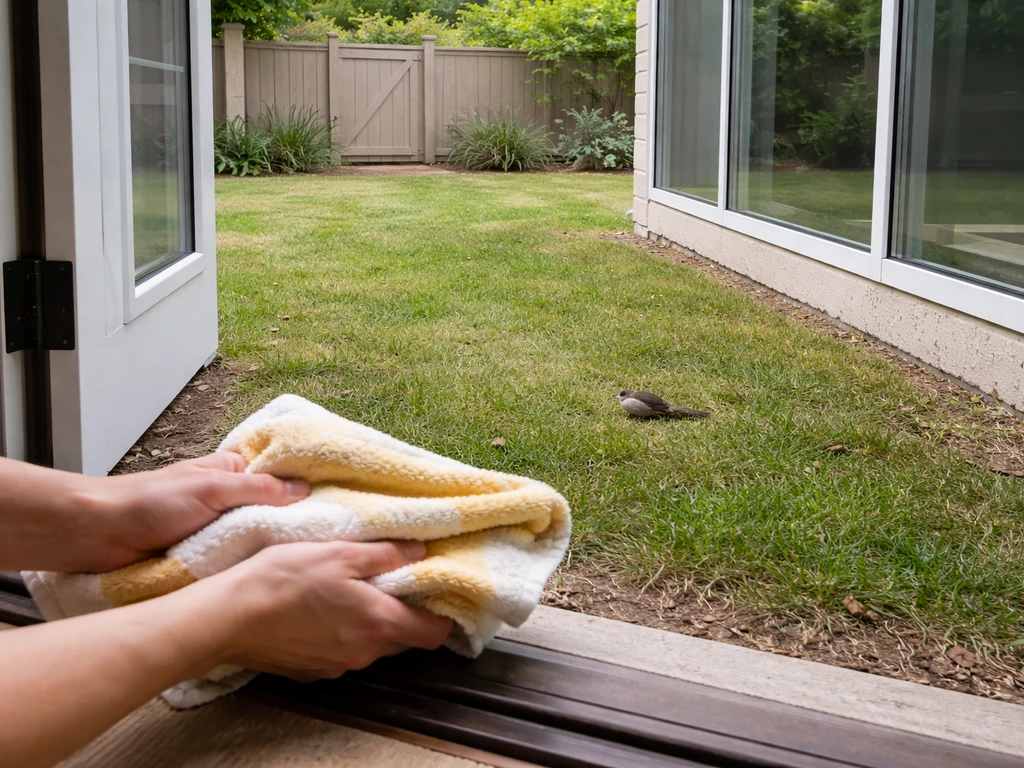
The very first thing to do is create a quiet perimeter. Move any children or pets indoors or to another part of the yard immediately. Cats especially can cause a second, fatal injury to a bird that is already disoriented, and even a well-meaning person crouching too close will spike the bird's stress response at exactly the wrong moment. Stay back a few feet and just observe.
While you're watching, note a few things: Is the bird upright or lying on its side? Are its eyes open or closed? Is it breathing hard, with visible chest heaving? Can it hold its head up? Is a wing drooping to one side or held at an odd angle? These observations are going to guide every decision you make in the next few minutes, so take thirty seconds to actually look before you do anything else.
If the bird is sitting upright, eyes open, and breathing normally, that is the best possible sign. It's almost certainly stunned from the impact and may recover on its own. If it's lying on its side, eyes closed, or gasping, you're dealing with something more serious and you'll need to act more deliberately. Either way, the next step is the same: get a container ready.
How to tell if the bird is stunned or more seriously injured
This is the most important assessment you'll make, and you don't need any wildlife training to do it. A stunned bird typically has no visible blood, no wing or leg held out at a strange angle, and may simply look dazed or wobbly. It might blink slowly or sit very still, but it can hold itself upright. These birds often recover well with rest in a safe, quiet space.
A more seriously injured bird shows one or more of these signs, and any one of them means you should contact a wildlife rehabilitator or avian vet rather than simply waiting it out:
- Visible blood or an open wound anywhere on the body
- A wing drooping to the ground or held at an obviously abnormal angle
- A leg that isn't being used or is sticking out to the side
- Rapid, labored breathing or gasping with visible chest movement
- Eyes closed or half-closed and unresponsive to nearby movement
- Head tilting to one side repeatedly or rolling around
- Not able to right itself when gently placed upright
- Still unable to fly after one hour of quiet rest
It's worth knowing that some serious injuries, especially internal ones like concussion or internal bleeding, are invisible from the outside. A bird can look relatively calm and still be in serious trouble. That's one reason why even birds that seem just stunned can benefit from a professional assessment. If you're ever on the fence, err toward calling a rehabber, not toward releasing the bird and hoping for the best. If you're dealing with a bird that seems completely unable to fly after hitting the window, that's a signal to act quickly rather than wait.
Immediate first aid: warmth, darkness, and safe handling

The core of window-strike first aid is simple: contain the bird safely, keep it warm and dark, and leave it alone. The less handling the better, not because you'll be doing anything wrong, but because handling adds stress to an already shocked animal. Here's how to do it right.
Setting up the container
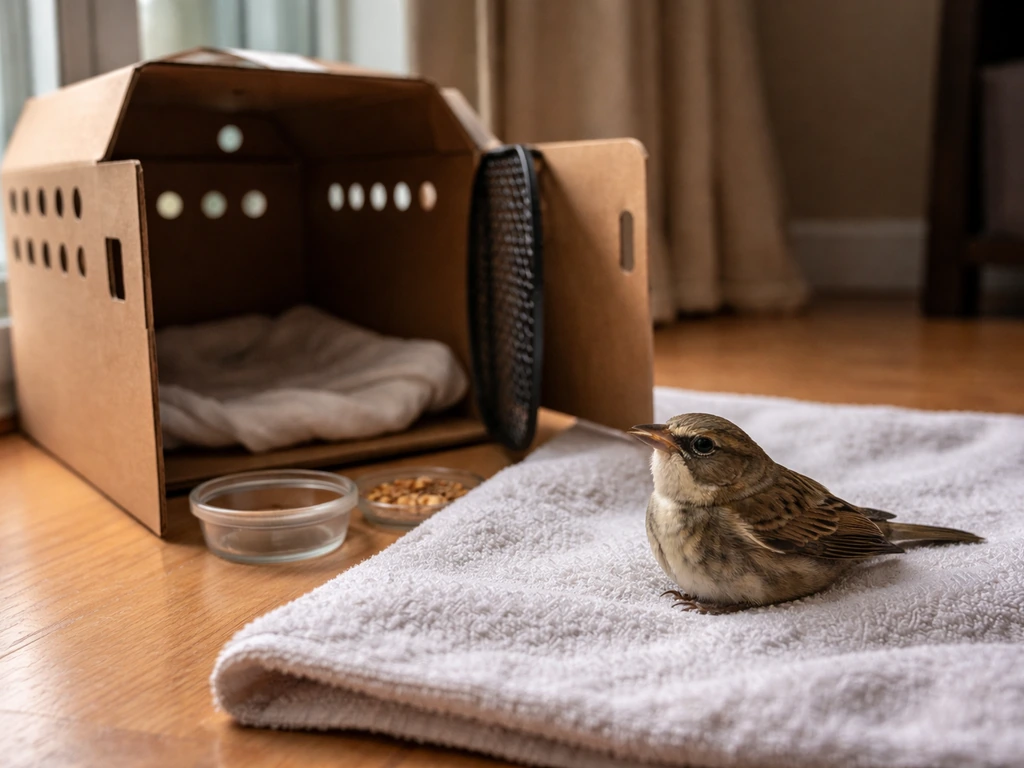
A small cardboard box or a brown paper bag works well. If you use a box, poke several small air holes in the sides. Line the bottom with a folded towel or a piece of cloth so the bird has something to grip and doesn't slide around. The container should be big enough for the bird to turn around in without hitting the walls or lid, but not so large that it bounces around during transport. Do not use a wire cage or a clear plastic container; darkness is important, and wire can damage feathers and feet.
Picking up the bird
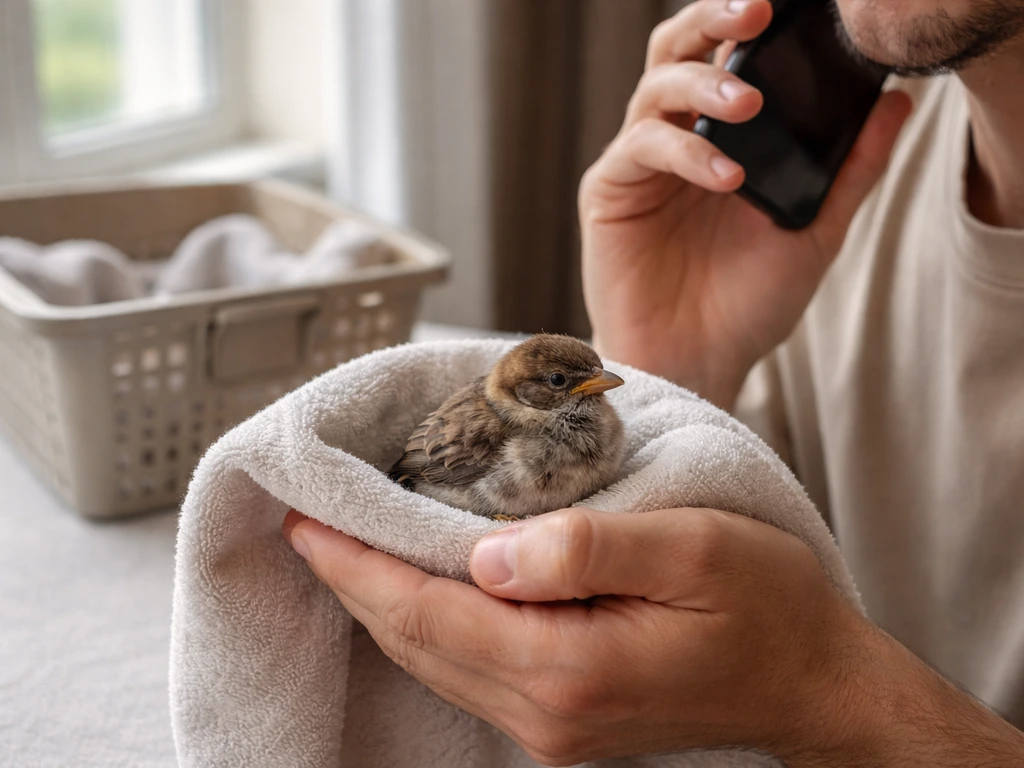
If the bird needs to be moved, use both hands to gently scoop it from underneath, cupping your palms around its body with its wings held lightly against its sides. You're not squeezing; you're just providing gentle, firm containment so it can't flap and injure itself further. Place it gently into your prepared container in an upright position. Being upright matters for recovery, so if it keeps falling over, roll the towel a little to prop it. Wash your hands afterward.
Where to put the box
Put the closed box in a warm, quiet, dark spot indoors, away from pets, children, loud music, and bright light. A bathroom, a closet, or a laundry room all work fine. Aim for room temperature, around 65 to 70 degrees Fahrenheit. Do not put the box in direct sunlight, near a heat vent, or in a cold garage. Set a timer for one hour and resist the urge to check on the bird during that time. Opening the box repeatedly resets the bird's stress response every time.
After about an hour, take the box outside to a sheltered area, open it gently, and step back. A bird that has recovered will typically fly out on its own within a minute or two. Window-collision birds usually recover within one to three hours with box rest when the injury is just concussive stunning. If the bird doesn't fly out, or seems just as dazed as before, it's time to call for help.
When to contact a wildlife rescue or avian vet
Some situations don't call for a one-hour wait. If you see any of the serious injury signs listed above, skip the waiting period and go straight to finding professional help. Time matters in those cases. A bird with a broken neck from a window hit or serious head trauma will deteriorate without treatment, and there's nothing safe you can do at home for those injuries. Rehabbers can administer anti-inflammatory medication that isn't available to the public but that makes a significant difference in outcomes.
Even for birds that seem only mildly stunned, getting a professional assessment is the smarter call if you have access to one. Concussion injuries can worsen over hours. A bird that flies a short distance and then lands again is not necessarily recovered; it may be struggling. If you've given it an hour and it still isn't flying confidently, contact help rather than extending the wait indefinitely.
Signs that mean call right now, don't wait
- Visible blood or obvious wound
- Wing or leg clearly broken or held out from body
- Gasping or labored breathing
- Seizure-like trembling or muscle spasms
- Unable to hold head upright at all
- Eyes completely closed with no response to nearby movement
- Still not flying after one hour of dark, quiet rest
How to find a wildlife rehabilitator near you
Your fastest options for locating help: search your state's fish and wildlife agency website, which often lists permitted rehabilitators by county. When you cannot reach a rehabber quickly, Audubon recommends using the blank" rel="noopener noreferrer">Animal Help Now site or app to find the right local help. The U.S. Fish & Wildlife Service also advises contacting local licensed wildlife rehabilitation facilities if you suspect a window strike blank" rel="noopener noreferrer">search your state's fish and wildlife agency website. The National Wildlife Rehabilitators Association also maintains a member directory if you want to search by location. For a real-time emergency lookup, Animal Help Now is one of the most reliable tools for finding the nearest available wildlife care immediately. Many local Audubon chapters also maintain referral lists and can point you to the right place with a quick phone call or email.
If you're not able to reach a rehabilitator before their hours end and a center is closing soon, bring the bird in for evaluation as soon as possible rather than waiting until the next day. Delaying care when there's a real injury is one of the most common mistakes people make, usually because the bird looks like it might be improving. If it's not clearly and confidently flying on its own, it needs to be seen.
Keeping the bird safe if it's still outside
If the bird landed somewhere you can't immediately reach, or if you're deciding whether to bring it inside, here's the most important rule: do not leave it on the ground outside unattended. A stunned bird sitting on the ground is an easy target for cats, hawks, raccoons, and dogs. It has no ability to flee and may not even register the threat approaching.
If you can't move it inside immediately, stand nearby to watch for predators, and keep any pets well away. Don't crouch directly over the bird or make sudden movements. If it's on a ledge or a step that's elevated, that's safer than the ground but still not safe enough for a prolonged wait. Get that box ready as quickly as you can and move the bird indoors. When a bird can't fly after hitting a window, its survival instincts are partially offline, which means it's depending entirely on you to remove it from danger.
Do not attempt to place the bird back on a branch or bush thinking it will be safer there. A bird that can't fly won't hold onto a branch properly and may fall and sustain a second injury. Ground level in a box indoors is safer than any outdoor perch until it has genuinely recovered.
What not to do: common mistakes that can hurt more than help
Most of the things people instinctively want to do with an injured bird are well-meaning but can cause real harm. Here's what to avoid.
| What to avoid | Why it's a problem |
|---|---|
| Giving water by dropper or placing water in the box | A stunned or concussed bird can aspirate liquid into its lungs, which can be fatal |
| Offering food (seeds, bread, worms) | Injured birds often can't swallow safely, and wrong foods cause additional harm; wait for professional guidance |
| Wrapping the bird in cloth or a towel | Restricting the body and wings causes additional stress and can overheat the bird |
| Forcing the bird to attempt flight | A bird not ready to fly will crash again, potentially worsening the injury |
| Using any medication, antiseptic, or human first aid products | Even small amounts of medications like ibuprofen are toxic to birds |
| Keeping it in a clear or wire container | Bright light and wire cause panic; darkness and a solid container reduce stress significantly |
| Repeatedly checking on the bird | Every peek resets the stress response; the quiet rest period only works if it's actually quiet |
| Releasing the bird the moment it looks alert | Internal injuries aren't visible; a bird that looks better may still need professional assessment before release |
One thing worth repeating: do not put water in the bird's mouth or into the box. It comes from a good place, but aspiration is a real risk with any bird that is disoriented or has a potential head injury. Hydration is something a rehabber will handle appropriately if needed.
Also, don't wrap the bird in anything. Some people instinctively want to bundle an injured animal for warmth, but restricting a bird's chest prevents it from breathing properly. A lined box at room temperature provides enough warmth without the risk.
What to realistically expect going forward
If the bird was truly just stunned and you gave it an hour of dark, quiet rest, there's a good chance it flies away looking perfectly normal. That's genuinely the most common outcome for window strikes caught quickly and handled correctly. The main job is making sure nothing else harms it during that recovery window.
If the bird goes to a wildlife rehabilitator, expect that the assessment will take some time and that treatment may involve anti-inflammatory medication, observation for neurological symptoms, and possibly a few days of monitored recovery before release. You won't usually be able to follow up directly on the bird's status, but licensed rehabbers are focused entirely on returning healthy animals to the wild, so you can feel confident it's in the right hands.
The one thing that has the worst outcomes is doing nothing at all, especially for birds that aren't simply stunned. If you ever find yourself uncertain about the situation, a quick call to a local wildlife rehabilitator or an avian vet costs you nothing and could make the difference. Most hotlines and centers are genuinely glad to help you assess the situation over the phone, even if you end up not needing to bring the bird in.
FAQ
Should I cover the bird with a towel or hold it until it calms down?
Do not wrap the bird or tightly cover its chest. Instead, use a lined box and keep it warm and dark, only handling to move it safely from underneath. Excess handling increases stress and can worsen a concussion or other internal injury.
How long should I wait before deciding it needs a rehabber?
Use one hour only for birds that are upright, responsive, and breathing normally. If it does not fly out after gently opening the box and stepping back, or it stays as dazed as before, contact professional help rather than extending the wait indefinitely.
What if the bird seems better after 15 to 30 minutes, but it still cannot fly confidently?
Improvement can still mean lingering neurological injury. If it cannot fly strongly and stay airborne, treat it as injured and get an assessment. A bird that flies a short distance and lands again may not be fully recovered.
Is it okay to give the bird water or food to help it recover?
No. Do not put water in its mouth or offer food. A disoriented bird can aspirate liquid, increasing the risk of respiratory complications. Hydration and feeding decisions should be handled by a rehabilitator if needed.
Where should I place the box at home, and what temperature is best?
Keep the closed container indoors in a warm, quiet, dark area away from pets and bright light. Aim for typical room temperature (about 65 to 70°F), and avoid direct sunlight, heat vents, or cold garages.
Should I release the bird outside right away if it wakes up?
Wait until after the rest period and only release when it can fly away confidently. If it remains disoriented, unable to fly, or falls over, bring it to professional care. Do not place it back on a branch if it cannot hold properly.
Can I transport the bird in a clear plastic container or wire cage?
Avoid both. Clear plastic can keep it stressed because it can see movement, and wire can damage feathers or feet. A small cardboard box or a paper bag with air holes is safer, and darkness supports recovery.
What if I find the bird injured but I am not sure it is from the window?
Window strikes can cause internal injuries that are not obvious. If the bird shows serious breathing trouble, drooping/odd wing position, inability to hold its head up, lying on its side, or looks like it might have head or neck trauma, contact a wildlife rehabber or avian vet rather than waiting.
What if the bird ran into the window and flew away, but I suspect it hit hard?
If it flew off normally and appears to behave like itself, monitor from a distance for a few hours. If you notice repeated landing, weakness, seizures, or it seems unable to fly again, contact a rehabilitator because the initial strike could have caused concussion or internal injury.
If I cannot pick up the bird immediately, is it safe to leave it on a porch step?
Do not leave it unattended for long. Even if a ledge is slightly safer than the ground, it can be targeted by predators. Keep pets away, stand nearby without sudden movements, and prepare the box so you can move it indoors as soon as possible.
What should I avoid doing besides touching the bird?
Avoid crouching directly over it, making sudden movements, giving water or food, wrapping it tightly, using a wire cage or clear plastic container, and placing it back on a perch before it can fly confidently.