A bird that can't hold its head up needs your help right now, but the most important thing you can do in the next five minutes is also the simplest: get it into a dark, warm, quiet box and leave it alone. Don't try to feed it, give it water, or prop its head up. Do not feed the bird, and keep it in a warm, quiet place to minimize stress until you can get help blank" rel="noopener noreferrer">Do not try to feed it, give it water. Just contain it safely and then figure out what's going on from there.
Bird Can’t Hold Head Up: What to Do Right Now
Marcus Chen
5 May 2026
Quick reality check: is the bird stunned, injured, or neurologically affected?
Before you do anything else, take ten seconds to observe the bird without touching it. You're trying to answer one question: is this bird dazed and recovering, or is something more serious happening?
A stunned bird (usually from a window strike) will often sit very still, look confused, and hold its head low or drooping. But it will blink, breathe, and may grip a surface if you place it there. Given 30 to 60 minutes of calm darkness, many of these birds come around on their own.
A bird with a neurological problem is different: it may have a persistent head tilt (head rotated or twisted to one side), it may roll or circle uncontrollably, it may have tremors or seizures, or it may show no righting reflex at all, meaning if you gently lay it on its side it makes no attempt to right itself. That last one is a serious sign.
Head tilts need to be distinguished from just a drooping head too: a droop can be exhaustion or shock, while a tilt or torticollis (head twisted to one side) points more strongly to neurological or inner ear injury.
One more scenario worth knowing: if the bird is a nestling or very young fledgling, some limited head control can actually be normal. Nestlings are partly bald, can't stand or grip your finger firmly, and genuinely don't have full muscle coordination yet. Fledglings are fluffier with short tail feathers, and they may look wobbly on the ground for days while learning to fly. That's not automatically an emergency. But if a young bird was knocked from a nest by wind, a predator, or a cat, treat it as potentially injured until you know otherwise.
Immediate first aid: keep warm, calm, and safe
The goal right now is to stabilize the bird until professional care can happen. You are not trying to fix it. Here's what to do in the first few minutes:
- Put on gloves if you have them, or use a light towel to gently pick up the bird. Wrap it loosely so the wings stay tucked against the body. Don't squeeze.
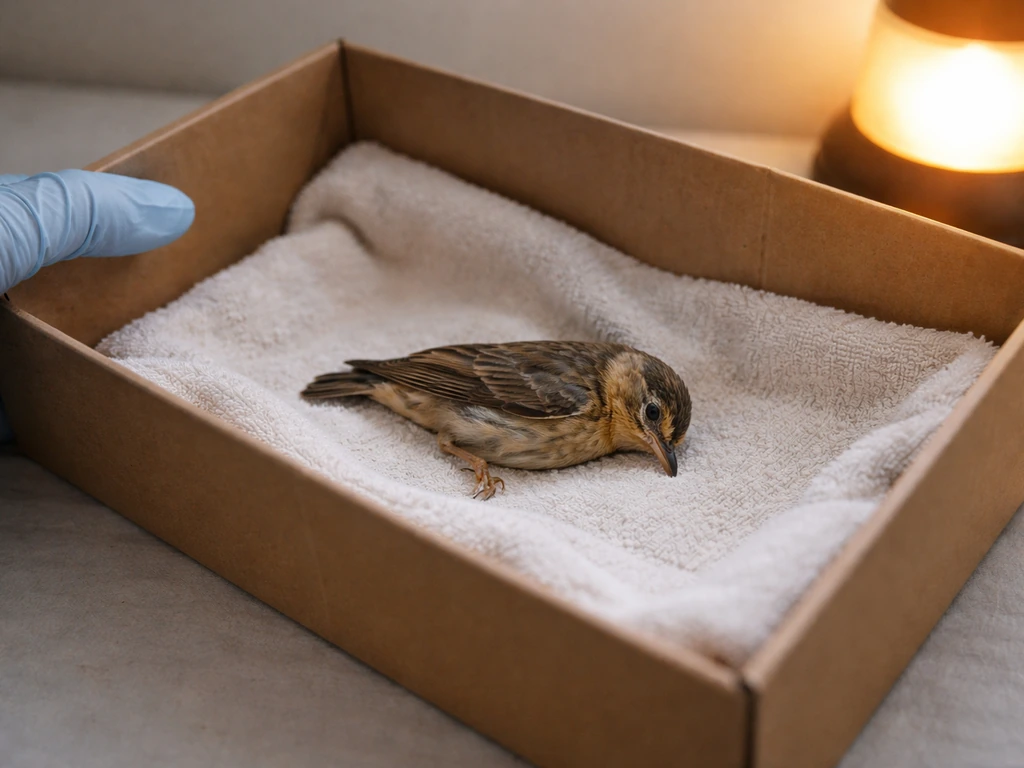
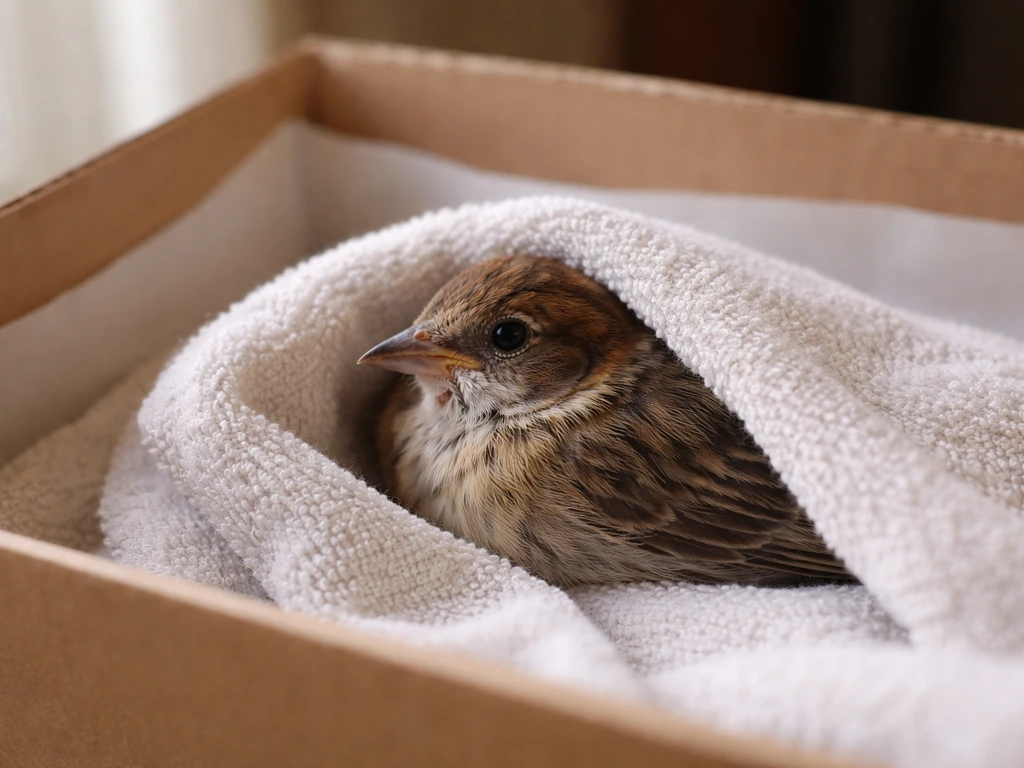
- Place the bird in a shoebox or small cardboard box with a few air holes punched in the lid. Line the bottom with a folded towel or paper towels so it has something soft to rest on.
- If the bird is a nestling, crumple some paper towels to create a little cup shape so it has something to nestle into.
- Close the box and place it somewhere warm, dark, and quiet. Away from kids, pets, loud TVs, and direct sunlight. A bathroom counter or closet shelf works well.
- If the room is cold, set a heating pad on its lowest setting under one half of the box only, with a folded towel between the pad and the box. This lets the bird move away from the heat if it gets too warm. Target around 80 to 85°F (27 to 29°C) for the warm side.
- Don't open the box repeatedly to check. Birds are prey animals and every time you open it, you're triggering a stress response that can make things worse.
Birds have an average body temperature of around 103 to 106°F, and they go into shock very quickly when injured. Warmth is one of the most genuinely helpful things you can provide. Everything else can wait a few minutes.
What to check next: breathing, bleeding, posture, and basic injuries
Once the bird is contained, take a moment to note what you observed before you closed the box. You'll need to describe this when you call for help. Here's what matters most:
- Breathing: Is it breathing at all? Is the breathing rapid, labored, or noisy? Is the tail bobbing up and down with each breath (a sign of respiratory distress)?
- Bleeding: Is there active bleeding anywhere? Check the head, wings, legs, and around the beak. A small amount of dried blood is less urgent than blood that is actively flowing.
- Head and neck position: Is the head drooping (chin toward chest), or is it tilted or rotated to one side? Can the bird lift its head at all when gently disturbed, or does it stay completely limp?
- Eye response: Are both eyes open? Is one eye closed or swollen? Does the bird blink or track movement?
- Wings and legs: Is one wing hanging lower than the other? Are the legs drawn up or trailing uselessly? Can it grip at all?
- Overall posture: Is it sitting upright, slumped to one side, or completely flat? Can it hold any upright position at all?
You don't need to do a full physical exam. Just observe what you can without forcing the bird into any position, especially if you suspect a head or neck injury. Holding the head at an awkward angle is itself a sign that the bird needs immediate transport, even if there's no visible wound.
Do's and don'ts when a bird can't hold its head up
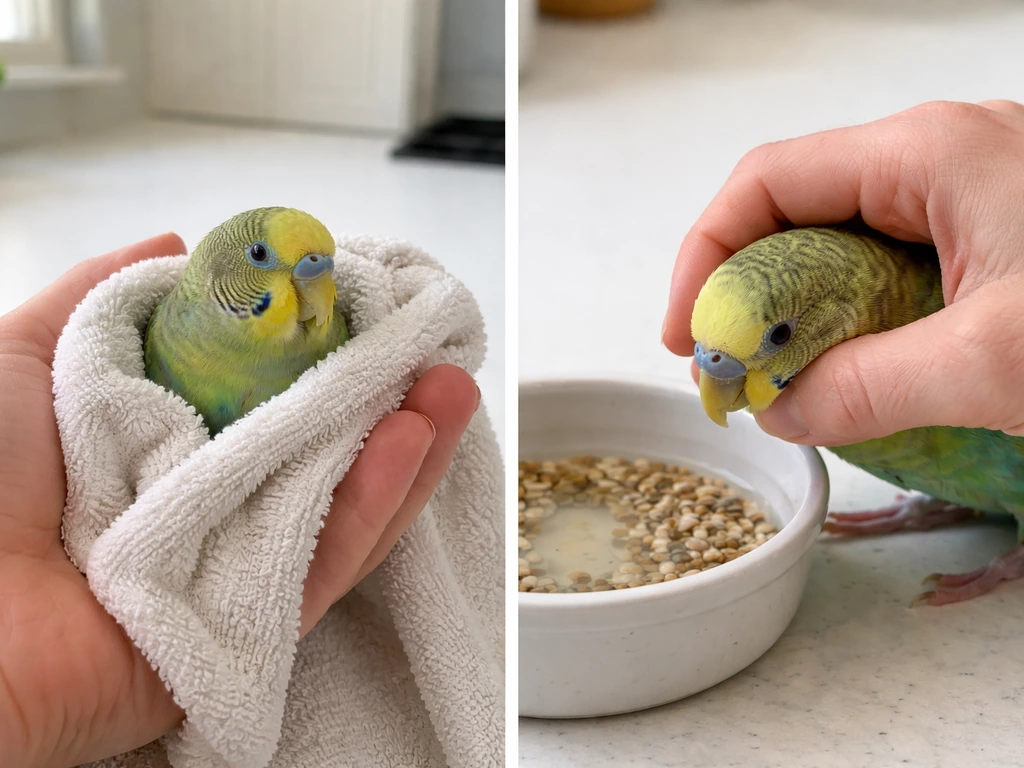
I know the instinct is to do something, to help it drink, to support its head with your fingers, to offer a crumb of bread. Please resist that urge. Here's why each of these matters:
| Do this | Don't do this |
|---|---|
| Use a towel to gently restrain and move the bird | Don't grab with bare hands or squeeze the body |
| Place in a dark, quiet box with ventilation holes | Don't use a glass tank or sealed container with no airflow |
| Provide gentle warmth (heating pad on low under half the box) | Don't place directly on a heat source or use a heat lamp overhead |
| Note what you observed for when you call for help | Don't keep opening the box to check on it |
| Call a wildlife rehabilitator or avian vet as soon as the bird is contained | Don't wait more than a couple of hours before seeking help |
| Let it rest undisturbed in the box | Don't offer food or water — aspiration risk is real and serious |
| Keep pets and children away from the box | Don't place it near noise, other animals, or vibration |
The no-food, no-water rule surprises a lot of people, but it's one of the most consistent pieces of guidance from wildlife clinics and avian vets. A bird that can't hold its head up cannot swallow safely, and forcing fluids or food can cause aspiration pneumonia, which is often fatal. The bird will be fine without food or water for the short time it takes to get it to a professional.
Red flags that mean urgent vet or rehab help right now
Some situations can't wait a couple of hours. If you see any of the following, stop reading and make that call now while you're getting the bird contained:
- Active bleeding that isn't stopping
- Seizures, tremors, or uncontrolled twitching
- No response at all to any stimulus (completely unresponsive)
- Labored or very rapid breathing with tail pumping up and down
- Head rolling or the bird spinning in circles
- Complete inability to hold any upright position, even briefly
- Visible bone protruding from a wing or leg
- Signs of cat or dog contact, even with no visible wound (cat saliva carries bacteria that cause fatal sepsis within hours)
- The bird appears to be trying to swallow but can't, or is drooling
- Suspected poisoning: oily feathers, seizures, sudden collapse near a treated lawn or food source
Cat contact is one that people often underestimate. The bird may look completely fine on the outside, but puncture wounds from cat teeth or claws push bacteria deep into tissue, and birds deteriorate very fast. If a cat got to this bird, treat it as a time-sensitive emergency regardless of how it looks.
Common scenarios that lead to head control problems
Window strike
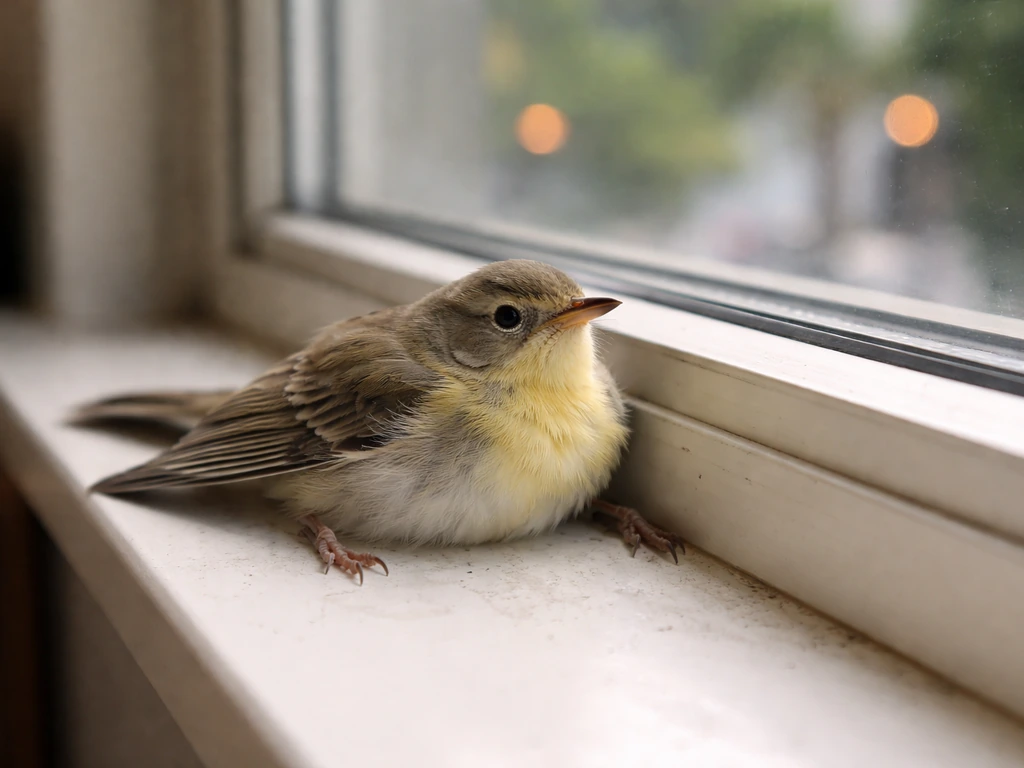
This is the most common reason people find a bird that can't hold its head up. The bird flew into glass at speed and sustained a concussion or brain trauma. It may be sitting stunned on the ground beneath the window, head drooping, feathers slightly ruffled. Many birds recover from minor strikes within 30 to 60 minutes in a dark quiet box.
If you need a quick comparison for outcomes, this is similar to what happens if a bird can't fly from minor injury, where rest often helps before you seek rehab. But if it's been more than two hours and the bird still can't hold its head up, it's not just stunned. Get it to a wildlife rehabilitator or avian vet.
Pet contact (cat or dog attack)
Even if the bird looks physically intact, if a cat or dog caught it, assume it needs professional care immediately. Shock alone from the attack can cause a bird to appear limp and unable to hold its head up. Internal injuries and infection from bacteria are also very likely. Don't wait to see if it recovers on its own.
Fallen from a nest
Nestlings and young fledglings found on the ground need a different kind of assessment. If the bird is mostly bald or has very short pin feathers and can't grip your finger or stand, it's a nestling that fell before it was ready. If you can see the nest and safely reach it without a ladder, you can return it. Parent birds do not reject babies that have been touched by humans. If the nest is gone or unreachable, or if the bird was dropped by a predator, contact a wildlife rehabilitator for guidance rather than trying to raise it yourself.
Shock from illness or poisoning
Birds that have ingested toxins (from treated lawns, rodenticide-poisoned prey, or certain plants) can show sudden neurological symptoms including head drooping, tremors, and inability to stand. If you found the bird near a freshly treated area, in an area where rodenticide is used, or near a known toxic plant, mention that specifically when you call for help. Don't assume it was a window strike just because the bird is near a building.
How to get help fast
In most cases, you need either a licensed wildlife rehabilitator (for wild birds) or an avian veterinarian (for pet birds). Here's how to find one quickly:
- Search 'wildlife rehabilitator near me' or go to the National Wildlife Rehabilitators Association (NWRA) or Wildlife Rehabilitators directory for your country.
- In the US, the NWRA and IWRC both have locator tools. The Humane Society's website also has a state-by-state list.
- For pet birds, call an avian vet directly. Search 'avian vet near me' or check the Association of Avian Veterinarians (AAV) for a directory.
- Many areas have a local Audubon chapter or bird rescue hotline. Search your city or county name plus 'bird rescue' or 'bird hotline'.
- If you're unsure, call your local animal shelter or animal control. They often know who to refer you to even if they can't take wild birds themselves.
When you call, be ready to tell them: where and when you found the bird, what species you think it is (or describe its size and coloring), what happened or what you suspect happened, what symptoms you're seeing right now, and whether you have it contained already. A photo taken from above the open box before you closed it is genuinely helpful and takes five seconds. The more clearly you can describe the head and neck position, the better.
If you genuinely can't reach anyone and need to transport the bird yourself, keep the box secured and as still as possible, keep the car quiet and warm, and drive directly to the nearest wildlife clinic or emergency vet that sees birds. Call ahead if you can so they're ready.
Aftercare and prevention: what to monitor until help arrives
While you're waiting to reach someone or waiting for your appointment, keep checking in on the box from the outside: listen for movement, notice whether the sounds are more or less distressed over time. If the bird was mildly stunned from a window hit and it starts moving more actively and vocalizing normally, that's a good sign. If it goes completely quiet and still after a period of movement, open the box carefully and reassess.
If it's a window-strike bird that seems fully recovered (standing upright, head up, alert, responding normally), you can try taking it outside and opening the box to see if it flies away on its own. If it still cannot fly, get it assessed by a wildlife rehabilitator or avian vet as soon as possible it flies away on its own.
If a bird that seems recovered still shows odd behavior like not trying to fly, it may be recovering slowly from neurological injury and needs assessment bird forget how to fly. If it flies off strongly, great. If it flutters and falls or seems uncoordinated, contain it again and get it to a rehabber.
A bird that appears recovered but has had a head injury can relapse, so err on the side of getting it assessed even if it seems fine.
On the prevention side, window strikes are by far the most common cause of bird head injuries. Window films, screens, and external blinds are the most effective solutions. Placing feeders either very close to windows (less than three feet away, so birds can't build up speed) or far from them (more than 30 feet away) also reduces strikes significantly. If you have cats, keeping them indoors removes the single biggest preventable risk to backyard birds. For nest-related incidents, resist the urge to relocate nests during nesting season, and check high-traffic areas of your yard before mowing or trimming.
A bird that can't hold its head up is a serious situation, but you've already done the most important thing by stopping and trying to help. If the bird is also unable to stand or walk properly, treat it as a neurological or injury concern and prioritize urgent veterinary or rehab care can’t walk properly.
If you noticed a bird in your backyard that can't fly, treat it as urgent and contact a wildlife rehabilitator or avian vet right away a bird that can't hold its head up. Get it contained, keep it warm and quiet, skip the food and water, and make that call. If a bird can't fly, it could be dealing with injury, shock, or a neurological issue, so professional guidance is often needed what happens if a bird can't fly.
If the bird also seems unable to move its legs, treat it as neurological and get urgent professional help can't hold its head up. Those same kinds of head control and neurological problems are often what prevent the caged bird from flying keep it warm and quiet. That's genuinely everything you can do right now, and it's enough.
FAQ
What if the bird is pet (from my home), and its head won’t stay up?
The same first-aid rules apply, keep it warm and in a dark quiet box, but call an avian vet immediately rather than a wildlife rehabilitator. Pet birds are often affected by illness, so watch for breathing effort (open-mouth breathing or tail-bobbing) and tell the vet, those signs change the urgency.
Can I give the bird water in a shallow dish while it’s in the box?
No. Even if you put only a tiny amount in reach, a bird that cannot hold its head up may be unable to swallow safely and can aspirate. If it needs fluids, a vet or rehabber will handle it with appropriate technique.
How warm should the box be, and can I use a heating pad?
Aim for warmth without overheating, a lightly warm environment is best. If you use a heat source, place it outside or under one side of the box so the bird can move away; do not put something directly against the bird, and avoid hot pads that can burn or cause rapid overheating.
Should I put the bird in a carrier or a shoebox? What’s safest?
Use a ventilated, escape-proof container that lets you keep the bird still and covered enough for darkness. Avoid wire cages for the short term because they can increase movement and injury risk. Make sure there are air holes, and keep the container lined with something soft like paper towel.
If the bird is still, should I assume it’s fine and wait longer than two hours?
Not if it still cannot hold its head up. A lack of head control beyond the window-strike recovery window is a red flag for concussion, neurological injury, or another cause. If you are past two hours with no improvement, prioritize getting professional care rather than continuing to observe.
What if it has a head tilt, but it seems alert and responsive?
Head tilt or persistent twisted head position still warrants assessment even if the bird responds to you. Alertness can coexist with inner ear injury or neurological dysfunction, and those can worsen after initial recovery.
How do I tell drooping from a dangerous tilt when I’m panicking?
Drooping usually looks like the head hangs low without rotation, and the bird may look sleepy from shock. A dangerous pattern is obvious rotation, consistent twisting to one side, circling, tremors, or no attempt to right itself when gently laid on its side.
My bird seems to recover in the box. Can I release it outside right away?
Only if it can stand upright, hold its head normally, and coordinate movement well enough to fly away. If it flutters, falls, or shows awkward movement, put it back in the box and seek rehab or vet help. Also, window-injury birds can relapse after a short period that looks like improvement.
What should I do if I find a nestling that can’t hold its head up?
First verify whether it is truly a nestling or fledgling. If it is mostly bald with very limited gripping and it fell from the nest, returning it to the nest is usually the priority when the nest is reachable safely. If it was knocked by a predator, the nest is unreachable, or it is heavily injured, contact a wildlife rehabilitator for guidance instead of attempting to raise it.
A cat or dog was involved, but the bird looks mostly clean. Does that still count as urgent?
Yes. Even with no visible wounds, internal injury and infection risk from teeth and claws can be severe. Treat it as time-sensitive emergency care and avoid waiting to see if it “improves on its own.”
Should I try to open the beak to see what’s going on or check for injuries?
No. Do not force the head, open the beak, or perform a physical exam. Handling can worsen suspected head or neck injury and increases distress, instead note what you observed (head position, breathing, movement) for the vet or rehabber.
If the bird is near a treated lawn, what extra details should I report?
Mention any recent lawn treatments, rodenticide use, or proximity to treated areas, and if you know what product was used or when it was applied. Also tell them whether you saw prey animals nearby, this helps them consider toxin exposure as the cause of neurological symptoms.
What if I can’t find a rehabber or avian vet right now?
Call the nearest emergency vet that handles birds or a 24-hour animal emergency line and ask specifically for “avian” or “wild bird” guidance. If transport is unavoidable, keep the bird contained, warm, and as motionless as possible, and drive directly without extended stops.
Can I keep checking on it by opening the box repeatedly?
Limit opening to when you must reassess after a period of movement changes. Frequent opening can add stress and temperature loss. When you do check, do it quickly and gently, and avoid repositioning the head or neck.